
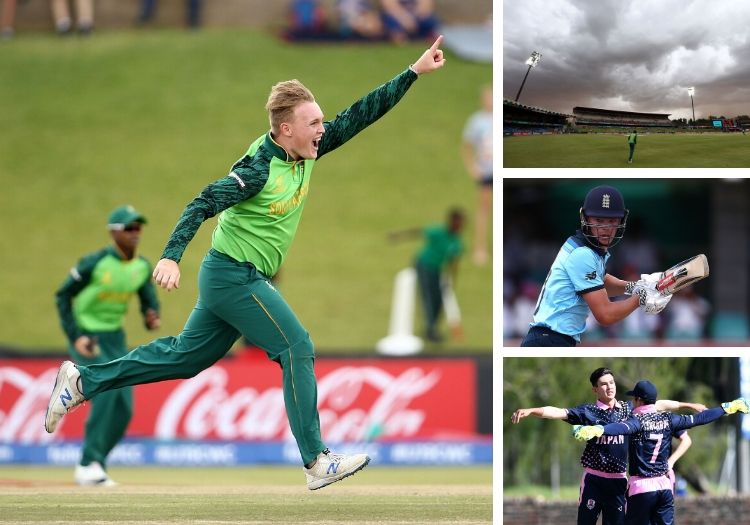
England, Sri Lanka and Zimbabwe picked up the first victories of their campaigns but knew results mattered very little, while the hosts squeaked past the UAE in rainy Bloemfontein
At the Mangaung Oval, South Africa and the United Arab Emirates played out the day's most pivotal fixture each knowing that a win would mean a quarter-final with Bangladesh and anything else would see them fall to the Plate League doldrums. But, when rain forced an early finish, it was the hosts whose batting had held out and managed to prevent a momentous upset for the Associate nations.
After a rapid century against Canada mid-week, Proteas leader Bryce Parsons returned to the steady hand he displayed against Afghanistan in the curtain-raiser to overtake New Zealand's Rhys Mariu atop the run charts with 84 from 83. His third-wicket partnership of 152 with Luke Beaufort is now the most valuable of the tournament in more ways than runs alone – accounting for more than half of the 299 total.
UAE opener Vriitya Aravind seemed to take particular confidence from the continued absence of Gerald Coetzee's 90-plus mile-per-hour pace from the South African attack, helping his side off to a positive start with a 17-ball 31 before Parsons himself got in the way with economical left-arm tweakers.
However, the powerplay wickets of Aravind, Aryan Lakra and Ansh Tandon had forced the UAE side into a significant change of tack with clouds looming, and Jonathan Figy and Kai Smith had slowed the scoring rate significantly in an unbroken fourth-wicket partnership of 47 from 14 overs by the time match officials gave in.
At that point, South Africa had their opponents sitting 23 short of par according to the Duckworth-Lewis-Stern calculations, thus making the hosts breathe a significant sigh of relief as they became the side to join the dominant Afghanistan from Group D in the Super League knockout rounds.
The final finish of the 24-game group stage was the seventh where rain either forced a reduction in overs or washed things out completely. Someone really should get onto the ICC about that drone umbrella idea...
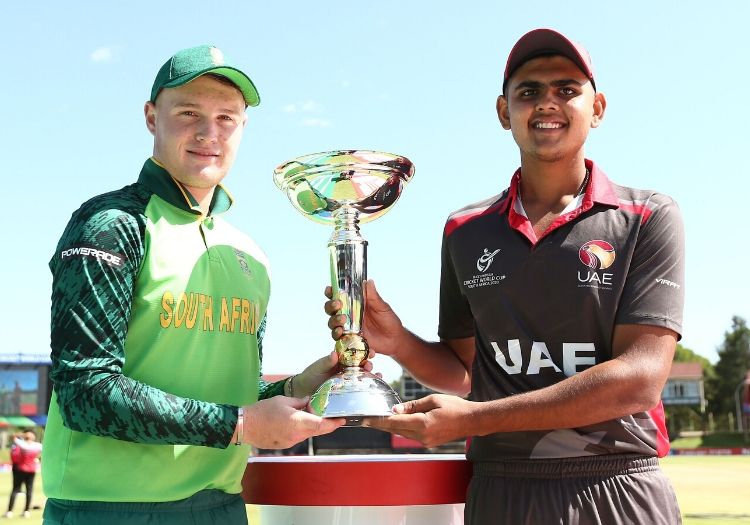
Bryce Parsons, here with opposite number Aryan Lakra, became the first player to pass 200 runs in the tournament
It is still quite some ask to try and process what exactly happened on Thursday, as Australia's tail fired 40 from the last 16 balls to nab a stunning last-ball victory in Kimberley to knock England out of title contention.
So in some ways it was quite fortunate that the final fixture in Group B ended up being a very mismatched affair that England wrapped up with relative ease in a little over three hours.
Nigeria's toils at their maiden tournament are well documented, having fallen for 61 and 57 in their opening outings and now triggering some déjà vu as they fell away for 58. Having won the toss, today's innings had at least offered a little more endurance with intermittent spells of promise – its 27.5-over duration was a new record for the side, and hopes of a miracle partnership were somewhat answered when captain Sylvester Okpe joined Miracle Akhigbe for a stoic fourth-wicket stand of 23.
But then England vice-captain George Hill had his way, having been warming his team's bench for the rest of the week before turning in a player of the match performance today. The Yorkshire seamer had both Akhigbe and Okpe caught by Dan Mousley an over apart on his way to figures of 4-12, and Hamidullah Qadri caught England's bowlers up to the efforts of their Australia and West Indies counterparts by taking four wickets across five legitimate deliveries.
Like Hill, Sam Young also made the most of his first game time – the Somerset opener hit an unbeaten 39, sending England past the mark with a nonchalant drive over the bowler's head to close the 11th over and seal his country's second-shortest Under-19 World Cup chase, after a 2008 effort against Bermuda.
Hill takes four and Young leads quick chase in new-look England win... U19 WORLD CUP TALKING POINTS
At the start of the tournament little more than one week ago, no group looked quite as tantalising as Group C.
In the green corner, you had Pakistan, two-time champions and Test mainstays but rocked by the late withdrawal of great seam hope Naseem Shah from their squad so he could focus on his senior Test duties.
In the other green corner, there was Bangladesh. An ever-growing presence in the men's game across formats, a robust youth programme in recent years had them boasting six of the eight most capped Youth ODI players since the close of the 2018 edition.
Then you'd find Zimbabwe, appearing at an ICC tournament for the first time since the national board was let back into the global fold late last year. Doubts about their pipeline were swiftly settled by warm-up scalps of South Africa and New Zealand, and they came only 24 runs short of chasing down almost 300 against India too.
Rounding out the pack would be Scotland, the only one of the four that had been through the 50-team qualifying process to get to this stage and the only one of five qualifiers to have taken down a Full Member nation in the process, thundering past Ireland and other opponents with canny pace-off bowling and an imposing crop of top-order talent.
But then it turned out to be the most one-sided pool of the lot.
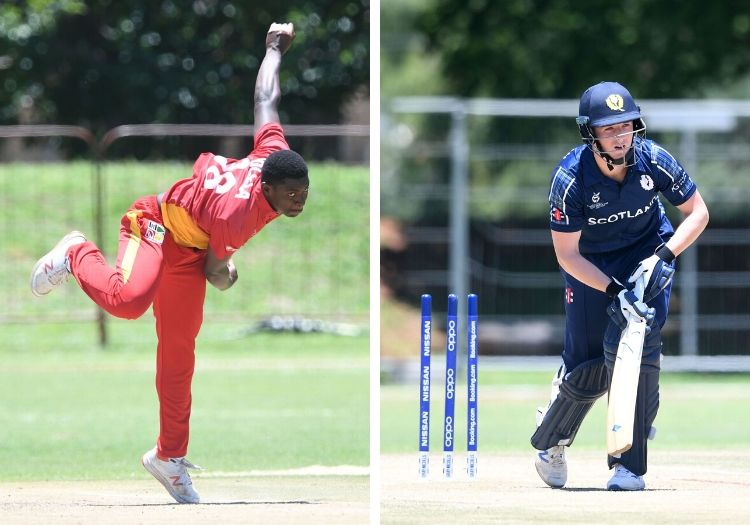
Zimbabwe supersub Sakhumuzi Ndlela deepened Scotland's top-order struggles
That Scottish top four combined for 58 runs in 12 innings, today falling away at their quickest rate yet as all four departed to Zimbabwean seamer Sakhumuzi Ndlela inside the first 6.3 overs. Ndlela was not even meant to be at the tournament – he came in for the injured Brandon James just three days before it all started – but his first three wickets today each struck a different stump.
That left Danny Cairns at the crease with 18-4 on the board, and his 74-ball boundary-less crawl to 28 steadied the ship before Kess Sajjad cleared the ropes four times in a contrasting innings of 68 at almost a run a ball.
But Zimbabwe made a mockery of the 140 chase – much like Bangladesh had done against them one week prior, reaching 132 in 11.2 overs – courtesy of a bolshy 85 from Tadiwanashe Marumani up top. Sean Fischer-Keogh again struck early by cheaply picking up Wesley Madhevere in the third over, though by the time Marumani fell to Jasper Davidson – Scotland's eighth bowler, whose first over was the 13th – Zimbabwe trailed by just six, which Milton Shumba swiftly pulled hard over deep mid-wicket three balls later.
With the sole exception of Pakistan's high-scoring win over Zimbabwe, where the aggregate of 550 runs remains the best in the World Cup so far, this result joins yesterday's washed-out decider in making Group C home to completely the opposite level of competition one might have expected. This was the fourth chase in its five completed games to be achieved in under 20 overs, and downright peculiar scheduling ensured it – like two of the final day's other fixtures – was only a wooden spoon playoff anyway.
Well, technically there was something riding on today's Group A closer between winless Sri Lanka and tournament newcomers Japan, whose sole point from a washout clash with New Zealand last Saturday meant they could still just about sneak past the Blackcaps to face the Group B winners West Indies in Benoni on Tuesday.
But not only would they have had to beat Sri Lanka after being put in to bat first, they would have had to score four times more than they did against India on Tuesday, and then ensure the chasing side managed no more than 51.
Or, as it actually turned out at the innings break in a rain-shortened 22-over contest, defend their total of 43 by bowling Sri Lanka out for no more than four.
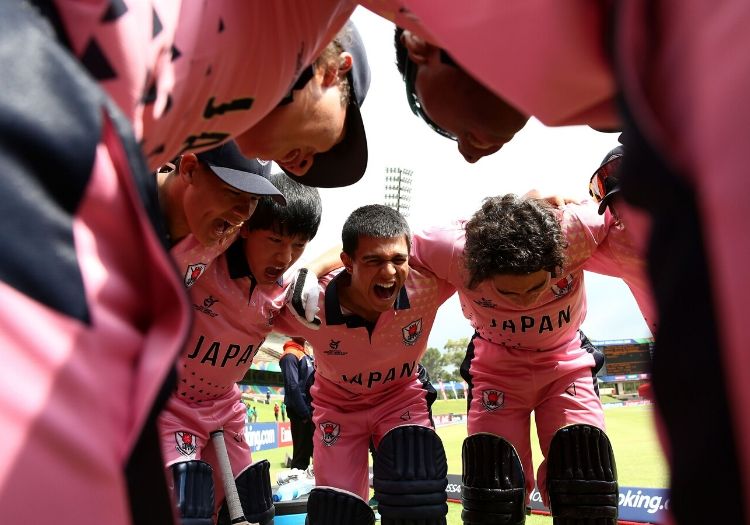
World Cup newcomers Japan were mathematically in with a shot at second place in Group D
Perhaps unsurprisingly, that didn't happen. After figures of 2.3-0-2-2 and an innings-closing run-out in the field, Sri Lanka's Navod Paranavithana hit the very first ball of the reply through deep mid-wicket off Yugandhar Retharekar, and three balls later he had sliced a cut to the same effect to send Japan's slimmest of Super League hopes firmly overboard.
Paranavithana didn't last much longer at the crease, being bowled by the very first ball of Kento Ota-Dobell's spell all of four minutes later, but neither Mohamed Shamaz nor Ravindu Rashantha offered Japan anything as they (and 12 extras) passed the target in 8.3 overs.
Results elsewhere confirm the inevitable: that Sri Lanka will face Nigeria and England get Japan in Potchefstroom on Monday as the Plate League's quarter-finals kick off with two more opportunities for World Cup cricket's newest nations to mix it with world-leading Test-quality youth talent. Similar scorelines can certainly be expected, even with Sri Lanka and England's misfires against their early opponents, but so too can invaluable chances to encourage the game's growth in two of its most exciting emerging nations.
Images: ICC / Getty

Welcome to www.thecricketer.com - the online home of the world’s oldest cricket magazine. Breaking news, interviews, opinion and cricket goodness from every corner of our beautiful sport, from village green to national arena.