
SAM MORSHEAD: Jonathan Agnew's approach is casual and conversationalist, and it is not hard to imagine him, loafers up on the sound desk at Salford Quays, coffee in one hand, custard cream in the other, perhaps a second button undone on his shirt
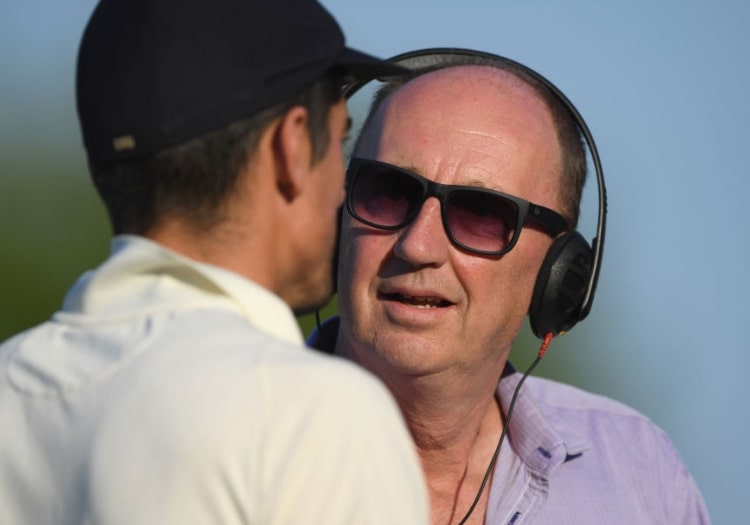
Jonathan Agnew lead a cast of familiar voices on The Cricket Social
“We’re on the internet now so we can talk about that.”
It is around three hours into the inaugural running of The Cricket Social - the new, definitely-not-live-commentary-off-the-television BBC programme running, just by happenstance, at the same time as England’s winter matches in Sri Lanka.
Jonathan Agnew has turned the conversation to Shane Warne’s dalliances in the bedroom - it’s raining in Dambulla, by the way - and, to the surprise of a nation, said “the sex word”.
“We’re not on Radio Four,” Agnew explains.
We most certainly are not.
The Cricket Social, streamed online and via the Beeb’s app, is a world away from the formalities, banalities and home comforts of Test Match Special.
Most of the voices are the same - Agnew, Phil Tufnell, Michael Vaughan, Ebony Rainford-Brent et al - but the tone, set so wonderfully by Agnew, is very different.
Perhaps, maybe even subconsciously, the BBC’s lead anchor is channeling the spirit of Test Match Sofa - the fan-led broadcast to whose ball-by-ball coverage he so vehemently objected in 2012.
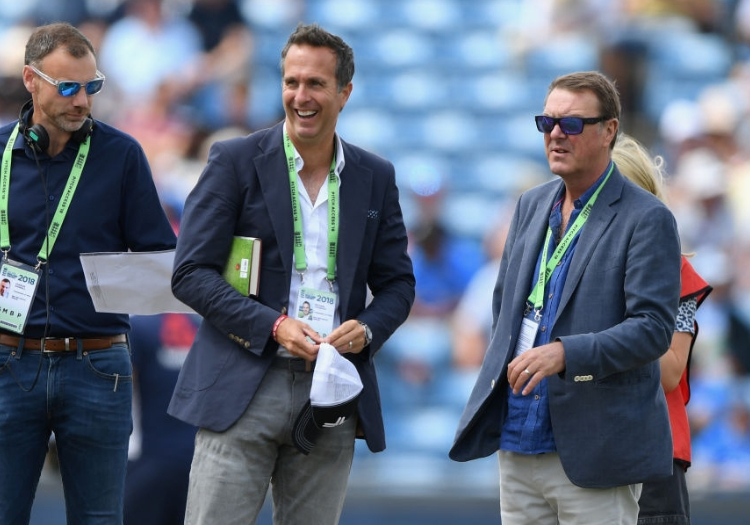
Michael Vaughan and Phil Tufnell were excellent on the show's first airing
While the BBC have been at pains to state that their new programme is nothing like the Sofa, fundamentally it is.
The Cricket Social is a rival to TalkSPORT’s in-situ coverage, it is impossible to listen to both at the same time and it is just as easy to find out the score from either medium.
Not that fans have ever been bothered by variety.
As it turns out, magically there is a place for more than one broadcaster around cricket’s table.
Agnew has often slated the format employed by the Sofa, which he saw as an infringement on the BBC’s live rights deal with the ECB during its heyday in the early 2010s.
There is something oddly karmatic, then, that here he is leading a team of pundits and journalists through a maze of cricketing tangents, ranging from WhatsApp to swords via Eddie Hemmings’ autobiography.
It is engaging, entertaining, genuinely funny radio, stripped of some of the ritualistic rigours of TMS, opening the broadcast up to a much wider audience.
"On TMS, Agnew plays the sommelier, an authoritative guide through the every nook and cranny of a day’s play. Here, he is the local barkeep, keeping the place running, wiping down spillages, easing his regulars through a lonely afternoon"
It is very similar to the Sofa - whose airtime was taken by trips to the fridge, witty jingles and tweets being read out on air - and its reincarnation, Guerilla Cricket (minus the swearing).
While he might take it as such, that is certainly not a criticism of Agnew.
In fact, in ‘relegating’ him to the ‘bowels’ of the internet, TalkSPORT have managed to free up a side of his character and BBC cricket coverage which listeners so rarely get to hear.
His approach is casual and conversationalist, and it is not hard to imagine him, loafers up on the sound desk at Salford Quays, coffee in one hand, custard cream in the other, perhaps a second or third button undone on his shirt.
You know what, it works.
On TMS, Agnew plays the sommelier, an authoritative guide through the every nook and cranny of a day’s play. Here, he is the local barkeep, keeping the place running, wiping down spillages, easing his regulars through a lonely afternoon.
At one point, his Siri goes off in his pocket - presumably mistaking the Sri in Sri Lanka - and he ploughs on unperturbed.
It later turns out to be his own phone.
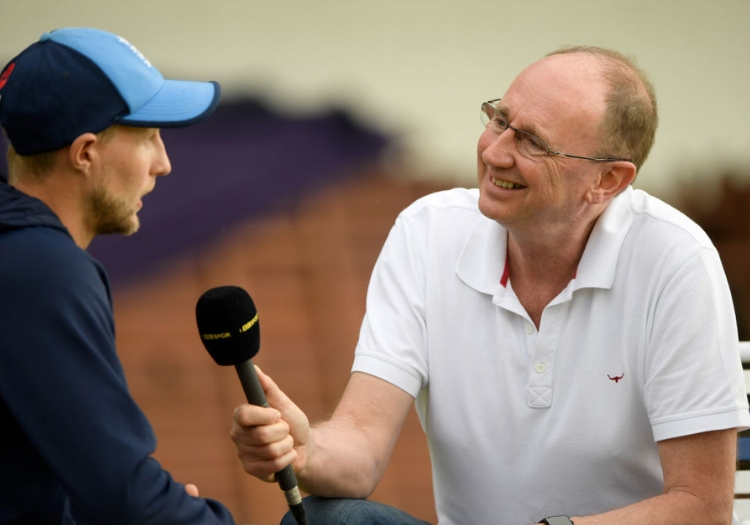
Agnew took a different approach to the way he leads Test Match Special
Taking their lead from Agnew, most of the rest of the Beeb’s assembled cast buy into the concept.
Tufnell is a natural fit. The format allows The Cat to inject humour and anecdote at will and, for a walking banterpedia, it is the perfect platform.
While Vithushan Ehantharajah - an excellent addition - talks Agnew through WhatsApp ‘ghosting’, Tufnell can be heard making ghoulish groans in the background.
When the conversation moves on to stag parties, the former England spinner details the time he went shopping with his mum and discovered a naked man chained to a trolly.
Tufnell the storyteller is much more engaging than Tufnell the analyst and here, in what is essentially an eight-hour podcast, he has limitless potential to explore his scallywag’s almanack.
Rainford-Brent, too, changes tack and cuts out all formality, unafraid to tell Agnew that she’d hoped he would “probe” a little deeper into Warne’s sex life and happy to usher the discussion down the most unpredictable of routes.
When there is live action from Dambulla - and there are only 15 overs of the stuff - it is only natural that Agnew begins to slip into TMS mode and, yes, at times he begins to describe the action as it happens via what The Cricketer can only presume is a TV screen.
But that is hardly worthy of damnation.
Not everything about The Cricket Social is perfect, some presenters take to the general idea more naturally than others while, after four hours without any action, the flow of the show begins to feel a little laboured, but it is hard to pick too much fault.
It is not as if the BBC have stumbled onto a winning formula here, more that they have adopted a tried-and-tested method and re-released it to the mass market.
The result, though, is something of a masterpiece. A hypocritical masterpiece, yes, but a masterpiece nonetheless.

Welcome to www.thecricketer.com - the online home of the world’s oldest cricket magazine. Breaking news, interviews, opinion and cricket goodness from every corner of our beautiful sport, from village green to national arena.