
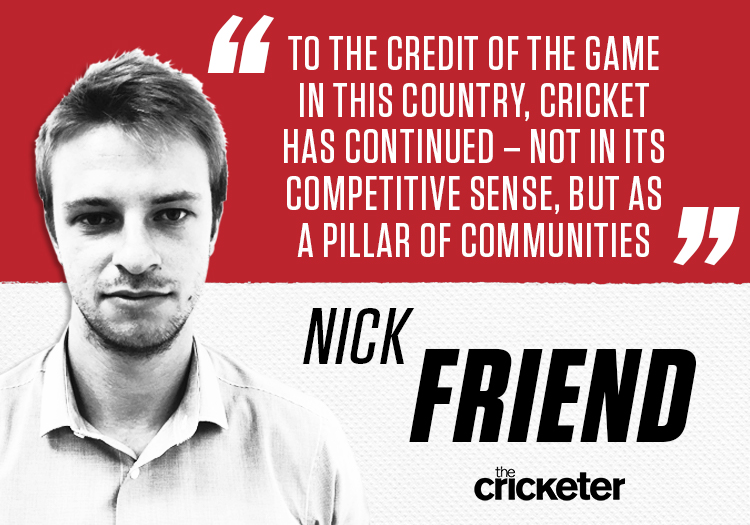
NICK FRIEND: It is to the credit of the game in this country that cricket has continued – not in its competitive sense, but as a pillar of communities and, by extension, as a sport in its traditional sense – a means of bringing people together
With no professional cricket to be played for the foreseeable future, clubs perhaps could have been forgiven for sliding off the radar temporarily, feeling sorry for themselves and silently bemoaning an indefinite delay to their raison d’être.
The sun might be out but the gates are locked and The Cricketer’s annual fixture wallchart is now little more than a collector’s item, with many players and off-field staff furloughed during these times of unprecedented worry and uncertainty.
Instead – and it is to the immense credit of the game in this country, cricket has continued – not as a sport in its competitive sense, but as a pillar of communities and, by extension, as a sport in its traditional sense – a means of bringing people together, figuratively rather than in any literal sense, of course.
Events of the last month have provided us all with several valuable reminders and lessons; in response, the role played by our cricketers has been somewhat life-affirming, an understanding that their impact can extend well beyond individual performances and trophies.
After all, it is worth remembering amid all this that life as a professional athlete is far from straightforward at present. There are fears over what happens next; for some in the last year of their contracts, futures are up in the air. Even the more positive murmurings – of a truncated season beginning in July or August – come without the guarantee of red-ball cricket; for some, that is the bread and butter.
In a recent interview with Rajasthan Royals physio John Gloster, he explained to me that he believed the mental side of this period to be its toughest aspect.
“We’ve suddenly taken these guys away from six to eight hours a day of being physically active in structured nets and physical environments to a constrained environment,” he said. “There’s probably as big a psychological play here as a physical play.
“There’s the fear of the unknown and there’s nothing worse for an athlete than a fear of the unknown.”
We know that James Anderson has been walking through his bowling action in his own living room, while one county player told me that he had been offered use of a friend’s home net. Joe Root joked that he might ask his wife to “start giving [him] throwdowns in the back garden”.
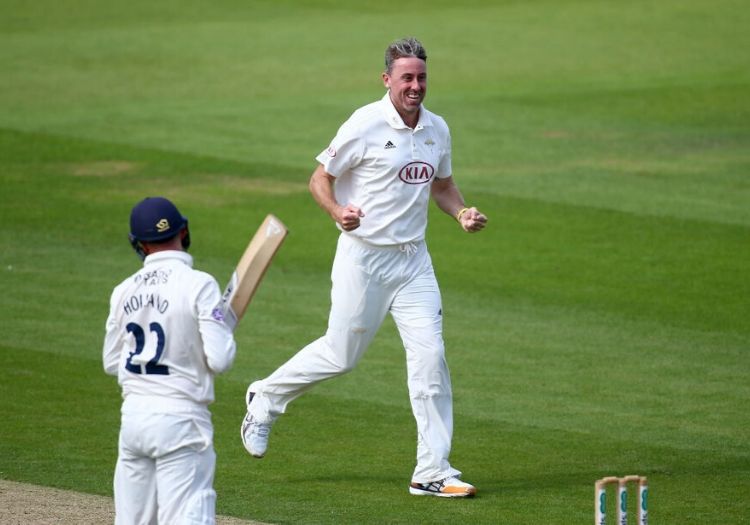
Rikki Clarke is one of several players to have spooken to club members on the phone
“I’m not going to lie,” Chris Rushworth admitted to me last month, “it is a scary place for a cricketer because no one knows what’s going to happen.” He is one of those whose winter is spent looking forward to April’s swinging ball – last year, he didn’t play once in the T20 Blast.
“For counties, the shorter formats are the money-makers. It’s a strange one to know what’s going to happen and where I’m going to fit in. It’s all the unknown – everything is at the minute.”
Nevertheless, he has started his own YouTube channel aimed at keeping children active throughout the country, offering coaching tips and presenting drills that can be practised at home.
Ian Bell, now 38 years of age and in the final year of his contract at Warwickshire, is desperate to carry on next year but admits we are in “unchartered waters”. He is offering a coaching session and a tour of Edgbaston in a competition he has set up, with all proceeds going to NHS charities.
Every county is doing its bit and the examples have been endless – both individual initiatives and wider club projects. Bell’s young teammate George Garrett, for instance, tweeted in late March of how much he had enjoyed chatting on the phone to a club member of sixty years. Surrey’s Rikki Clarke has done similar, as have Yorkshire director of cricket Martyn Moxon and several others.
Club Captain Tom Westley was joined by Simon Harmer, Shane Snater, Rishi Patel, Robin Das and Eshan Kally to prepare hot meals for NHS staff working long hours in the intensive care units, as well as elderly and vulnerable people in the community. https://t.co/rSCmHKJ1dr pic.twitter.com/m9flaOwY6X
— Essex 🏠 Cricket (@EssexCricket) April 6, 2020
Young off-spinner Amar Virdi has been volunteering with a humanitarian aid organisation, providing meals to homeless, elderly and vulnerable people.
Meanwhile, footage emerged on social media of Essex T20 captain Simon Harmer calling a seven-year-old boy to wish him a happy birthday and offering him the shirt he wore in last season’s Blast final as a gift. The sight of little Tim’s smile – a picture of bemused astonishment – was all you needed to see.
Clubs, too, have played their part; media executives have been terrific, acknowledging the importance of continuing to provide their communities with content, while most have provided regular website updates – both of their strategies through these months and of any developments, whatever its significance. Even the uptake to The Cricketer’s Quarantine Cup from counties and their players was as generous as it was pleasantly surprising.
Kent captain Sam Billings is the only member of Kent’s playing staff not to have been furloughed (Joe Denly is England-contracted). That decision was taken in order to allow Billings “to support the club’s efforts in the community”. He has also agreed a reduction in his salary, in line with all other players in the Kent squad.
The wicketkeeper-batsman has been hugely proactive, shaving his head to raise money for the NHS, as well as offering via Twitter to help anyone in Canterbury who might need help with their shopping.
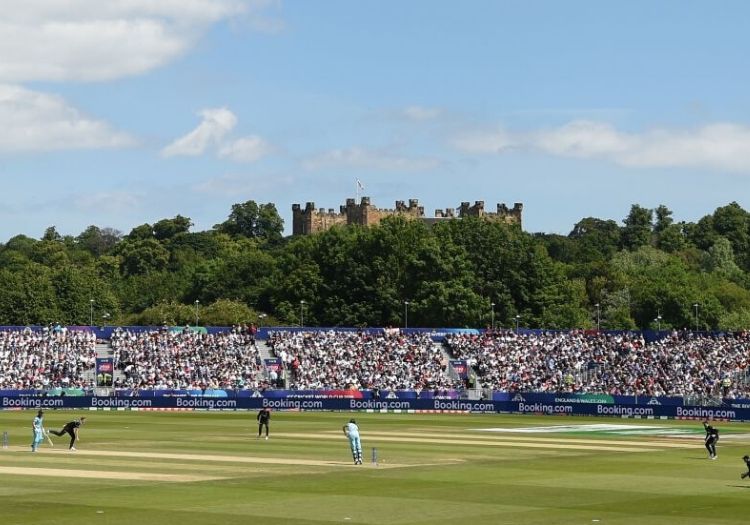
Durham are among the clubs to have offered out use of their ground to the NHS
The list goes on. Yet, the point of this is not to hail individual after individual, but rather to highlight the shared moral compass among the wider circle of players – evidence of which was further heightened by the collective agreement reached on April 8.
“The understanding from our players and the willingness to help has been particularly heartening,” Worcestershire batsman and PCA chairman Daryl Mitchell said in his statement, praising the “outstanding” support he had been given by his colleagues. “Like many industries, cricket recognises the challenges it currently faces; the players have been alert to the need for them to play their part.”
That extends to England’s centrally contracted players as well – both male and female. Heather Knight and Sophia Dunkley have signed up to the NHS volunteer scheme, while the women’s side as a whole is to reduce their salaries through April, May and June.
The men have donated £500,000 to the ECB and “selected good causes”, with Tom Harrison also taking a 25 per cent temporary and voluntary drop in his own pay. Sam Curran has raised upwards of £10,000 for NHS staff and workers, while Jos Buttler’s World Cup final shirt ultimately went for £65,100 – all that money going to the Royal Brompton and Harefield Hospitals Charity.
Edgbaston, of course, is being used as a drive-through coronavirus testing centre for NHS workers, while Durham offered Emirates Riverside to the health service and local council as soon as it announced that the ground would be closed to the public. Others have done similar.
Essex have had their players cooking meals for the local community, with Lancashire offering 5,000 free tickets to a Blast fixture for NHS workers as and when the game is allowed to resume in front of crowds. The pandemic has hit the Red Rose county harder than most, with David Hodgkiss, the club’s hugely respected chairman, tragically passing away in late March.
“Not only are they saving lives, they are putting their own lives on the line,” said Daniel Gidney, the club’s chief executive. “You can't get any more selfless than that. This is a financial crisis the economy is facing, and not least Lancashire CCC.
“But life is more important. And to lose our chairman at 71, for him to be robbed of so much life at a reasonably young age, has been heartbreaking.”
It is a reminder, if ever one was needed, of the importance of perspective. The lack of cricket is a great shame, no doubt. It will return at some stage but, in the meantime, the English game can be proud of its efforts as a family and as a group of communities. It has had to think on its feet, but it has abandoned neither itself nor those who depend on it. In the toughest of times, it has been admirable.
To remind ourselves of happier times we're offering a £20.19 subscription to celebrate England's World Cup win once again. Click here to take claim

Welcome to www.thecricketer.com - the online home of the world’s oldest cricket magazine. Breaking news, interviews, opinion and cricket goodness from every corner of our beautiful sport, from village green to national arena.