
Middlesex's new head coach talks to NICK FRIEND about missing out on the job last time, what he learnt at Surrey, the importance of empathy, his take on the pitch debate and how to take the county back to the glory days of 2016
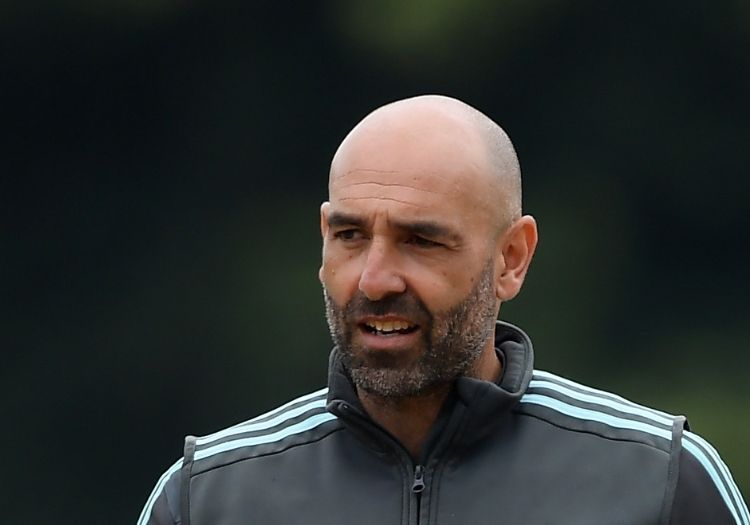
When Richard Johnson lost out to Stuart Law in the winter of 2018 for the job that is finally his, he never assumed he would return to Middlesex.
Instead, he thought that was his opportunity lost, after eight seasons as bowling coach and a half-summer in interim charge during which he displayed all the qualities that, four years on, have convinced the hierarchy that their former seamer was the right man, after all.
Ultimately, the proof will be in the improvement of individual players and results on the field following three pretty wretched campaigns, but the early signs are positive and it's difficult not to be convinced by the merits of his appointment, coming at the end of a lengthy recruitment process.
Rejected once before, making that leap was a challenge: between times, Johnson worked at Surrey under Alec Stewart's directorship, with both Michael di Venuto and Vikram Solanki trying their hand at the top job. He admits to being apprehensive about leaving that role – a job with security and at which he excelled.
"I didn't want to ruin that," he explains.
But there is something different about the relationship between Johnson and this Middlesex squad: he knows almost all of them to a degree that is highly unusual for an incoming head coach, and it's difficult to shake the notion that he was destined to belatedly find himself here. Take Robbie White, whose under-10 coach was Alan Coleman, the county's new head of performance cricket, and who first came across Rory Coutts, the newly named club coach, when he was 13. On his second-team debut, he was overseen by Mark Ramprakash, the current batting consultant, and Johnson.
Within a squad of which 70 per cent has come through the pathway, there are plenty more similar anecdotes. Ethan Bamber made his professional debut in Johnson's temporary spell in charge after Richard Scott's departure. Even Mark Stoneman, who was Middlesex's first domestic signing for five years when he arrived last midsummer to strengthen an ailing batting line-up, came from The Oval, Johnson's former employers.
Hence, the decision to put himself through the ringer once again: "This was an opportunity that, if I'd passed it by, would I have felt the same in three or four years' time? Probably not, because the group that I actually know and trust wouldn't necessarily be here."
The sense is that this gives him a head-start on the other candidates vying this position. Through pre-season, he has given the air of a laid-back character – certainly more so than Law – with a philosophy based around "relationships" and "trust".
Some on the outside have suggested this looks a cosy setup – Johnson, Coleman and Coutts have worked together previously and know each other well – when perhaps there is a view that this Middlesex side has needed fresh ideas from beyond the north London bubble. And while he can see why those theories exist, there is an insistence that he returns a better coach for his experiences over the river.
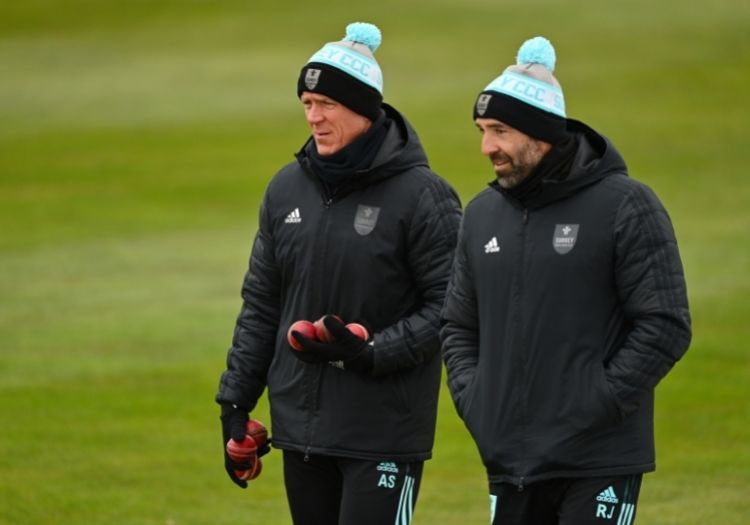
Johnson learnt plenty from Alec Stewart at Surrey (Dan Mullan/Getty Images)
"Sport is not 'comfortable'," he says. "You are judged on results – that's it. Relationships are important, so if being 'comfortable' is having good relationships with people, then I'm fine with that. But the job is to win. I'm under no illusions that results are the most important thing. And if you're not learning all the time and picking up ideas, then you're not doing your job."
Stewart, Di Venuto and Solanki have all contributed to that progression, while working with a squad packed full of international cricketers has provided a new insight. "How you coach those guys is different, and picking up all of that is huge."
He has learnt from some of the best. As a 21-year-old, he was a roommate of Jacques Kallis during his time as an overseas player at Middlesex. He shared a dressing room with Ricky Ponting at Somerset and more recently has admired Hashim Amla at Surrey.
"They just have a focus," he smiles. "They love what they do. It's a passion of theirs. It's not a chore. It's not a job. They just love it. You see their focus in practice. Some will practise longer than others. Hash is non-stop. He just wants to hit ball after ball after ball. Yet, Ricky will go the other way at times and want to feel a little bit underprepared for his innings because he wants to be switched on in the game."
Can he instil any of that into this squad?
"I think that's a difficult question. I don't know. You want people to have that passion, but whether you can instil it in them is a different thing. I think you can instil the focus. Trying to pinpoint and narrow down focus is something to look at.
"But I think development is my big thing, really. I truly believe that if you can develop and make people better in everything they're doing – attitude, physical or technical – by five or 10 per cent, that adds up to the team performance getting better. If your performances as a team are better, you've got more chance of winning. Winning is the end goal, but it's all the bits that make it up."
Sitting in the pavilion at Merchant Taylors' School, where Middlesex shifted for the outdoor segment of their pre-season schedule after basing themselves in the indoor centre at Lord's through the crux of the winter, Johnson is listing the coaches whose paths he has crossed. Duncan Fletcher, Richard Pybus, John Buchanan, Don Bennett, Andy Flower, Graham Thorpe, Dan Vettori. It's a varied list of characters. Johnson's own style, he reckons, comes from his playing days.
"Those experiences definitely shape you as a personality," he reflects, "without doubt."
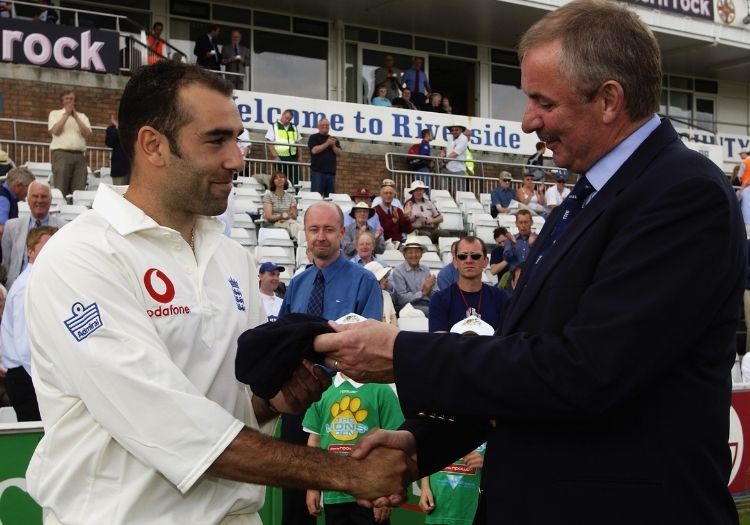
Johnson is handed his cap ahead of his Test debut in 2003 (Tom Shaw/Getty Images)
One story stands out in his mind, centred around Kevin Shine, formerly England's bowling coach and now with Nottinghamshire. Once upon a time, he and Johnson were Middlesex teammates.
"I had to fight hard for what I had: yes, I had a natural ability, but it wasn't consistent. And I couldn't understand why it wasn't consistent. Then, Kevin rang me up and said: 'I've just seen you on TV and I feel like I can help you.'"
As mates, Johnson would routinely visit Shine anyway, but they spent an hour together on his action and "he helped me more in that hour than anything I'd ever done in my whole career".
The following summer, Johnson picked up 50 County Championship wickets, had one of the best seasons of his life and promptly left for a fresh start at Somerset.
"He got me thinking how one technical point shaped my career a little bit, and then I played for England. As a process, I look at that and I realise that being coached made me better as a person. So, I probably fell into coaching a little bit. But actually, on reflection, I was always that way minded because of how my career went."
He paraphrases a line adopted by Gary Kirsten upon taking the India job. Empathy is front and centre of Johnson's playbook, partially a consequence of his own career. It's why he was such a popular choice among the players who are now his responsibility.
Because he retired early, aged 32, it's easy to forget quite how much he packed in before his body called time on bowling: the highs of being named man of the match on Test debut and taking ten wickets in an innings against Derbyshire, the lows of the knee injury that meant he couldn't take his place on a tour of the Caribbean and the subsequent curtailment to his time as an international cricketer.
"Gary Kirsten said something along the lines of: 'Whatever decision I make, I'm going to put my player's cap on first.'
"That's the empathy part. What do I want as a player? How do I see it as a player? Then, you put your coach's cap on afterwards. That always resonated with me. When you start coaching, it's easy to become a coach, and you forget what it's like to be a player.
"My body let me down ultimately. I played for England, which is something I desperately, passionately wanted to do. Yes, I wanted to play more, but injuries and the toll of injuries just put a toll to that. Yes, I was left out, but I got left out because I was injured. I don't have regrets because I couldn't do anything about it. Every player should have that ambition of representing your country; it's the most amazing thing you can ever do."
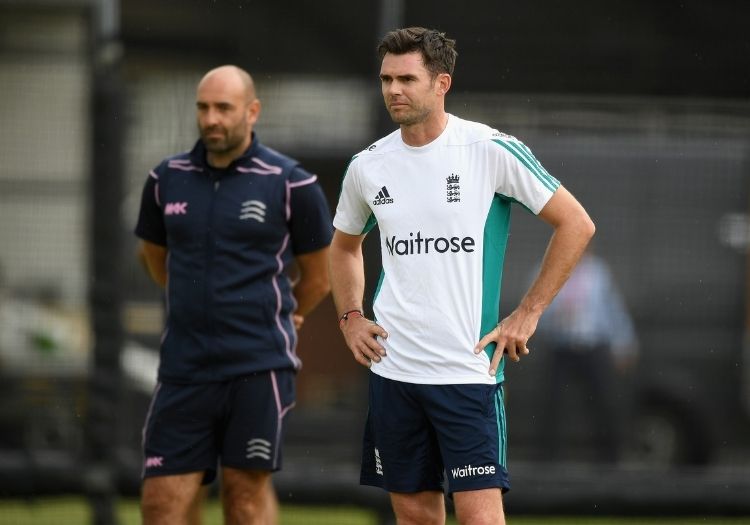
Johnson has worked with England Lions in the past, as well as with the senior team's bowlers (Gareth Copley/Getty Images)
He mentions James Anderson at this juncture, with whom he shared the new ball at Chester-Le-Street in his first England appearance, still going almost two decades on. "He delivers the same action every single ball, and he can deliver what he wants every single time. That's the holy grail for any bowler," says Johnson, loosely using his example to defend the likes of Darren Stevens and Tim Murtagh, whose modus operandi – of utilising impenetrable accuracy rather than express pace – came in for considerable indirect criticism over the winter as England struggled abroad and appropriate scapegoats were sought.
"The conditions are the same for everyone, so why aren't the other 95 per cent of bowlers exploiting them?" he asks. "If it was that easy, everybody would do it. Of course, there's a skillset."
For Johnson, leaving behind The Oval's flat surfaces for the seam-friendly pitches of Lord's might be the greatest change for him to comprehend. In Middlesex's pre-season friendlies at Merchant Taylors', they requested that grass be left on to prepare batters for the challenging conditions likely lying in wait at HQ. Last year, there was just one innings in excess of 300 in the County Championship at Lord's – and that came on the first day of the season, when Sam Robson made a big hundred. Even then, he was dropped twice. Only Chelmsford averaged fewer runs per wicket.
On the back of that, Ethan Bamber, who picked up 52 red-ball wickets last season, admitted to The Cricketer this winter that whether his success had been down to his own skill or the surfaces had left "doubt in my mind".
Speaking as a batter, Stephen Eskinazi added: "If you play on a difficult pitch at home, the dynamic of your season changes because of the different pressures that shouldn't be there. You then struggle to play your own game and it's almost like a self-fulfilling prophecy. It affects your practice, it affects your preparation, it affects your attitude, it affects everything that goes into the rest of the season."
There has been a positive dialogue between the county and those at Lord's through the off-season, and there is also an understanding of the mitigating factors – namely, a shortage of days to prepare – that have gone into producing decks that have proven so challenging for batting.
Johnson, though, is pragmatic about the situation: "As a batting unit, you have to embrace the challenge, understand the challenge and not be afraid of it. It's easier said than done: when batters' techniques are pulled apart on a wicket that you just have to land it somewhere near and it does something, it's very difficult mentally. But I think that's the bit we have to get over. It is what it is. Lord's is our home ground, we know what the wicket's going to do, and we need to get better at facing up to it. That's the bottom line. There's no excuse."

Johnson was Middlesex's bowling coach when they won the County Championship in 2016 (Dan Mullan/Getty Images)
Ramprakash, "the best player of his generation in county cricket", is onboard to help with that.
Johnson adds: "If, as a young batter, you can't tap into him for help, who are you going to tap into? We're talking about how we play on difficult wickets, he was one of the best at it. Everything that he can give to those young players is gold dust."
So, it pleased him when the squad first started in the Merchant Taylors' marquee that net sessions appeared to leave his batters as mentally knackered as his bowlers were physically weary. "It was actually draining having to concentrate that much with the ball zipping around. That's what we wanted – difficult net sessions."
Yet, in contrast to these recent struggles, when Johnson was bowling coach for Middlesex's title-winning team in 2016, they drew 10 times, didn't lose once and averaged three batting bonus points per game.
Those were the glory days: "Very much a well-thought-out five-year programme to try and win something."
It began before that, with Middlesex second-bottom of Division Two in 2010. A year later, they were promoted as champions. And then, incremental progress: they were the third-best team in the land by 2012, fifth in 2013, seventh in 2014 and second in 2015.
"So, things don't happen overnight," he stresses. "We have to work out how we win games in the second division to get promoted. Once we're in the first division, it's the same process. Your initial thought is how to stay in the division to build the confidence to win games and to learn how to do that. It is different cricket. Second division cricket is very difficult to get out of: you have to win a lot of games to get promoted."
The arrival of Shaheen Shah Afridi will help in that regard, while Peter Handscomb is due a more fruitful summer than the last. Murtagh and Bamber shared 110 wickets last year, while Robson and Mark Stoneman are one of the better opening pairs on the circuit. Four straight wins late last season were evidence that shoots of recovery were beginning to sprout.
"But you don't just get rid of four or five years of underperforming overnight. Performances at the end of last season will definitely help, one hundred per cent, though there is still what I would call a scarring there. But we've got a very talented young group, we've got very good senior players. We need to bring those two together.
"But importantly when we cross the line, it's learning how to win again consistently."
Parallels to the past are clear, and this time – belatedly – it's Johnson's turn to shape Middlesex's future.

Welcome to www.thecricketer.com - the online home of the world’s oldest cricket magazine. Breaking news, interviews, opinion and cricket goodness from every corner of our beautiful sport, from village green to national arena.