
NICK FRIEND - EXCLUSIVE INTERVIEW: If there is a single frustration in Waddington's story, it is sport's self-importance, its refusal to coexist with anything else

Have you heard the one about the Blackpool, Kilmarnock and Stoke City midfielder who captained Saqib Mahmood, Haseeb Hameed and the Parkinson twins?
If you didn't know Mark Waddington's name before clicking through to this interview, you are probably by now fairly confused. Perhaps even a little intrigued.
This correspondent hadn't come across Waddington either until last month, when Callum Parkinson revealed to The Cricketer that his skipper at the Bunbury Festival and through the age groups at Lancashire had gone on to play professional football instead. So, here we are. The natural progression: a chat with one of the more interesting, thoughtful athletes you are likely to come across.
There is a fascination with multisporters, who made it in one discipline and, if the myths are to be believed, could have done so in another.
Maybe that's what is so refreshing about this conversation. Waddington disagrees. Or rather, he can't be sure. He remembers feeling as though he had "a really good chance", aware of the Bunbury prestige and its history as a production line. But then, no sportsperson ever chooses to make it. If it was down to a choice, then we'd all be playing for England, wouldn't we?
Yet, in his case, all the statistics and anecdotes contradict the modesty of his self-analysis. Matt Parkinson has told him he would have made it – and if not at Lancashire, where he was in the academy at 15, then elsewhere on the county circuit. Others, too, remain convinced. But Waddington never played cricket past the age of 16, his passion suffocated by the archaic regulations that come with signing scholarship forms in professional football.
"There were tears when I was having to make the decision," he reflects. And, having seen what it takes to make it, he is uncomfortable with the notion that the stars would automatically have aligned for a cricket career alongside those with whom he grew up.
"I was still a kid when I stopped," he says. "I knew I was good at cricket, and I knew I stood a good chance. But I'd never really been tested at that next level, where the margins are really fine and you're playing against all the best players. I was still playing kids' cricket. When Matt said that to me, I said to him: 'Do you really think so?'
"I speak to Matt and Callum now, and I say to them: 'What is the difference between professional cricket and club cricket?' They're like: 'Mate, it's massive.' I was never put in that environment. People don't realise how high the jump is. People who don't know anything about cricket say to me: 'Why are you playing that rubbish?' And I just say: 'Do you know how hard it is to hit a cricket ball when it's bouncing halfway down and coming past your helmet at 85mph?'
"I was never tested like that. I had a very good chance, but I never had that next step. I never played any second-team cricket. I never played under-19 cricket because I'd stopped."
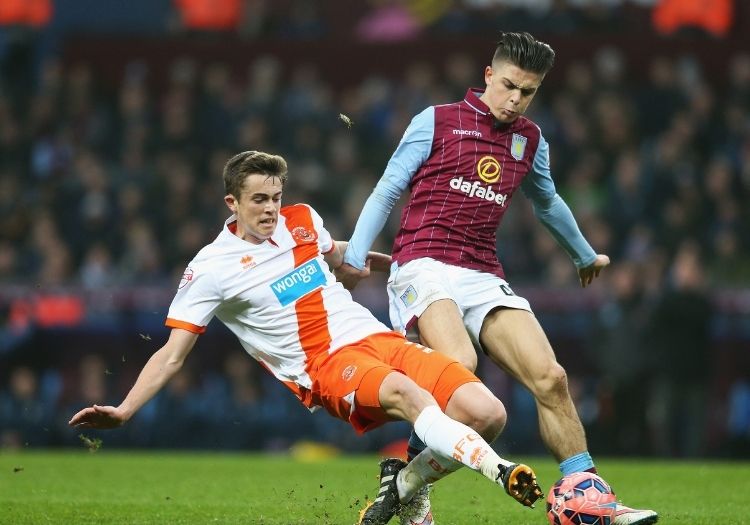
Mark Waddington challenges Jack Grealish during an FA Cup tie at Villa Park (Clive Mason/Getty Images)
So, as far as Waddington is concerned, this is an interview with one of the great junior cricketers rather than a story of what might have been. That viewpoint is why he insists there are no regrets about a choice that no teenager should have to make with such finality. He is 25 now, focusing predominantly on coaching after falling out of the professional game and into the semi-pro sphere. That fate was never for the want of trying, but simply by virtue of the tribulations of a tough industry. He counts what he's had – spells with Blackpool, Stoke, Kilmarnock, Falkirk, Barrow and Blyth Spartans – as a success story, such is the jeopardy of elite sport. He trained with Peter Crouch, Bojan Krkic and Marko Arnautovic, and played in front of 30,000 spectators in an FA Cup tie at Villa Park. "Walking out to that, you cannot describe the feeling."
Which is why he isn't prepared to lament the road not taken. In the United Kingdom, the average cricket career finishes at 26. What's to say he'd have been one of the lucky ones, even if he'd followed the trajectory of a uniquely talented Lancashire cohort?
"It's mad: I'm privileged to have done what I've done, and I have made it as a pro footballer," he says. "Yes, my career has been cut short, but it is so tough. Thankfully, it paid off for seven years.
"There are players better than me who've gone on to have better careers than me. There are players better than me who've been out of the game at 19 or 20. There are lads still playing now in League Two and League One, who I think I'm better than.
"I loved cricket, but for it to just stop like that, looking back I don't know how I did just let it stop"
"There are loads of guys who I've not seen for a while, they still ask me if I regret not choosing cricket. I look at them and they must think they know what I'm going to say. But I don't. If you know sport at the elite level and how tough it is..."
He tails off, but his point is clear – to assume he'd be in Australia now, in an England Lions squad alongside his former teammates, would be to disrespect all they've waded through to reach that point. And perhaps the question itself makes light of what he's achieved in such a cutthroat game. One suspects that these thoughts would resonate with other elite sportspeople, for whom it must be so frustrating when those on the outside claim to know what it takes.
Indeed, Waddington's football story is indicative of how hard it is. You can have all the tools and still not get out what you deserve.
Being an amateur footballer for the first time means that he will return to cricket next summer after a decade away, turning out for the first team at his boyhood club, Orrell Red Triangle, in the Premier League of the Liverpool and District Competition.
"The first thing they said to me was: 'Listen, you're coming straight back in, batting in the top five where you did, fielding at extra cover and turning your arm over.'"
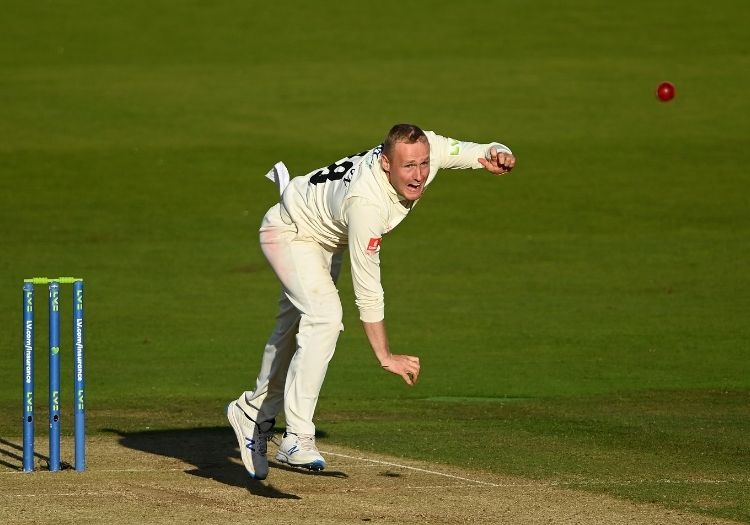
Matt Parkinson was Waddington's leg-spinner in Lancashire's age-group side (Alex Davidson/Getty Images)
He broke rank recently, telling Matt Parkinson – who has given him a pair of spikes and is sorting him out with more kit – that if he scored his runs and took his wickets, then it wouldn't surprise him if he was invited to turn out for a county second team.
"He looked at me and started laughing."
A rare blemish on that realistic outlook but also perhaps emblematic of an enthusiasm to get back to the game that was initially his priority.
"I told both that there were going to be crossovers in the season," he explains, reminiscing of his formative years, when two sports were competing for his affection. "Cricket was the main one, so there would be a month where I'd play cricket and miss out on the football."
A glance at his Play Cricket record, and it's easy to see why that confidence still exists: 947 runs in 2010, 1,083 in 2011, 718 in 2012, 873 in 2013. And then it stops. Football. In 168 recorded matches by the age of 17, there were 22 fifties and 11 hundreds, including two at first-team level and unbeaten scores of 155 (as a 13-year-old) and 165 (as a 15-year-old). While they were at club level, Waddington's stock was already known higher up the food chain: when a talent ID event was held at Loughborough University a year before the Bunbury Festival, with each county sending its best prospects, Waddington came seventh, with Hameed and the Parkinsons also in the top percentage.
Waddington was their captain, first leading Lancashire as an 11-year-old and later selected to skipper in the age-group above and then again at Bunbury.
"I learnt so much," he says. "I liked having that responsibility when I was out there, leading the lads. I always thought I was one of the more vocal guys. Honestly, I used to come off the field with headaches. I was just non-stop."
He recalls overseeing on-field arguments, such was the competitiveness of a group of future pros. None more so than with Matt Parkinson: "He would move the field and I'd tell him to leave it. We'd be at each other. And then, next minute he'd pitch one on leg and the slip would catch it. We'd be laughing and joking, and when we came off the pitch, we were all best mates. It was carnage."
He adds: "It was easy to captain, you know."
Routinely, Mahmood would begin 50-over games with three slips and a gully. "The hardest bit was man-management because we were so competitive. We were all multitalented, we all wanted to field in the best positions."
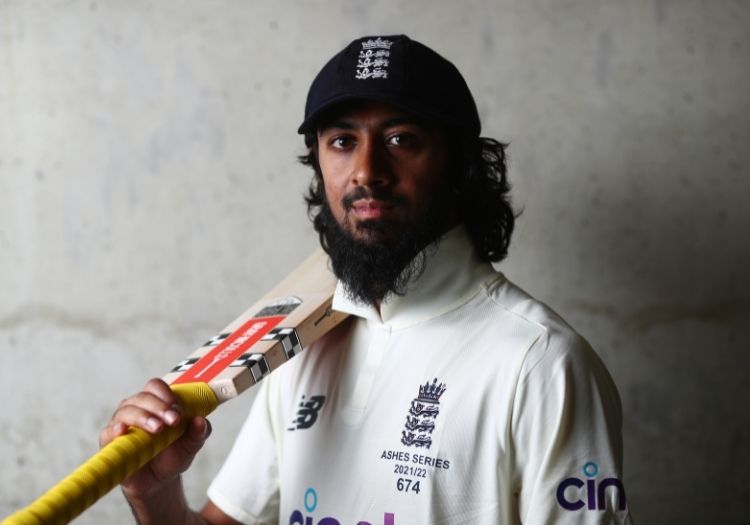
Haseeb Hameed opened the batting under Waddington's leadership (Chris Hyde/Getty Images)
Callum Parkinson, now one of the country's leading spinners, was a left-arm seamer then, opening up from the other end. And then, his twin would wreak havoc, often with more than enough runs on the board – courtesy of Hameed, Josh Bohannon, Harry Dearden and Matt Critchley, who was a year older.
With the bat, he was a cultured left-hander, though not as technically perfect as Hameed. With the ball, watching Liam Livingstone in recent times has served as a reminder: "I'd chuck down anything." Like Livingstone, it was a mixture predominantly of leg-breaks, burgling wickets and stealing overs where needed.
"Honestly, mate," Waddington begins, in his element as he looks back.
"I still speak to people now in cricket, and they'll talk about their junior sides. I go back to my old club and watch junior cricket being played, but you cannot compare our team. It sounds really bad, but I just laugh when people say things like: 'Oh, you want to see this lad bat.' That's not me being big-headed, but we just knew. You should never get complacent or say in sport that something is too easy, but at times it was."
He reels off the counties that were habitually disposed of: Cheshire, Northumberland, Staffordshire, Cumbria, Durham. They would traipse south to the Taunton Festival, where only Yorkshire and Hampshire could really compete.
"People still ask me if I regret not choosing cricket. I look at them and they must think they know what I'm going to say. But I don't"
Against the rest, they could foresee how the game was going to, how they were going to win. Most of the time, as above. When Waddington reminisces now, he knows the bad loser in him developed in that period, as part of a team that simply didn't lose. "That's it," he laughs. "It was like clockwork. We knew that if I won the toss and it looked like a decent pitch, we'd bat and look to get 300. It was just mad. You'd then have Saqib Mahmood running in. Matty would come on as my first-change bowler and rip through teams. It was crazy."
Bunbury was a significant moment, a realisation that others felt he had what it took. In that week, he skippered against Dan Lawrence, Tom Moores, Dom Bess, Joe Weatherley, Mason Crane, Aneurin Donald, Martin Andersson and Ollie Westbury, all of whom reached county cricket.
Captaincy fascinates him: Callum Parkinson described Waddington to The Cricketer as "an unbelievable leader for a young lad". He believes that the skills it gave him helped when he slipped into Blackpool's academy and senior setup, especially having done the job in the age-group above.
It moulded him as a vocal character in an environment that demands strong personalities. "Although there were a few guys my own age, I still had to captain four or five guys who were older than me. But I wasn't afraid to say: 'Listen, you're coming off.'"
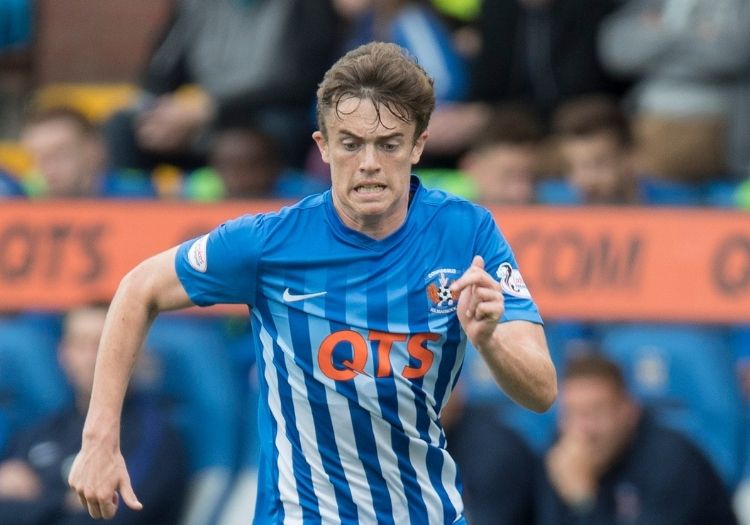
Waddington in action during a loan spell at Kilmarnock (Steve Welsh/Getty Images)
He explains: "When you have to make heat-of-the-moment decisions in a football game, I think it did help me. I learnt a lot from cricket – on and off the pitch."
Among those lessons is the reason for which he is back at Blackpool now in a coaching capacity, where he is focusing much of his energy. After a deal to play semi-pro with Warrington Town didn't quite work out, there is a recognition that acting as a mentor to the next generation is perhaps his likeliest long-term calling.
"I found it hard coming out of the professional game," he admits. "I'm just about getting sorted now, but I haven't played for 12 months because I found it difficult with the level I'd been at. You'll see a lot of players in a similar situation to me who stop paying because there's such a big leap between the semi-pro game and the pro game.
"Realistically I'm 25 now and you have to think that I'm not a 'project' to anyone. I'm not 18, 19 or 20. I think you need a bit of luck along the way."
Which brings him to Ciaran Donnelly, Blackpool's academy director, who has brought him back into the fold to work with his youngsters.
"He liked me," says Waddington, "but I earned that respect because I worked so hard to get that chance. He was the one who pushed me and pushed me until I got into the first team.
"He has looked after me so well, and I think you need that along the way. I was the first on the training pitch and the last off. I was always asking for advice, which a lot of young players don't do now. There were players who were technically better than me on my scholarship, but I got the gig ahead of them because I worked hard, and I showed that I wanted it more."
Perhaps that takes us back to where we started, reflecting on what it takes to become a professional athlete, even if it doesn't quite go as planned. That hard work was a legacy of his childhood; his father was cricket-first and a keen player and coach at club level but never once pushed his son towards either sport. His mantra simply demanded 100 per cent. "He never once told me when I'd had a good game or a bad game. He just told me to listen to my coaches."
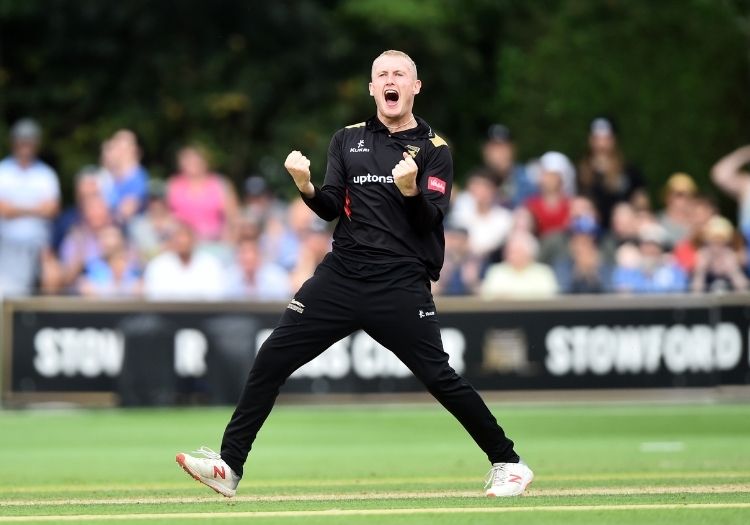
Callum Parkinson was a left-arm seamer during his time playing alongside Waddington but has since reinvented himself as one of the circuit's leading spinners (Nathan Stirk/Getty Images)
If there is a single frustration in Waddington's story, it is sport's self-importance, its refusal to coexist with anything else. He doesn't put his decision down to peer pressure per se, but on reflection he wonders whether the opinions of those around him – none of his schoolfriends played cricket – shifted the scales.
"I think I did take that into consideration. It's easy at that age to fall into that trap. I didn't think about myself very much, but I thought about others a lot."
From the moment he agreed scholarship forms at Blackpool, he signed away his right to play recreational cricket. It's as nuts as it sounds. Football's pre-season began in July, and that was that. "Even though I wasn't a pro, I wasn't allowed to play."
It irritates the coach in him, the idea that a multisport kid should have to make such a binary choice so early, piling every egg into a single basket. And the fact that he is heading back to club cricket next year at the first opportunity says plenty, as if he has never let go of being made to stop. Would he encourage greater flexibility, then?
"Definitely. I think it helps you as well. It can only help you in the long run: it's a bit of a distraction, a bit of an off-switch. To have a chance to make it in any sport, you need to be fully focused and doing the right things.
"When you have to make a heat-of-the-moment decision in a football game, I think it did help me. I learnt a lot from cricket - on and off the pitch"
"But I still think being fully focused, in my opinion, is playing another sport: you're still looking after your body, you're still doing the right things and keeping active, you're still socialising. There is the other side to it, which is not wanting to go out and do the wrong things. Professional sport is full-on, but I think growing up – especially younger kids – you can learn so much through other sports.
"Professional sport is intense, but you reap the rewards from it. I know that when I was in the full-time game, I did everything right. I probably went too far the other way, if that's possible. The day before a game, I wouldn't even leave the house – I'd be resting up with the TV on. I think you have to be that way, but sometimes you just have to relax.
"I think that is the problem with a lot of people in sport, where you see stories of people struggling – it might be through a dip in form or something in their personal life – and they just need that time to relax. In the off-season, I had six weeks off. Maybe I should have tried to not think about football, but it's non-stop. When you've won a game, you're on top of the world; when you've lost, you don't want to go in the next day. You have to be so mentally strong.
"I loved cricket, but for it to just stop like that, looking back I don't know how I did just let it stop. It's just a weird one. When I played football, I'd finish a game, I'd go home and I'd be on the phone checking how the lads who I'd grown up with were doing in their cricket. Even my local side that I'm going back to play for, I'd check all the scores."
Next year, back in the ranks, he won't have to. Their skipper is back in the game.

Welcome to www.thecricketer.com - the online home of the world’s oldest cricket magazine. Breaking news, interviews, opinion and cricket goodness from every corner of our beautiful sport, from village green to national arena.