
NICK FRIEND: Lane, head of youth cricket at Middlesex, was once England Women's all-conquering head coach - in the space of six months in 2009, he won the World Cup in Australia, claimed the inaugural World T20 at Lord's and retained the Ashes
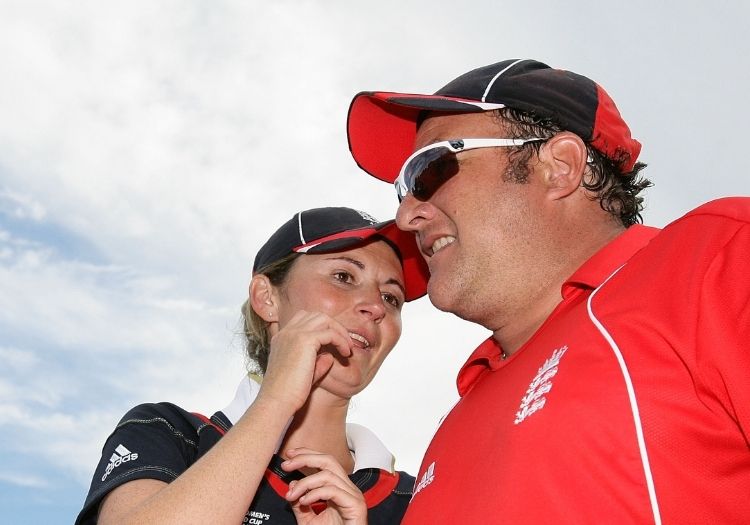
For close to an hour, Mark Lane is in his absolute element. The former England Women's head coach starts talking about coaching. And he doesn't stop.
"I had to say to Nicky Shaw, my vice-captain, before a World Cup final: 'Listen, Nicky. We're not going to pick you today. We've had a look at the pitch and we're going with someone else.' She burst into tears. Within five minutes, Jenny Gunn has trodden on the ball and gone over on her ankle, so I've gone back to Shawsy and said: 'Nicky, I need you to play now – you're bowling really well, do what you've been doing.'
“She then burst into tears again through excitement. And who was player of the match? Nicky Shaw: 4 for 34. She started crying again and said: 'I fucking told you.' Jack Birkenshaw, my assistant, lent over and went: 'Lad, that was fucking genius.' I'd love to say I planned that, but I hadn't! The rest is history. You've got to be able to make tough decisions, but you've got to be able to put an arm around people."
For five years – between 2008 and 2013 – Lane was at the helm, the mastermind behind a period of unparalleled success. In the space of six months in 2009, his team won the World Cup in Australia, claimed the inaugural World T20 at Lord's and retained the Ashes at New Road, Worcester.
That was just the start, though also the peak for a brilliant team full of names who have since become more recognisable as the game has grown in the professional, post-Lane era.
Charlotte Edwards ended her international career as England's greatest batter, with Claire Taylor not far behind; Katherine Brunt is still going strong; Holly Colvin has become a significant administrator in the women's game; Lydia Greenway is a respected pundit, coach and figurehead for the sport; Isa Guha is a world-class broadcaster; Ebony Rainford-Brent is a widely admired voice across cricket and beyond; Sarah Taylor achieved legendary status as one of the finest wicketkeepers the game has seen.
"I think it's wonderful," he says, reflecting on where the women's game has gone since his involvement. "Am I jealous? Not really. Am I pleased for them? Absolutely I am."
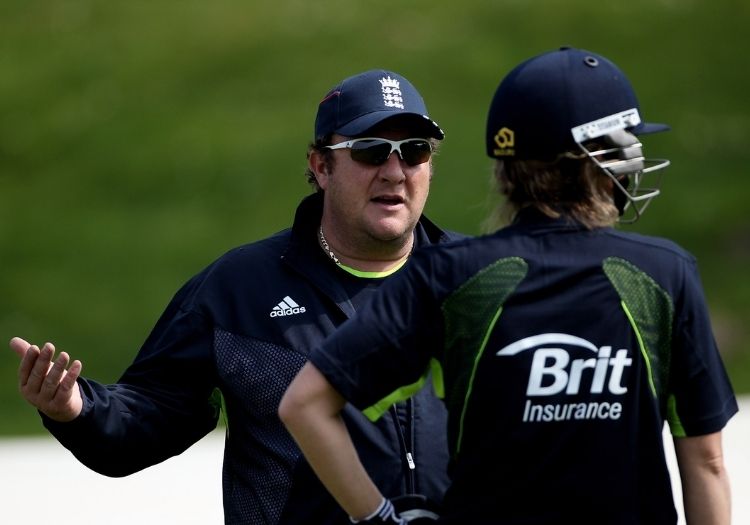
Lane was England Women's head coach for five years (Tom Shaw/Getty Images)
And that, you sense, is Lane, briefly an unremarkable wicketkeeper-batter for Berkshire at the turn of the century but otherwise a coach desperately committed to his craft for more than a quarter of a century. Since 1996, he has been at it full time, barring a single year off as he learned to cope with not being England coach anymore. Instead, he spent 12 months working for a friend as a groundsman in Surrey.
"I cut some grass," says Lane, laughing. "My biggest dilemma when I was mowing outfields was whether to have a cheese sandwich or a ham sandwich, and that was it. I loved it. I was rolling pitches, the sun was out: I had no stress whatsoever. It was a year I needed."
But it meant not coaching, not being able to give back directly. So, he fell on his sword and has been on the job ever since. These days, he is Middlesex's head of youth cricket, albeit in an interim capacity following an internal restructure that resulted in a promotion for Rory Coutts, his predecessor.
"I just love coaching cricket," he says, with a very deliberate emphasis on the verb. In all, he repeats that exact line six times in 55 minutes. "If someone wants help, I want to give them that help.
"I'm a coach rather than a director of cricket. If you give me your best 14 players, I'll mould them into a team and we'll win some stuff."
"I couldn't be any more pleased for Heather. She was absolutely a future England captain when I first met her"
If coaching is about building relationships, then it's easy to understand why so many have been so keen to run through brick walls for Lane. Listen to him speak almost without pause for breath – "this one's part of my after-dinner speech," he jokes as he rolls into another tale – and you'd be tempted too. Each is told with the gusto of a battle cry.
"I'm passionate about players getting better. For me, it's not about the badges and tracksuits. Like, the week before Luke Hollman took 10 wickets in the Championship match down at Sussex, we did a couple of spin-bowling sessions. He will randomly text to thank me, but that's what we do and that's what we're here for. It's about him, not about me."
Looking at Lane's resumé, you'd think that his career touched its summit with England. But you sense he'd disagree, wary of disrespecting everything else that has fallen his way. And if there's a single gripe attached, it's that those multiple world titles never led to an MBE.
"I'm still confused as to why I've not got one – they hand them out left, right and centre!" Without a glittering playing CV upon which to fall back, he has done it the hard way, beginning with seven years at a cricket centre in Guildford, where each evening he would spend five hours conducting one-to-one sessions. "I might coach an eight-year-old followed by a doctor who just wants to have a hit, and then you might have a county under-14 player," he recalls. "You'd learn your craft and your trade."
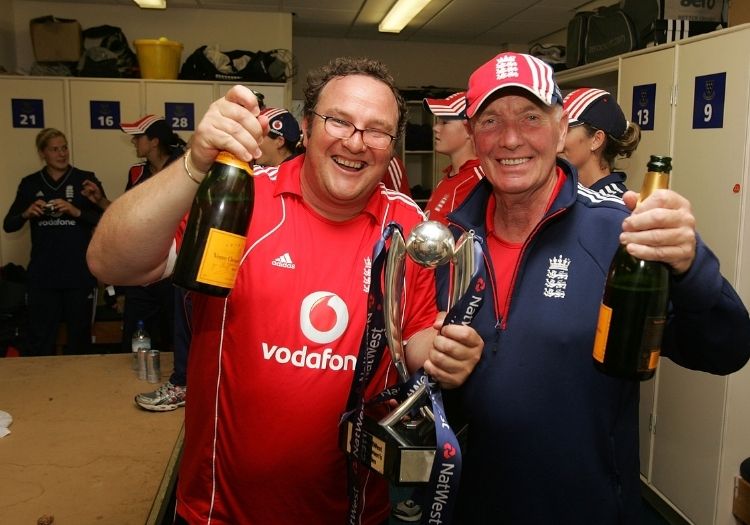
Lane and Jack Birkenshaw celebrate after a series win over India (Christopher Lee/Getty Images)
Happenstance led him to Andy Moles, who enlisted Lane as his assistant to the Kenyan national team for two years on a £25,000 pay cut.
He knows how mad that might sound to the uninitiated, so he feels the need to justify himself: "I thought it would give me international experience and different exposure, so I invested in myself. I was trying to get myself ready for the opportunity. Then, the England Women's job came up and I was ready – rather than going: 'Shit, this is here now. What do I do now?'"
Better than anything, that thought process sums up Lane's philosophy. He uses the same language to explain his reasoning for drafting in Anya Shrubsole as a teenager and flying her around the world with Team England before handing her a debut at 16 years of age, and the same words again as he remembers the obvious potential of a young Tammy Beaumont, whom he shoehorned into his batting line-up whenever – and wherever – possible on account of "seeing something in her". The idea being that when a more permanent opportunity arose, she might be ready to take it "rather than waiting for the opportunity and then having to get ready for it".
Preparation, essentially. It's why he is so heartened to see so many of his former players moving into coaching roles now: Edwards and Dani Hazell both led teams in The Hundred last summer, while Laura Marsh has taken on a coaching role within Sunrisers' regional setup.
"Lydia rings me all the time for advice about batters – I get her to send me videos and I help her. I think it's brilliant that people like her want to help, contribute and give back. I know she's got her business as well, which is wonderful. Laura asked me if she could come down and talk about coaching. It's great. Lottie rings me up and I'm always here to help if it puts people on the journey that I've been on.
"The game needs more female coaches, and these girls want to get better."
As that necessary process takes place – and he is a fan of Lisa Keightley, who overlapped for two years as England Academy head coach during his stint with the senior team – his only concern is where that same sense of battle-harden comes in. In his experience, it started with an extended apprenticeship through Chance to Shine. And he has never stopped learning: the year after finishing with England, he was briefly involved with Ireland Women.
"Actually, it's not all that razzmatazz," he adds. "You have to get stuck in and get dirty.
"I quite like it when one of the lights isn't working or the bowling machine doesn't work. You have to earn the right."
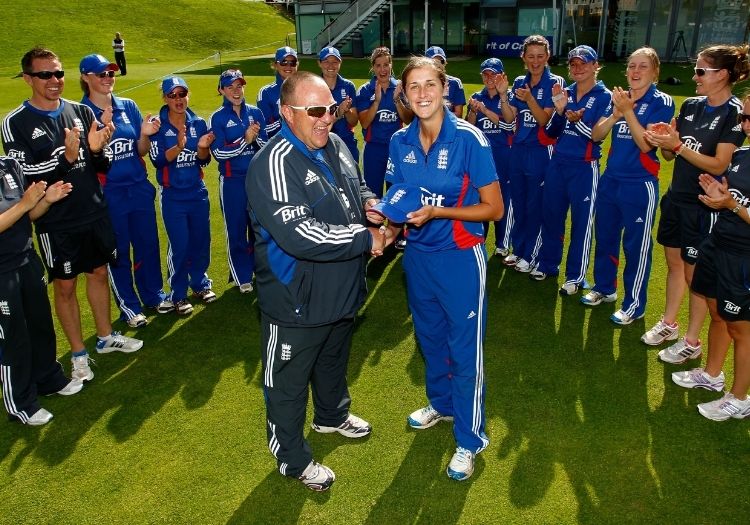
Lane presents Jenny Gunn with her fiftieth international cap (Paul Thomas/Getty Images)
Eighteen months ago, Lane reckons he'd have seriously considered moving back into the women's game with one of the regional hubs but feels further away from that eventuality now. He helped Sunrisers where possible last year but felt guilty that he "couldn't give them the time they deserved".
As part of his Middlesex gig, he does some work with the county's first-team players, several of whom came through the ranks under his watch.
"I said to Thilan Walallawita: 'When you make your debut, I want to be there to watch.' I get so much satisfaction seeing them playing first-team cricket because of the journey they've gone through."
He looks back, too, on the difficult conversations with the same players in their teenage years. "I couldn't think of anything better than seeing someone like Blake Cullen, Luke Hollman or Joe Cracknell going on to play for England. How good would that be?"
Talk returns to Claire Taylor. For Lane, she best represents everything he stands for, and they worked together as player and personal coach for 14 years. Towards the end of that time, when she became the first woman to be named a Wisden Cricketer of the Year, she asked Lane to accompany her to the unveiling. He wanted her to take her father instead but she insisted.
Lane likes that tale because their relationship was founded on two different ends of the spectrum: Taylor, an Oxford maths graduate, and Lane, "just a normal bloke".
"She once said to me that she wanted to become the best player in the world. And I said: 'I want to play for Man United.' It's okay having the skill, but have you got the will?"
Before the days of proper funding, Taylor paid Lane for coaching out of her own pocket. In India, she would complete a five-mile run before settling in for a bat "because she wanted to feel fatigued". For 18 months, he didn't let her hit a ball behind square, lobbing up slow deliveries on a slow surface to force her into developing her game. For all of that, validation came in the World T20 semi-final at The Oval, when Taylor and Beth Morgan put on a 122-run partnership to beat Australia. Lane had leant on his Surrey contacts to request the boundaries pushed out as far as possible. "I knew we'd outrun them because we were fitter than them," he says. England might not have been professional in name back then, but they were in approach.
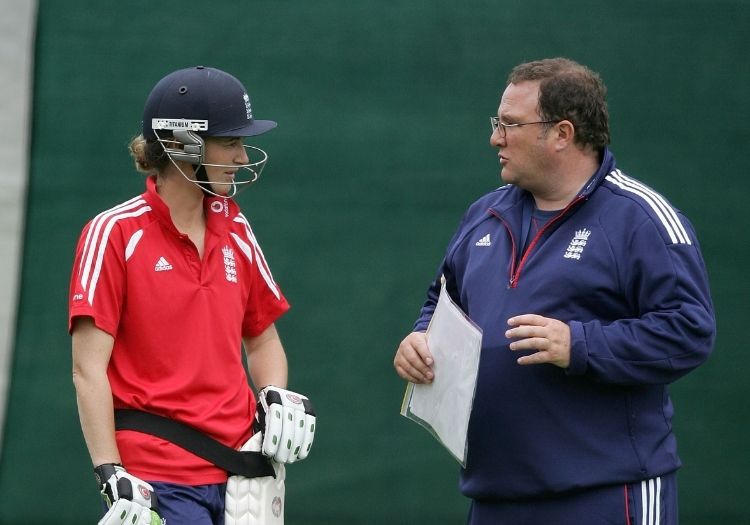
Captain and coach - Edwards and Lane - deep in conversation (Christopher Lee/Getty Images)
"When she won the semi-final with Beth, I knew we'd done all these different drills about hitting space and knocking it for twos. It's okay acquiring skills, but at some stage you have to go and do it. With Claire, a ball on fifth stump would go through mid-on. The way to get her out was to bowl back of a length and get her to cut, because her grip was all wrong. But as soon as you bowled straight, you were in a world of trouble. But she knew that. So, she'd leave the wide one and when you went straight she'd whack you for four. So, it's not about having the perfect technique; it's about having the technique that works for you."
He sees some of Taylor in Heather Knight as well – not technically speaking, but as a principled leader and a resilient, excellent role model. "I couldn't be any more pleased for her," says Lane. "She was absolutely a future England captain when I first met her. She's cut from the same sort of cloth as Lottie: tough but fair, very approachable, very honest.
"Paul Shaw was in charge of the academy when she was coming through, and he knew she was a proper player. She's a tough cookie, Heather. She played a lot of men's cricket down in Plymouth.
"I told her to score runs in the academy, so she got a hundred. She just said to me: 'I've scored my runs now.' So I had to be true to my word, and we got her involved. She wasn't as fit as she might have been, so I got her doing some running. She ran and ran and ran and ran and ran. I thought to myself: 'This kid has got it.'"
"I just love coaching. If someone wants help, I want to give them that help"
Hence the Edwards comparison: "I knew how to talk to Lottie. If I shouted at her, you wouldn't get anything. If I said to her: 'Listen mate, that's not good enough,' she would come back at me and I'd come back at her. And I knew that the next day in the nets, she would be thinking: 'Fuck you, I’m going to show you.'"
She would travel to Guildford for sessions with Lane. So, too, would Greenway, Marsh and Rainford-Brent. He would drive south to coach Sarah Taylor. It was an altogether different world to the women's game in its current guise: he had a full-time physio, a strength and conditioning coach and a team manager, but access to a specialist bowling coach was limited to 10 days, while he had his own assistant for 100 days. "But we built something on that," he laughs.
"I was on the road every day to coach, but that's what I love doing." It's no surprise then that he can't get his head around the bloated backroom teams assembled these days: "You wonder how they all get on the airplane."
He reflects: "At that time, the game wasn't where it is now. It's wonderful to see Heather doing what she's doing; it's lovely to see Katherine still performing. I still speak to the girls – they still ring me, I still ring them. It was an integral part of my journey. Hopefully the likes of Lottie, Lydia and Claire have helped these girls to earn a very good living out of playing cricket, which ultimately is a game, but a game they're doing really well at."
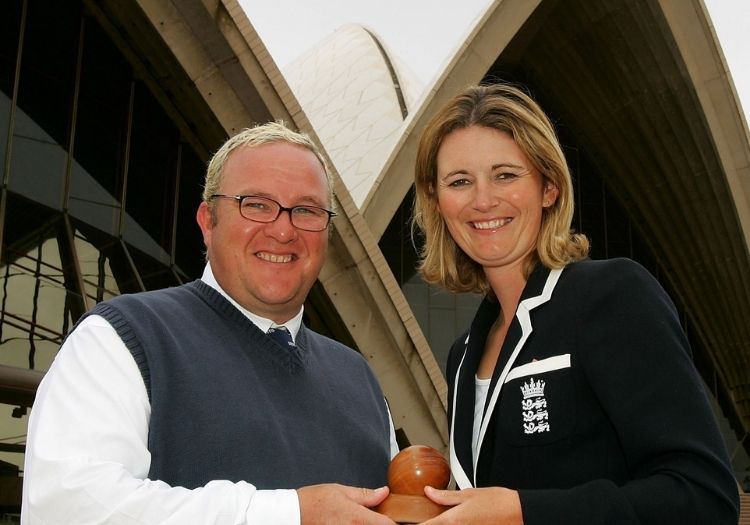
Edwards and Lane celebrate their Women's Ashes victory in Australia in 2008 (Ezra Shaw/Getty Images)
Eight years on from Lane's departure, there are 67 female players on full-time deals – whether England-focused or domestically.
"Now they get paid for this, they have to understand that they're accountable. If you're a batter, you have to score runs. You're not going to keep on getting paid if you're not producing. That pressure exists now. You have to earn that contract extension.
"You can see The Hundred and the regional hubs paying dividends. Some people are underperforming and they're under the pump; some people are performing and they're being rewarded. That's what you want from your investment. Brilliant things are happening: we're seeing young players like Alice Capsey and Charlie Dean."
None of that existed in his time; he knew structural change was imminent – "with what we'd done, the ECB had to make a move" – but his spell in charge ended 12 months before the first tranche of central contracts came to the table.
No animosity, just an appreciation that his cycle might be complete: "We had lots of success. Clare Connor and Hugh Morris were very appreciative." Under his tutelage, England won 46 out of 60 ODIs, 43 of 54 T20Is. They became the first team ever to win two ICC world trophies in the same year.
He laughs again. "There was a time when we had to transform the team, with a few careers coming to an end, and there was an article written that compared me and Sir Alex Ferguson, and how we transformed teams. Ironically, Fergie stole my thunder and retired on the day that I got sacked!
"I didn't get sacked though. I rang my missus one day and said: 'Whatever happens in this World Cup final, I'm done.' My daughter was three. I didn't have a job to go into, but I just felt the time was right for them and for me."
And just like that, Lane has to go. There's no need, but he apologises: "Sorry, I've made this interview a lot about me." When the phone goes down, suddenly everything feels eerily quiet. There can't be many who love the game quite so much.

Welcome to www.thecricketer.com - the online home of the world’s oldest cricket magazine. Breaking news, interviews, opinion and cricket goodness from every corner of our beautiful sport, from village green to national arena.