
NICK FRIEND: Bamber ended the season on 100 first-class wickets, but it hasn't always been plain sailing. Through the winter, he opened up over several conversations about dealing with self-doubt, eating issues, inferiority complex and hard work

Ethan Bamber has just put the finishing touches to his latest piece of latte art. He has mastered the fern, but today sees an attempt at a heart fold into something more closely resembling a canyon.
"It's a lovely bean, though," he laughs, speaking as a self-declared "coffee snob". It is one of several quirks that make him an atypical professional cricketer. He isn't a gamer or a regular drinker or a race-goer. Instead, Middlesex's young bowler is a theology graduate, a foodie and unapologetically willing to discuss the "deep stuff".
That isn't said with any hint of arrogance, and his one wish through several conversations over the course of the off-season is not to be portrayed as if he's cracked it. Rather, the opposite.
"For me to be an okay county cricketer has required a lot of work," he says. "A lot of work: how I think about the game, how I think about myself, how I train, how I look after myself, how I live. And that is just to get into a county team and have that one okay season. So, to be a really good cricketer is going to require a lot more work. And to be a really, really good cricketer is going to require even more work. But it's not necessarily about being that; it's about getting everything out of myself."
Understanding what goes into that process was the basis of this project – to touch base periodically through the winter and explore the mental side of the game for a young cricketer doing far better than he'll give himself credit for but, nonetheless, still nearer the beginning of his journey than anything else.
"I told myself when I was 15 that I was never going to be someone who could have been a cricketer," he says. "I was either going to be a cricketer or I wasn't going to be good enough, but I was going to try everything to do it. I'd be lying if I said I've always been really comfortable in myself or I'd never tried to play up to a crowd or never tried to be more alpha than I am. Of course, I have. But I do feel like I can be myself now."
"My biggest doubt about myself is that I'm someone who in a very short career so far has done okay because of the pitches. That frustrates me because I want to know that I'm actually skilful enough"
Those who know him – on the circuit and beyond – can attest to that: a disarming humility that has often manifested itself in a propensity to apologise at all corners and caveat any praise. The bio at the top of his Twitter profile simply reads: 'sorry', and the "one okay season" he describes was really much better than that.
"Just because you're really macho and alpha, it doesn't mean you want it any more or less. It doesn't mean you're going to work harder or less hard. I hate people shouting for me to come on in the gym. That doesn't work for me. It works for some people. But my motivation comes from inside of me. It takes confidence to be who you are on the pitch – a bit quirky, a bit weird. Some people probably think I'm a bit weird, which is fine."
That doesn't mean he doesn't have an ego, he insists. It just shows itself differently: he enjoys being picked to front up to the media after a bad day at the office and, more pertinently, sitting down to do things like this. "I really like being interviewed."
***
It seems odd to identify an absolute low-point, but Bamber knows now that he won't feel so trapped ever again as he did two years ago. The nadir came on July 28, 2020, on the first afternoon of Middlesex's two-day friendly against Northamptonshire after months in lockdown. He bowled 15 unthreatening, wicketless overs before sitting down in an empty stand with Alan Coleman and breaking down in tears.
And although he maintains that this shouldn't read like a "sob story", it provides the context for everything since. Bamber weighed 80 kilogrammes on his debut in 2018 and then 76 a year later. Through the early stages of the pandemic, that number nosedived to 67, 13 shy of where Middlesex wanted him. He has kept his headshot from the squad photo day as a reminder of how gaunt he had come to look through a well-intentioned – but misguided – effort to work himself into extreme shape. "I just trained a ridiculous amount," he says.
In his diary, he has kept a record of the lengths to which he went: without delving into the finer details, they amounted to three physical sessions each day – one before breakfast, one afterwards and a third in the afternoon.
"It's just so stupid," he reflects, allowing himself a wry smile. "It came from a place of the world being in a bad place, mum and dad not being in a great spot, but the one thing that I could control was what I did in my day. It felt like the only way to get any sense of achievement. I love cooking and I love food, but I was like: 'Well, if I'm going to eat then I need to work.' And that's where this slightly unhealthy relationship developed. That's where it came from."
It reared its head on a day that should have been perfect: cricket, after so long without it. He ate well in the morning and had enjoyed a day off beforehand. "But I was bowling," he recalls, "and I just felt like they could have stood aside and the ball wouldn't have knocked the bails off, and yet I was trying so hard. I was just so far off the pace."
Coleman, now the county's head of performance but then Stuart Law's assistant, has been a long-time confidant since coaching Bamber as a teenager, and the truth is that no one could have been better placed to deal with the aftermath of what he describes as his "most humiliating moment".
Bamber recalls: "Through that whole period, I'd been irritable and so emotionally charged. Anything would upset me or make me super-happy for a second. I lost my sense of humour. It was like someone had pulled a cloak off. I just broke down. It was a really seminal moment."
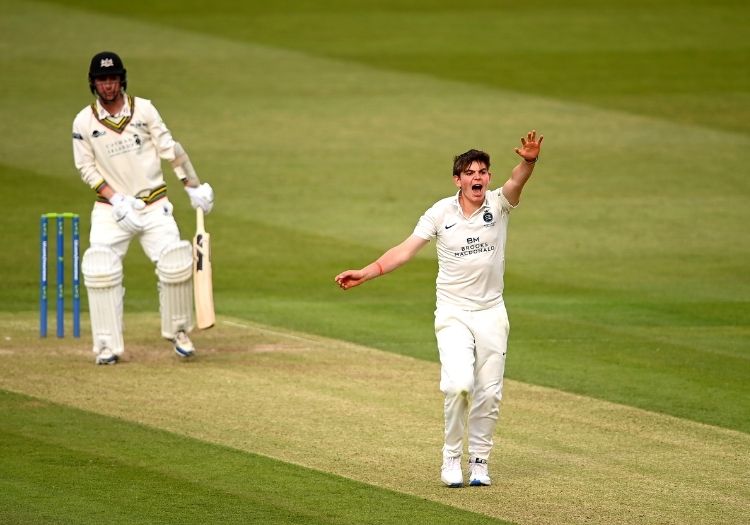
Bamber took 52 County Championship wickets last season at 20.84 apiece (Alex Davidson/Getty Images)
A word here for Law too, not always famed for his sense of empathy. Bamber took him for a coffee a couple of days later and laid bare his soul. "He was fantastic," he says. "He could not have been more supportive. I didn't necessarily feel like I belonged at the cricket club at that stage; I hadn't imprinted my name on the field; I felt very lost in that setting and really out of my depth, so I was quite nervous about what might happen, but he listened and he understood."
From there, everything changed: Bamber only took one wicket in that half-season as he fell down the pecking order, but he was put in touch with Sporting Chance through the Professional Cricketers' Association and can scarcely speak highly enough of the support he's received since. He has also become an ambassador for the mental health charity, Opening Up Cricket, whose wristband he sports. It is his style not to want this episode overblown, for others have their own plights that are "much worse than whether they can bowl a cricket ball".
"But I look back on it and feel like it was so severe because I felt like I was giving every single fibre of my being, and yet I was so far off the pace. And if I feel like I'm giving everything and thinking about it all the time and trying to get every miniscule aspect of my life in place and I can't even get in the second team and I'm bowling at the academy lads in the nets because they're the only people who won't whack it, how high is this mountain?"
In hindsight, there remains an element of frustration at the months of potential progression that were lost, and one aspect that he continues to find difficult to reconcile is the point at which hard work becomes detrimental. Bamber has never considered himself to be particularly talented "because your relativity scale changes as you go up – if I go into a primary school, they think I'm uber-talented because I'm a professional cricketer, but if I go into an England dressing room, they wouldn't think I'm that talented because they're all international cricketers".
And so, his unique selling point as a youngster was his unwavering fitness, and his approach to academy life was effectively that extra running equated to extra reward. "My point of difference was always that I could push myself harder, do more and sacrifice." And for a time, that was sufficient.
But he knows now that he simply "ran out of rungs on the ladder, and actually the intensity you have to operate at when you reach the level you want to is not sustainable if you just do it again and again and again".
"It's a really strange dichotomy. When you're sitting on the sofa, you're resting. And that is going to make your work better, but the instant thought is that someone else will be doing something, so I could be using this time better. Therefore, am I being lazy and complacent? I never want to appear complacent, and my initial answer to that is: what can I do to get better?"
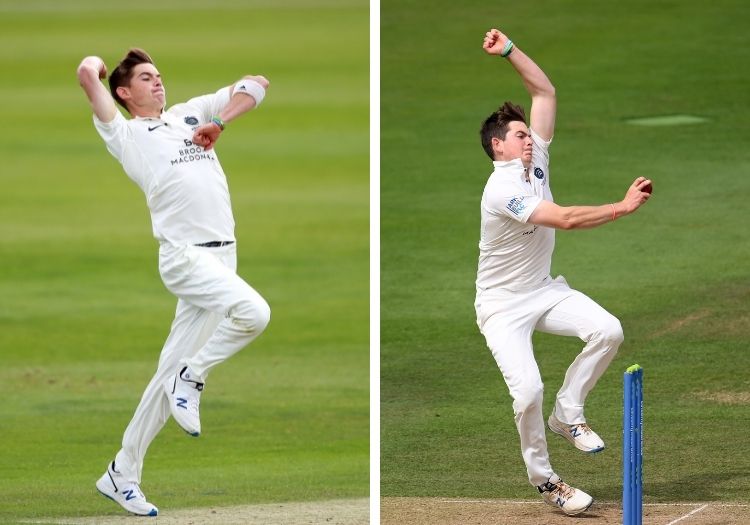
2020 v 2021: the stark difference in Bamber's physique on either side of his issues with eating and training (David Rogers/Getty Images & Justin Setterfield/Getty Images)
As a regular podcast-listener, he has lost count of the number of former athletes who have relayed the same message about rest and recovery, and others who have spelt out how life spiralled out of control through their struggle to stop pushing themselves. After 520 match overs last summer, he has started to get the picture.
Between our first and second interviews, Law was sacked by Middlesex after three years in the job and replaced by Richard Johnson. For Bamber, that means renewing his relationship with the county's former bowling coach, who left for Surrey at the end of 2018. On a purely human level, it also means losing the man to whom he opened up at his lowest ebb. And while their relationship was hardly watertight, that conversation left a lasting bond and a realisation of the trust involved in expressing his vulnerability.
He says: "It's strange, isn't it? You give a lot to someone and you get a lot from someone. I suppose I am quite daunted by having to build a new relationship with someone and maybe having to have those same conversations again. They take quite a lot of emotional energy from you, and they require a lot of patience and generosity from the other person.
"I certainly feel the loss of Stu as a person, coaching aside, more than some of the other guys on the staff just through that one conversation."
There is a lovely anecdote about the end of last season, 14 months on from Northamptonshire and shortly before Bamber would be jointly named as Middlesex's red-ball cricketer of the year, along with Sam Robson. Law approached him during the final game of the campaign – a defeat at Canterbury – and offered a quick hug. 'Well done, mate. We're proud of you,' he told him.
"That did mean a lot to me," says Bamber, "and I think you do remember those things. I feel really grateful."
That gratitude extends to his teammates as well; 70 per cent of the county's first-team squad are academy products and Bamber reckons he would count at least 10 of them as close friends: "It changed cricket from being something I was really scared of going into every day and anxious about because I knew I was going to see faces that make me happy."
***
Still only 23, Bamber spent the winter on exactly 100 first-class wickets, including 52 at 20.84 apiece last summer. In the country, only six men – Luke Fletcher, Chris Rushworth, Sam Cook, Tim Murtagh, Dane Paterson and Simon Harmer – took more. That alone makes him uncomfortable. Proud, but uncomfortable. Murtagh comparisons are nothing new, but Bamber insists they are disrespectful to his mentor and teammate; he holds out particular admiration for Cook, another young seamer enjoying success without the god-given ingredients needed to bowl genuinely fast. Matt Milnes, too. "I look at guys like that and I find them really impressive."
For that particular subsection, this has been a strange period. England's Ashes struggles, as so often happens whenever the national team fail abroad, precipitated conversations around the problems facing domestic cricket, with the pace of the bowling deemed to be chief among them. Bamber wrote down in his diary a quote from Kevin Pietersen in the aftermath about "average bowlers on poor pitches".
It was a typically brutal take, offered without much nuance, but for him it has been difficult to shake. Other than in 2020, he has tended to take his wickets at a steady rate as a professional cricketer, and because of that he has often wondered whether his success has been the result of his own ability or the conditions around him. "My biggest doubt about myself is that I'm someone who in a very short career so far has done okay because of the pitches, not because of my skill," he explains. "That frustrates me because I want to know that I'm actually skilful enough."
Indeed, he has taken wickets on every ground he has bowled, and the spells he remembers most fondly from last season took place on flat pitches at Merchant Taylors', Cheltenham and Leicester. Not many seamers on the circuit would insist on Beckenham as a "favourite outground".
"Still my first thought when I'm at the top of my mark is: 'Oh my god, they do this.' I don't think I've ever thought that they might be looking at me thinking this is going to be tough"
Lord's, on the other hand, was a particularly challenging venue for domestic batters last season, with the highest County Championship score of the season there coming in the first innings of the campaign. It was the only time a team made in excess of 300. Bamber averages 17.92 at HQ.
"Is it my fault that the pitches are like that? No. But do I want to be better than that? Yes, of course. Does it frustrate me that three times when I bowled in the fourth innings last year, teams chased down big totals against us? Yes. Does that make me think I've got loads to do on my bowling? Yes. The really good bowlers win games in those situations when conditions aren't in their favour."
For those reasons, he doesn't consider the winter narrative to be a personal dig, but rather "a valid criticism". Bamber talks a lot about becoming a better bowler and is fascinated by the intricacies involved in scaling that peak. There is an acceptance that "not everyone is an exceptionally gifted, naturally freakish athlete" and, by extension, he doesn't have the natural tools of Blake Cullen, a teammate whose raw pace has brought immediate success in the T20 Blast and The Hundred.
But he has studied Dale Steyn to understand how he balanced full throttle with other spells where he held himself back, and he spoke in depth with Kyle Abbott recently for an interview on his Opening Up blog about how the South African goes about his work. Shaheen Shah Afridi's arrival at Lord's will provide another brain to pick, as does Johnson's return.
Worcestershire's Dillon Pennington, his great mate from their England Under-19 days, spent part of the winter in Adelaide, and a trip like that – into climes that he knows would challenge him – is high on his bucket list. "They'd definitely look at me and think I was shit, so I'd have to really work on my skills," he says, smiling, but also confident that he'd be better placed to thrive there now than when he started out.

Bamber, John Simpson (left) and Max Holden (right) at the Tottenham Hotspur Stadium, where Jacksonville Jaguars faced Miami Dolphins: he has become fascinated by the NFL (Instagram: Ethan Bamber)
Sat in a café in front of a bowl of chicken curry, he modestly describes his strategy back then as simply to "bowl balls" and hope, before "discovering some skill" last season. "What I want to do now," Bamber explains, "is understand how to apply those skills in a collective package: put a spell together, set a batter up, understand when to try to swing the ball, when not to. I want a modus operandi that is effective.
"Someone said to me last year: 'Have you been talking about England?' I just said: 'Are you even being serious? Let's be real.' Can you imagine me playing for England Lions at the moment? I will give every fibre of my being, but I don't think I'm good enough yet. I'm trying to be, and I think one day I will be if stuff aligns. But I think it's farcical to think that just because you get some wickets and have a good year, you're suddenly amazing. Or if you have a bad two years, you're suddenly crap.
"All I try to bring myself back to is: am I doing all I can to get better, am I trying to learn? When I'm given the opportunity, am I in the best place to take it? I think so. If anyone has any ideas on how to make me better, I'd be happy to listen to them."
Because that remains the principal motivation: self-improvement – a work ethic he inherited from his parents, who are both actors, and his brother, Theo, who has played an enormous role as supporter-in-chief. The outfield at North Middlesex, his childhood club, has often doubled up as his own running track.
He insists: "Fundamentally, if I never take another wicket but I genuinely think for two years I've worked really hard to become a better bowler, then I'll be happy. A lot of people have said it to me – and they've meant it in the best way: 'Oh, why would you bother trying to get better? It's working.' Well, yes, it's worked for a little bit, but I don't want to play Division Two county cricket all my life. I may, and that's fine. I'm very happy if that's all I'm able to achieve, but I'm not trying to make that all I'm able to achieve."
With that in mind, the next step is to take a proper, match-winning haul – the kind that Abbott, Cook and Mohammad Abbas tend to deal in. That persists as one "monkey on my back". Another is developing the self-belief to take the big wickets. "That's the sign of a really good bowler." Even as some of his scalps are read back to him – Rory Burns, Paul Collingwood, Zak Crawley, James Bracey, Ben Duckett, Liam Livingstone – he laughs in denial: "I hate the idea of imposter syndrome, but I really do sometimes feel: 'How on earth have I found myself here?' I mean that in a really nice way, but it's mad.
"I think I'm the kind of bowler at the moment who batters get out to and ask: 'How the fuck did I get out to him?' I would love to change that.
"Still my first thought when I'm at the top of my mark is: 'Oh my god, they do this.' I don't think I've ever stood there and thought that they might be looking at me thinking this is going to be tough.
"I would love guys to think I'm a really good bowler, but I don't think I'm good enough for people to think that yet. I feel like I have a lot of proving to do to myself. I'm bowling at someone like James Vince, for example; he's a gun. I'm not that, but I'm going to give my best."
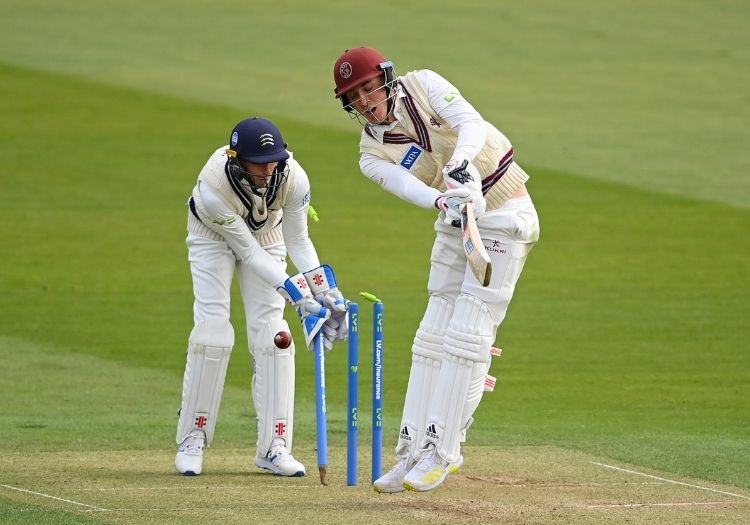
Bamber has been grappling with the perception of occasionally bowling with the wicketkeeper up to the stumps (Alex Davidson/Getty Images)
Others might disagree with that assessment. But if he's not there already, then he will get there, you sense. Whatever his own reservations, he is one of the most impressive young players on the circuit; talking to The Cricketer at Christmas, Coleman spoke in awe of his dedication. "There aren't many other lads in county cricket who would get 50-odd first-class wickets but then come to you literally two weeks after it had finished and say: 'Right, this is how I want to get better. I'm not happy with what I did last year.'"
There is no tangible end-goal, however. Simply, that mindset doesn't work for him, though he puts it quite beautifully that "one of the things I want to know is that when I have the ball, my teammates feel secure".
He is reminded of an Eddie Jones podcast, in which he was asked whether he'd ever coached the perfect game of rugby. The response? 'No, I've coached the perfect half.'
"That insatiable desire is what keeps me going," says Bamber. "To be as good as you can be. The day I stop wanting to try and achieve it, that's the day I'll have to stop playing professional cricket."
He refers back to his coaches regularly, and particularly Coleman, though his respect spans much further. He visits the academy on Thursdays to help out, watching how Rory Coutts, Mark Lane and Dan Housego go about their work in overseeing the club's next generation. Because Bamber's major fascination is with people: how they coach, how they manage the personalities of the youngsters coming through the system and how they adapt their methods to each one.
"How do you take someone who's really good and get the best out of them all the time?" he asks. "I've been changing rooms with guys who are really good, and we've performed really badly. So, why does that happen?"
He received an email recently from Nick Denning, his personal development manager assigned by the Professional Cricketers' Association, about a coaching skills course that he is keen to undertake next year. In a way, he has already spent plenty of time preparing for it, and the dream post-playing is to work within that sphere, perhaps in a directorship role. In the meantime, he has become obsessed with sporting documentaries and the figures featured within them: "It's not that I love Dallas Cowboys or Arizona Cardinals, it's that as soon as you see a person, you're then invested in something more." Money is no object in the NFL, but he admires the teams – and individuals like Russell Wilson – "who do every single thing in their power to be better each day".
Unlike those athletes, Bamber can't afford a personal chef and Middlesex can't build a new indoor centre – as Dallas did – at the drop of a hat. But the ambition remains the same: "I'm not here because of any extraordinary talent, so I can't afford to think that just because I've had a decent year the rest will continue. I really feel like I owe it to myself and to everyone who's helped me get to this point to give it absolutely everything."
***
The great irony here is that Bamber's highlight of last summer perhaps looked like his most chastening experience. It was the first night of Middlesex's Blast campaign, and he was a surprise inclusion for a local derby against Surrey that was broadcast live by Sky and took place under the Lord's floodlights in front of a sell-out crowd, with a particularly short boundary towards the Grand Stand and the substantial twin threat of Jason Roy and Will Jacks leaning on their bats. Bamber, on the other hand, wore a blank shirt without his name on the back, such was the collective shock – that extended to the kitman – to see him thrown in for his T20 debut.
He bowled 2.5 overs for 43 runs on a night when no Middlesex bowler was spared. Jacks, an England Under-19s teammate, smashed 70 off 24 balls. "Genuinely," he laughs, "I wouldn't change it at all. And my overriding memory of that night is absolute enjoyment. I know that sounds completely stupid." In a way, he is prouder of that – and his overall set of fledgling limited-over numbers – than his red-ball exploits.
Such is the difference in atmospheres for a T20 evening and a four-day encounter, it was his first time in front of a packed house, his first experience of Eoin Morgan's captaincy, his first taste of being dragged quite so far outside his comfort zone.
"Looking back, I went onto that pitch thinking there was a good chance I was going to get hit. I didn't help myself there."
He recalls standing at the top of his mark, thinking about what Surrey's openers might be saying about him. "I suppose when you do that, you give the power to someone else."
With the last ball of his first over, Jacks edged through where first slip had been stationed until the previous delivery. And of the 2,791 times he approached the crease in first-team cricket in 2021, that one stands out because of what he told himself at the top of his mark.
"It's something I'll take forward into next year," he says, "that actually, once you're out there, they've picked you, you're playing in the game, and there's no point in apologising for being there. I was so conscious of who I was bowling at, and that I'm not known as a white-ball bowler, that I didn't give myself the best chance of even performing to my ceiling – which may be too low anyway, but I didn't even reach it.
"Whereas in the red-ball stuff, I got to the stage where I started to believe that I have a bit of a presence and that maybe people thought that I was at an advantage rather than me being like: 'Oh my god, look who I'm bowling at. Wouldn't it be a great moment if I got a dot-ball here?'"
In that sense, he has envied Jacks at times – and his "aura" on the pitch. "Sometimes I wish I could bottle a bit of that," he admits. "I've had little spells of that, but there's still a little bit of me – when I get into that slightly arrogant state when I bowl, which is probably when I bowl at my best – that goes: 'Oh, don't do that, that's a bit arrogant.' I'd love to just care a little less about that sometimes.
"The most important thing for me is that off the pitch I am the person I want to be, and that's what I want to concentrate on mostly. I would hope that I'd always work and fight hard enough on the pitch to get the results that I deserve – good or indifferent – but I don't want to compromise myself off the pitch. But I think I can be a better competitor on the pitch and not lose that."
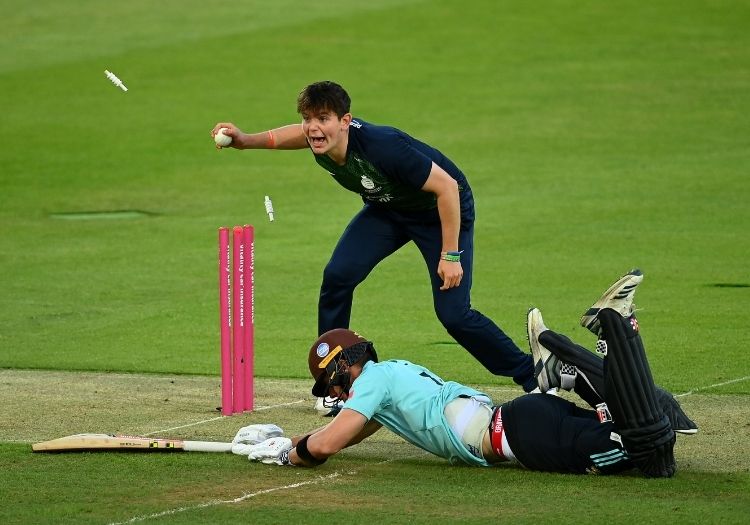
"Absolute enjoyment" – Bamber only has happy memories of his T20 debut, even if he was on the receiving end of Surrey's opening assault... (Alex Davidson/Getty Images)
He returns to the memory of that night and chuckles again: "My Blast average is infinite, you know?"
But five T20 matches as a 22-year-old learning his trade on flat pitches do not make a white-ball career. "I feel like I had a free shot at it, and I cocked it up. But you're going to cock up lots."
In typical style, he has spent the winter plotting what happens next: "I want to be the best death-bowler at the club." That's the goal – and he believes he has the skills to thrive in a role he performed successfully at the Under-19 World Cup four years ago.
"I love it. I love bowling then. I love the pressure. I love the fact that you can affect it. I love the fact that if it goes wrong, it's on you. There's nothing worse than standing on the boundary, thinking you can't really do anything."
More than anything, though, when he next plays white-ball cricket he will know to trust himself. His single regret from the Blast campaign was a tendency to second-guess his gut, whereas his Royal London Cup performances – no one took more wickets for Middlesex – were founded on committing to his instinct.
"There's no benefit in thinking it's going to go badly," he has learnt. "Just trust yourself. At least you can then be like: 'Well, I thought it was the right decision, but it went wrong.'"
He remembers calling Theo at the end of a high-scoring defeat by Sussex, where he conceded 56 runs in 10 seemingly fruitless overs. Bamber saw things differently. "I just said: 'That is the best I've bowled in this competition, hands down.' There was not one ball that I didn't commit to." That they didn't all work is beside the point.
That philosophy stems from 2020, when his struggles left him unsure for how long he would have this career. Two years on, that feels an awfully long time ago. He settled on a new coping mechanism – commit, relax, enjoy – and has at times scribbled those three words on his wrist as additional motivation at the top of his mark.
"If that's the last game I ever play, then so be it," he says. "But I'm going to know that I committed to every ball. I think I've just started to realise that as lovely and supportive as people are, no one is going to do it for you. When you're out there, it's you. And if you're waiting for someone to hold your hand to the crease and bowl the ball with you, it's not going to happen."

Welcome to www.thecricketer.com - the online home of the world’s oldest cricket magazine. Breaking news, interviews, opinion and cricket goodness from every corner of our beautiful sport, from village green to national arena.