
NICK FRIEND pays tribute to the publican who became one of English sport's most significant administrators of the 20th century. He was Surrey's president for a period and also a family friend
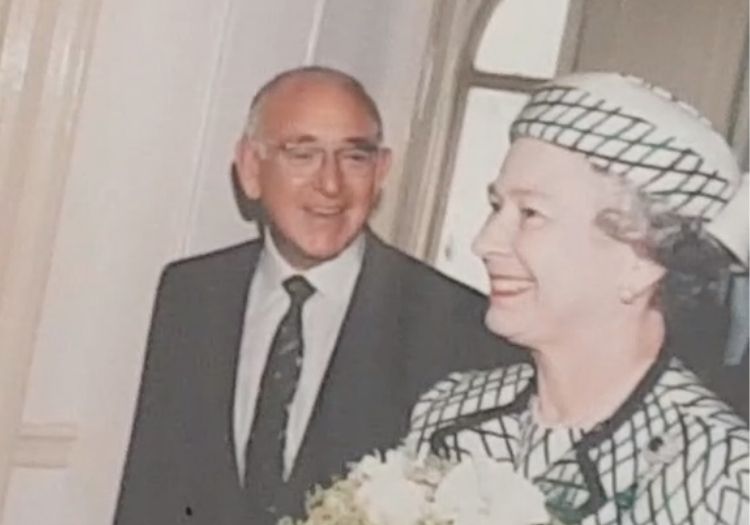
Bernie Coleman lived an incredible life. He passed away on Saturday, aged 97.
My maternal grandfather, Leonard, died two decades ago; I didn’t know him for long enough and that fact – given what I’m fortunate to do now and his lifelong passion for the game – has always saddened me.
Bernie was my mother’s godfather and, over the last 20 years, the final contemporary link to her dad – a friendship that began with a chance encounter on Tooting Bec Common shortly after the war, during which Bernie had served in the Royal Navy. There was a sense of poignancy, then, on the few occasions when we spoke in recent years: for, there was nothing more that Leonard would have wanted to do than talk cricket with his grandsons.
Together, they co-founded Castle Cricket Club, named after the pub that Bernie took over from his father. He later owned The Dog & Fox in Wimbledon Village, but he was far more than a publican: he was an entrepreneur and an innovator, who changed English sport as one of its great, understated administrators.
Not that Bernie would have wanted it any other way, but you probably don’t know his name. In a tribute on Surrey’s website, chairman Richard Thompson described him as “one of the true greats”. He was a member for 78 consecutive years. AFC Wimbledon’s send-off called him “the man who saved The Dons”. It is entirely possible that without him, neither club would exist today.
It is an inevitability of the world we live in, though, that the executives we remember are often those who’ve failed in their duties as responsible guardians. Bernie Coleman was one of the best, one of the most significant, one of the most dignified.
For a time, he held a stake in Crystal Palace. But when the club was sold, he refused to claim the money owed to him. “I was entitled to several million but I couldn’t take that,” he told me in 2017. “It would have been wrong. I never took money out of sport.”
Eventually, he agreed to take a third of his entitlement and used it to start a charitable trust, the proceeds of which went back into the game. He supported nearby charities and medical research, as well as funding coaching for young cricketers. Even this year, while housebound, he paid for 25 season tickets at AFC Wimbledon for local schoolchildren. Last week, he wrote a cheque to fund a Christmas party for a volunteer network set up during Covid by fans of the club across Merton, Wandsworth and Kingston.
Four years ago, when I was studying for a Masters in sports journalism, I went to meet him for a university video project at his flat overlooking the All England Club. For two hours, we sat and chatted. Or rather, I listened as he regaled me with the feats of his career. Because while his mobility had waned in his advancing years – I remember his initial reluctance to appear on camera – the sharpness of his mind and an extraordinary recall for the most vivid details of times-gone-by had remained. Belatedly, then, here is that interview.
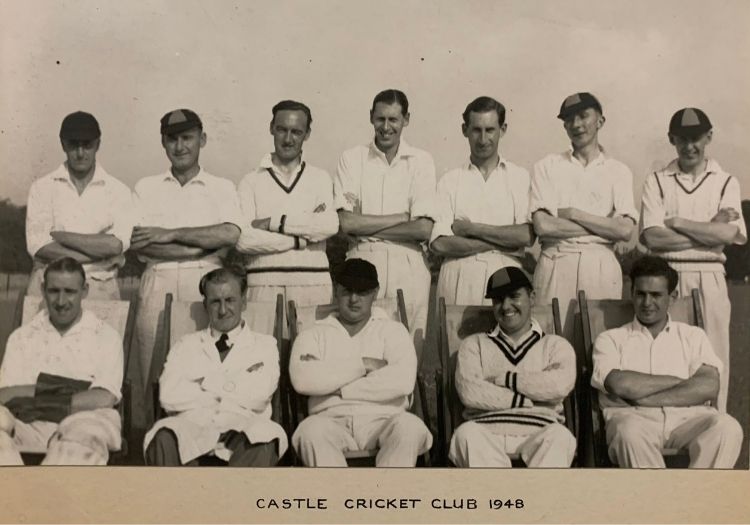
Castle Cricket Club: Bernie stands second from left, Leonard third from right
“There are thousands of stories,” he smiled. One of an encounter with the Krays’ associates, another of a tour to Rome, where he played at the Princess Doria Pamphili ground, overlooking the catacombs under the hills. “On the first day, we were playing the Rome clergy. We were going out to bat, and their opening bowler was coming up the hill. This fellow was wearing a cassock; he had cycled up on a bicycle and arrived at the ground in his full whites. He was a Geordie lad – they were a diverse team, the Rome clergy.”
There was another tour to France: “We played this game at the Parc des Princes, but first we went to the Eiffel Tower. They had got television cameras to come and cricket bats, and halfway up the Eiffel Tower they got us to whack oranges over the side. The midday paper came out and there were pictures of us. The match was in the early evening and there were about 20,000 people there. Before the match, the Paris Police Band were playing. We had the national anthems of both teams. We didn’t know why we were there!”
All became clear on the next day’s newsreels, however: the entire charade – the game and the confusion on the Eiffel Tower – had been designed for the launch of Cricket, a cigarette lighter brand.
“I’ve had a very good life, a very interesting life. And that’s all that matters really. I enjoy talking about it.” He was less keen on being credited in public, though, and was reticent to attend parties, even if he had developed an enormous list of famous contacts along the way.
Eventually, he became Surrey’s 31st president in 1991, meeting the Queen in the same year when she christened the Queen’s Gate behind the Bedser Stand. Thompson tells a lovely anecdote about that encounter: the pair chatted for two hours – twice as long as she had been due to stay, such was Bernie’s charming fascination. Twelve months earlier, he was awarded an OBE in the birthday honours for services to cricket and charity. Later in life, he watched England all over the world, spent winters in Australia and became a close friend of Richie Benaud.
“He cannot take compliments,” interjected Joyce, whom he married in secret at a registry office in Morden when both were in their 80s. She died last summer, but they had been a formidable team, running pubs – 12 at one stage – and restaurants together through South London until retiring from the business in 1989. She once issued an ultimatum to Buster Mottram, the former British No.1 tennis player; he had disrespected her waiting staff and she was having none of it. “Do that again and never come back,” she told him. “He never did it again.”
Of her husband, though, she added: “I get so angry with so many of these executives who have never done anything for some of the clubs they’ve been in. Bernie given a fortune – and I mean a fortune – to all of them. He has done so much for sport. Especially cricket, especially The Oval.
“The truth is, I love that man sitting there more than anything in this world.”
Bernie stopped her gently: “Oh, you’re prejudiced.” And just like that, he had proved her point.
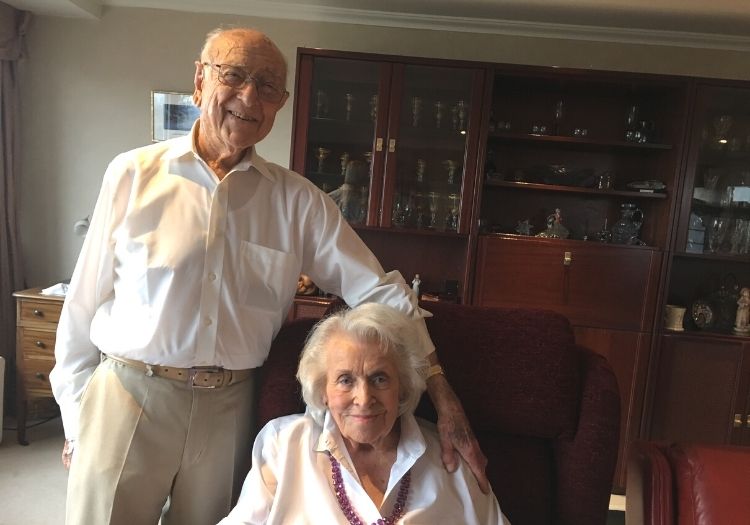
Bernie and Joyce, a formidable team who married in secret when both were in their 80s
I only watched back our conversation last night, amused by Joyce – ever the restaurateur – almost force-feeding me, her guest, with smoked salmon sandwiches as Bernie spoke.
He was always thinking of others, always thinking of how to look after his clubs. Cricket has much to thank him for. He was the publican who found himself on Surrey’s committee, brought onboard after helping to raise money for Alec Bedser’s benefit, and became the first real modern marketeer in the English game.
“In those days, club committees were very toffee-nosed,” he said. It was at the behest of senior players Stuart Surridge, Peter May and Alf Gove that he was enlisted as chair of an inaugural marketing committee, tasked with raising the funds to rebuild a derelict stadium.
“Everyone was skint, the whole game was skint, and it was run by these people who didn’t realise that the players were getting nothing. They were earning buttons.
“Gubby Allen was sitting in charge of cricket at Lord’s and they didn’t care. They were mostly Old Etonians and public schoolboys, and they never really cared. It was a bit ‘them’ and ‘us’. The amateurs came out of separate dressing rooms. They wanted me to find ways of raising money for the club. That’s how I started.”
From there, he broke new ground.
It was Bernie who secured the contract for The Foster’s Oval – among the first naming rights deals of its kind – through former Australia allrounder Bob Cowper and John Elliott, the Australian businessman and politician. Effectively, it paid for Surrey to knock down the Ladies’ Pavilion to construct the Bedser Stand, with an indoor school underneath.
Elliott was keen to launch the beer in London, and Bernie was unafraid of trying his luck.
He recalled: “I said to Elliott: ‘You wouldn’t think about lending us a million quid, would you? I see you’re launching Foster’s.’ He asked what he would get, and I said: ‘I could get you the naming rights on the ground.’ He said: ‘You couldn’t do that!’ And I just said: ‘Well, what if I could?’ He shook my hand and we were on.
“I went back to the committee and said that we could get this million if we named the ground the Foster’s Oval. They said: ‘We can’t have a brewer.’ But I said: ‘Across the river, there’s a ground called Lord’s.’ Now, Thomas Lord – amongst many things – was a wine merchant. So, if he could do it, then why couldn’t we use Foster’s? So, they had to agree to it. We got the first million but needed lots more. We went back to them and got another million and eventually we gutted the pavilion and lifted it. We got about four million quid out of Foster’s.”
Well beforehand, Bernie had already displayed his acumen. It was his creativity that saw the invention of perimeter advertising hoardings, realising their easy moneymaking potential for a club that at the time was strapped for cash. History was made. At a similar time, when the amateurs’ dressing room in the pavilion was no longer in use, he gave it a fresh coat of paint and turned it into a hospitality area. He sold it as a box for £500 through a contact at Excess Insurance, who received advertising space as part of the deal for the fifth Test of the 1972 Ashes series.
“At the Vauxhall End, there was a sign for Excess Insurance,” he said. “Gubby Allen walked into the dressing room with his cigarette holder; he looked up and saw this sign. ‘What’s that sign? We can’t have that.’ The chairman pointed him in my direction. I just said: ‘Mr Allen, that sign is £500. We are broke, so is everyone else in cricket.’ The following day I got a letter from Lord’s saying that this sign must go. We took no notice of it.
“The following year, a deal was done so that every Test match ground could have these signs.
“On one of the signs on one occasion, we had a company called Mikropul Ducon. Someone asked me what it was for, and I said I thought it was a Greek contraceptive. I thought nothing more of it, but later in the season Ian Wooldridge, the journalist, wrote a brilliant piece in the Daily Mail. He sent someone to a local chemist and did this fantastic article, and it turned out to be a sewerage firm! Ian was a lovely, lovely man.”
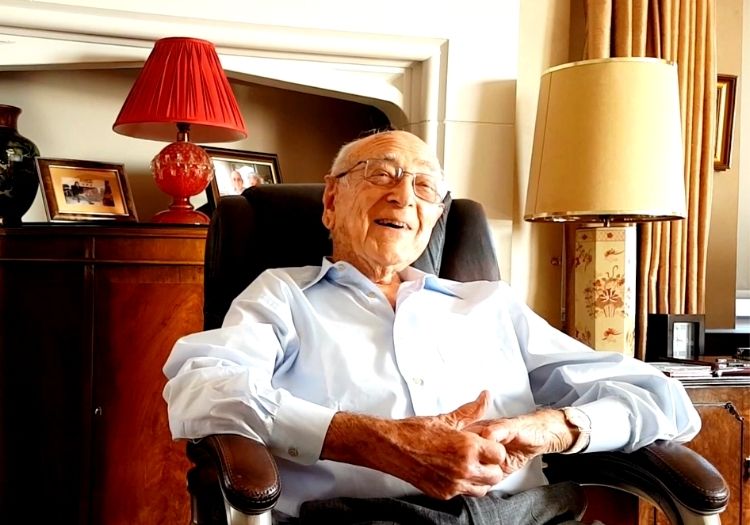
Bernie Coleman never lost his ability to tell the stories of his life
Bernie used The Oval’s position as the final Test of the summer as an additional bargaining chip: if companies wanted an advertising hoarding, this was their last chance of the season. The upshot? They made a killing.
There were plenty more examples of his ingenuity. It came naturally, you see: he was already running a pub in Kingston by the age of 15. When he returned from the war – his father very ill and his brother killed in the Royal Air Force – he took on another pub “that was as dead as a dodo”. He spent £20 on a piano, hired a player and turned the venue into a regular entertainment haunt.
“That wasn’t marketing,” he added, “but I was an entrepreneur.”
When Surrey wanted to build the Laker Lock Stand, he persuaded the club to introduce season-long seat reservations and boxes for the first time – sold at £100 and £5,000 each, respectively.
“With that, we didn’t have to spend a penny on building the stand,” he laughed. “And then, we’d got the Foster’s money. So, we’d raised a lot.”
And among the benefactors for the nets in the Ken Barrington Centre, then-Wolves chairman Sir Jack Hayward and Boris Karloff’s wife, Evie, gave £30,000 each.
“We just wheeled and dealed and sold. That’s how it went. That was the beginning.”
So, to Lord’s, where his friend Raman Subba Row, the former England batter who spent four years as Surrey’s chairman, persuaded him to head up a brand-new marketing team at the Test and County Cricket Board.
Early on, the chairman of the board complained to him about cricket’s lack of media coverage. His response? To allow photographers the freedom to roam at international games. Until then, newspapers had to rely on a single box camera essentially providing the same shot over and over again.
“I went back to the board and said: ‘We’re going to have cameramen in for Test matches.’ They said it was out of the question, but I got it through. We got frontpage pictures in The Times.”
Bernie spent much of that time taking on the BBC, frustrated by the lack of competition for cricket’s broadcast rights and the knockdown price that he felt they were able to pay through an absence of alternatives. He tried to partner with other national sporting bodies in an attempt to force change: “There was an unholy alliance between BBC and ITV that they never bid against one another.” He even campaigned to get coverage of Sunday League cricket on Channel Four, who were keen on the idea, but was thwarted when the BBC threatened to stop showing Test matches if the plan went ahead.
As such, it is little surprise that he sided with Kerry Packer over the legitimacy of Channel Nine’s bid to take the rights to Australian cricket from ABC.
“I couldn’t understand why all the other countries were brought into an internal affair for Australia,” he reflected on that episode. “The Test and County Cricket Board brought this case, but they should never even have been involved. It was so stupid. I went out to Australia, and I ended up with Packer in Sydney for their first floodlit match.”
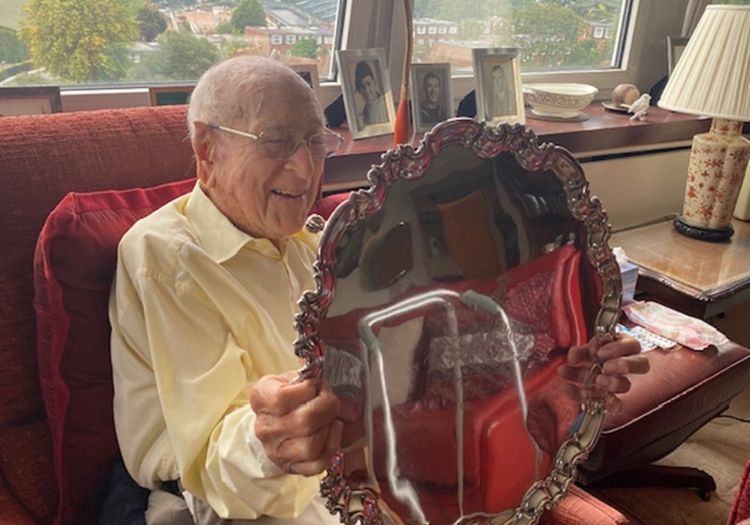
A photograph taken earlier this year, with Bernie admiring a salver presented to him in honour of his contribution to the Test and County Cricket Board (Surrey Club Archive)
Years later, he played a key part in perhaps the first major change that international cricket ever saw on British television, setting up the arrangement for Sky to carry England’s tour of the Caribbean in 1990 – the first time an overseas tour had been broadcast live back to the United Kingdom.
“I’d been trying to get Test cricket back from abroad for years,” he said. The plan involved a friendship with Wooldridge and his wife Sarah, a senior executive at IMG. Bernie asked her to speak to Mark McCormack on his behalf; McCormack, an American lawyer, IMG founder and bigtime sports agent, knew little of cricket but was interested, nonetheless.
“The next day, I got a phone call from Mark,” he recalled. “He sent two of his people to meet me at Lord’s, and we got it done. Nothing had ever come back live from any country before. We got the first live television back to England of a Test match from abroad. It was in Trinidad.”
And that success led indirectly to a seminal moment.
“BSkyB and Sky had just started. They were an absolute disaster and Sky had nothing to sell. They brought over a bloke, David Hill, who had worked for Kerry Packer on the cricket. I said to David: ‘There’s a new football thing – the Premier League is going to start. If you could get that, you’d have something to sell.’ The following morning, he called me and asked for more information. We arranged to meet Rupert Murdoch.
“Sky outbid ITV and got it. There is a letter somewhere from David Hill to Ron Noades (then Crystal Palace’s owner), and he put at the bottom: ‘Give my kindest regards to the legendary Bernie Coleman.’ I will always remember that bit.”
That word came with a slight self-effacing grimace. As Thompson wrote on Sunday: “Never wanting the limelight or attention, he just wanted to help in any way he could.”
This was just as true at Wimbledon, a football club he took on in some of its bleakest hours, purely out of a sense of duty to a community institution, having worked in the village.
He never claimed to know anything about how to run a football club, but he took their supporters’ club building, turned it into a pub and paid them a rent for it to provide a much-needed cashflow. When those dire straits came round again, he gave them money to keep the club going and became president, taking over the shares from Cyril Black, the Conservative former MP for Wimbledon.
“I didn’t want to, but I said I would if it was going to help them,” Bernie smiled. That was his nature. He gave the pub back to the club so they could take its income directly, and in 1974 Allen Batsford was hired as manager. Three years later, a fairytale journey to the Football League was complete. When he sold the club to Noades, who kept him on as president before enlisting his help in the takeover of Crystal Palace, he insisted on doing so for £2,971 – the same figure he had paid. The only condition of the deal was that Noades must not sell the ground. Earlier, QPR owner Jim Gregory had offered him £30,000 – only, he wanted the club to become little more than a training ground for his existing team. “I just couldn’t accept that.”
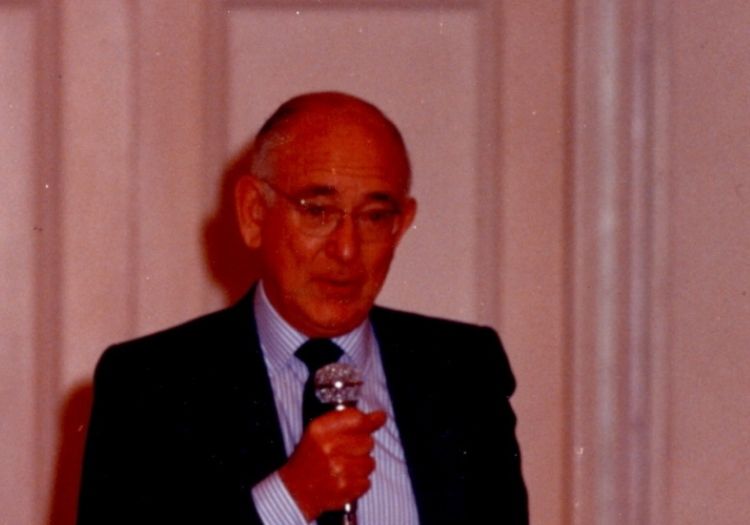
Bernie Coleman died on Saturday at the age of 97 (Surrey Club Archive)
Simply, it was never about the money, but rather those – “a wonderful core of local people”, as he described the AFC Wimbledon supporters who rebuilt their club following the MK Dons controversy – he felt privileged to be representing.
“And now, all these players are millionaires,” he said, reflecting on today’s sporting landscape. “That’s the world, isn’t it? The pendulum has swung too far the other way, in my opinion. All you read now is how much these people are worth. But do they enjoy their life? That is all that matters.”
When we spoke on the phone during last year’s lockdown, he commented on today’s tendency for quote-led journalism, explaining how he preferred to read the thoughts of the writer on their subject. I’ll grant him that wish here: Bernie Coleman was an exceptional, selfless man whose impact we still see today. Sport has much to thank him for. Closer to home, so does my family, for almost 80 years’ friendship.
He would end phone calls with the line: “If I don’t pick up next time, you’ll know why.”
That time has come, and the world is poorer.

Welcome to www.thecricketer.com - the online home of the world’s oldest cricket magazine. Breaking news, interviews, opinion and cricket goodness from every corner of our beautiful sport, from village green to national arena.