
NICK FRIEND: Part-time fly-half, part-time opening bowler, Rudie van Vuuren juggled a career as a medical doctor and is now one of Namibia's leading conservationists. Yet, almost two decades on, an unusual record remains his own
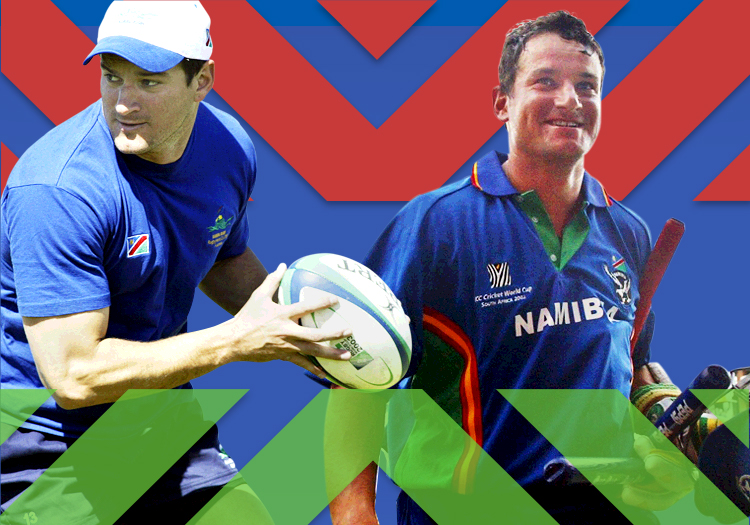
In 2003, Rudie van Vuuren became the first man to take part in the World Cups of both cricket and rugby in the same year. Nobody had done so before him, and none have matched his feat since.
There was a five-wicket haul against England and the scalp of Sachin Tendulkar and yet, they sit almost as footnotes in the remarkable existence of a Namibian, whose mission since the end of his sporting journey has been to ensure the preservation of his country’s animal kingdom.
“I wake up every morning with the sound of a lion roaring, and I go to sleep with the sound of a lion roaring,” he explains.
It is a sacred image that he refuses to take for granted; it is why he does what he does.
The 47-year-old paints an extraordinary picture of life at his wildlife sanctuary home outside Windhoek, just one strand of the Naankuse Foundation he first set up with his wife, Marlice, back in 2006.
It represents a single branch of a far wider conservation operation; what began as a solitary project has blossomed into much more. The organisation takes its name from the ancient language of the San Bushmen – it means ‘God will protect us’, and it has committed itself – and van Vuuren himself – to fighting against the real peril of endangerment.
Angelina Jolie is among those to have forged a close bond with their work; they offer a home to orphaned and injured animals, while a separate clinic exists for the wellbeing of the San people, believed to be Africa’s oldest tribe.
“I’m very privileged to live the life I live,” van Vuuren reflects. “It’s incredible; my children live on a farm, they grow up on a farm, they don’t wear shoes, they speak the ancient San language.
“I’m very privileged in that sense. Every day that I’m outside, in the bush and in nature, I just realise how incredibly privileged we are. I have an absolute love for it.
“But every day I spend outside, I also realise that I have to make a difference. It’s so precious that every day I think about how I can keep protecting this, how I can keep this intact for my children.
“It’s a double-edged sword – on the one hand, it’s just incredible being involved in what we do, but on the other side, we know that there’s a real threat. We have to work incredibly hard to keep it intact.
“Our main work is in the mitigation of human-wildlife conflict. In our country, there are all these things like poaching and the killing of cheetahs by farmers. Lions, leopards, rhinos – those are the animals that we work with.” Funding comes from a variety of partners, donors and an eco-tourism business that van Vuuren runs alongside the sanctuary.
There are layers to every living organism, unique aspects that make each human being who they are. Few, however, can have accomplished as much as van Vuuren – an expert in two industries, an international athlete in two more; the holder of an untouched – and perhaps untouchable – record.
In 2003, he followed a Cricket World Cup bow with a place in his country’s squad at the Rugby World Cup months later. It is a curious set of circumstances that renders him an outlier among all others.
Part-time fly-half, part-time opening bowler, he juggled a full-time career as a medical doctor: twin passions – for sport and for saving lives. He has served as the personal physician to Namibia’s president.
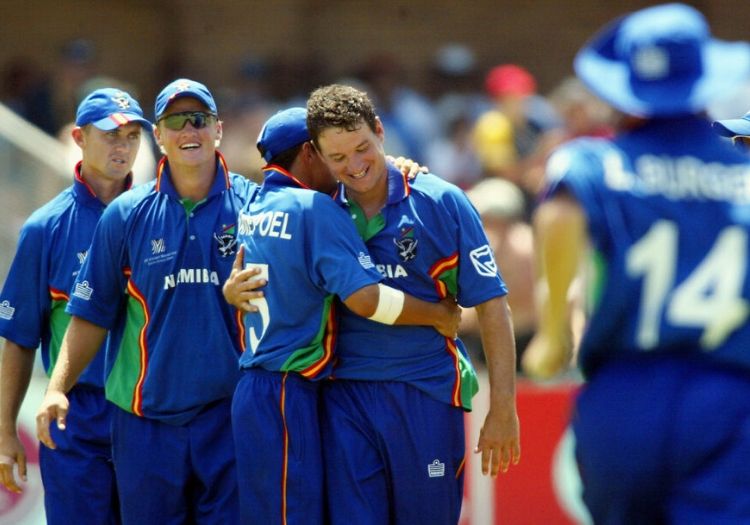
Rudie van Vuuren dismissed Michael Vaughan, Sachin Tendulkar and Virender Sehwag at the 2003 Cricket World Cup
“If you look back now, it was fantastic,” he laughs. In the context of his present endeavours, he is reflecting on a different world, a time in his life for which he remains immensely grateful.
“I didn’t really realise that playing in a Rugby World Cup and a Cricket World Cup was such a big thing until somebody picked up on it, that it had never been done before.
“I had the opportunity to play against England, I had the chance to play against India and the best players in the world – Sachin Tendulkar, Adam Gilchrist, Michael Vaughan. That was an awesome experience for us.”
An injury picked up on the eve of Namibia’s first game of the rugby equivalent against Argentina ruled him out of much of the tournament, but he would return for their final game, coming on as a replacement against Romania.
“For seven years, I had played rugby and cricket non-stop for Namibia, so that injury had to come,” he chuckles.
It did, at least, mean that he missed the humiliation of a 142-point loss against Australia – a result that still stands to this day as the greatest margin of defeat in Rugby World Cup history.
In van Vuuren’s shoes, however, the truth is that the result never truly mattered. He was an amateur athlete in a professional’s world. His weight would alter by five kilograms season-on-season as he sought to transform the body of a nagging medium-pacer into the physique of a rugby player, readying himself for a battle of muscle and body mass.
The African Cheetahs a natural home range of 1390 SQ KM. Due to fencing, many now have less than 20 SQ KM from which to hunt. Cheetah human conflict mitigation is a complex process but the main aim of cheetah conservation remains the protection of habitat. #wild4wild #naankuse pic.twitter.com/yORCrxJOLH
— Naankuse Collection (@Naankuse) November 20, 2018
He took eight wickets during Namibia’s month at cricket’s top table; it remains, to date, the only time that they have made it to the 50-over showpiece.
Among his prize scalps were Tendulkar, Virender Sehwag and Michael Vaughan; 16 years on, he cannot help but laugh at its absurdity – the doctor with the low, slingy action, who became a leading conservationist, sharing an oval with some of the game’s all-time greats.
“Taking Tendulkar’s wicket was amazing,” he recalls. He had almost dismissed him early on in his innings, only for the Indian icon to escape an early scare en route to 152, before losing his middle stump to van Vuuren’s medium pace.
“There were a couple of things that stood out,” he reminisces. “I remember going out to bat against Pakistan. We were something like 42 for 9; the world record at that stage was 53 for the lowest total ever. Our team manager just said to me: ‘Doc, please just keep us out of the record books’.
He recalls facing Shoaib Akhtar, Wasim Akram, Waqar Younis and Saqlain Mushtaq as he survived against one of the great international bowling cartels. Namibia would finally be bowled out for 84.
“I was having a go at these Pakistan bowlers – I was chirping Shoaib Akhtar and Waqar. Shoaib was bowling 161kph in that game.”
Against England, the African underdogs lost by just 55 runs. For van Vuuren, it would be the scene of his finest hour; he took five wickets, including those of Vaughan and Nick Knight.
“I remember bowling a ball to Michael Vaughan that he tried to pull; he pulled it to midwicket and got caught,” he says. “As he walked past me, I just said: ‘Michael, it’s much slower than it looks.’ I could see him just smiling.”
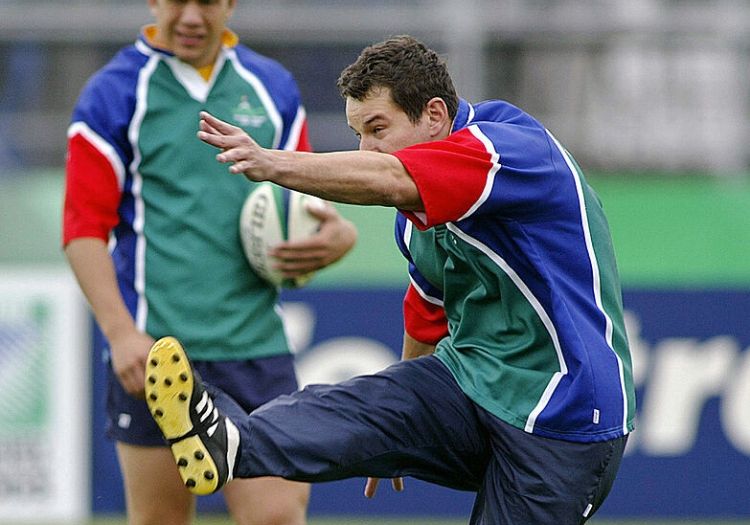
Van Vuuren picked up an injury that almost forced him to miss the Rugby World Cup
With the bat, Van Vuuren struck the final ball of the match – bowled by James Anderson – for six. He proudly recounts that particular nugget. “I was batting with my roommate and I said to him that I wanted to face the last ball of the game,” he adds. “I hit him straight back over his head.”
There is a genuine emotion to the voice of this man of many talents as he looks back on a sporting career born out of an unflinching determination and a desire to represent his country.
Having witnessed first-hand the impact of international sport on his own livelihood, the dearth of openings afforded to those beneath the traditional status quo saddens him. His story is a reminder of the romanticism of a truly global World Cup – one that is truly open to the world.
Thus, he carries a robust frustration at the way in which associate cricket has been sidelined in the years since his golden summer.
Namibia’s qualification for next year’s Men’s T20 World Cup – it will be their first – is a tale that, perhaps, has gone under the radar in the wider context of the qualifying tournament. Yet, it is a heart-warming return for a nation that can truly benefit from its cricket team.
“If we want to grow this great game globally, we need to produce local superstars,” van Vuuren explains. He is back involved with the national cricketing body after a while away from the setup.
“That World Cup made superstars out of some of us because we came back and people started recognising some of us, people started wanting to be a cricket player for Namibia because they could go to a World Cup.
“In a third-world country like Namibia, that’s a career opportunity. Think about what happens if you can go to a World Cup and somebody sees you and you end up having the chance to play in the IPL or whatever.
“It’s incredibly important that we do put these players on the world stage. It’s incredible that it’s being televised now. In Namibia, the whole nation is talking about the cricket team and that is how we have to grow the game globally.
“I still feel as though I owe a lot to cricket. It was a game that took me all around the world and it gave me the opportunity to see the world. I would never have had that opportunity; I didn’t come from a very rich background, so I wouldn’t have seen the world if it was not for sport.”
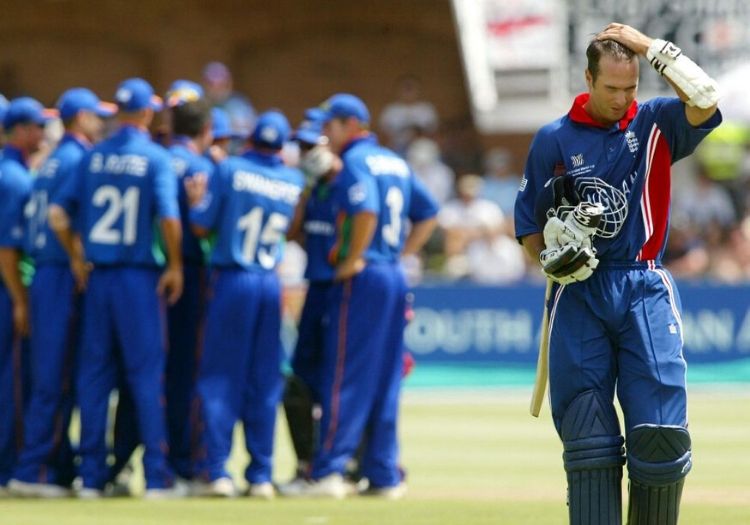
The Namibian dismissed Vaughan on his way to a five-wicket haul against England
Indeed, he even traces his marriage and, by extension, his second career in conservationism, back to a piece of fortune made possible by his sporting exploits.
During his time doing the hospital rounds, he came across his then-teammate Schalk van der Merwe, a flanker, being treated for a leg problem. Van der Merwe asked van Vuuren if he would take his sister on a date. “He said: ‘I’ll pay you for that. I’ll give you a cow and a calf,’” van Vuuren recalls with a bemused chuckle.
The rest, as they say, is history. Van der Merwe, then just a teammate, is now his brother-in-law. “Marlice grew up on a wildlife sanctuary in Namibia, while I always loved nature,” van Vuuren adds. “I grew up on a farm and that just sparked the whole conservation thing. The fact that I played rugby actually brought me to my wife and eventually to what we’re doing now.”
Looking back, he reckons he was a rugby player first, before his passion for cricket truly sprouted. He namechecks Bob Woolmer, Gary Kirsten and Eric Simons – a trio of coaches who paved the way for his own knowledge and understanding of the game to grow.
“I always viewed cricket more as an English kind of sport, but I loved playing it,” he says. “But by the time I had retired, I must say my love for cricket was a little bit more than rugby.”
And ultimately, that was what it was all about. As van Vuuren opens up on his past existence – one in a different stratosphere to the extraordinary, crucial work for which he lives now, he exudes a thrilling joy at all he was able to achieve.
“At that time, you never thought of money,” he stresses. “We were semi-professionals, we got paid a little bit. But it was just an absolute privilege to play against the best players in the world.
“If I look back now, I obviously wish I could have been exposed to it earlier in my life, but the memories I have from it are incredible. I have learnt so much from sport in what I do today. It’s all about discipline.
“That discipline has taught me a lot in life. Even now, I exercise every day because I was so used to exercising day in, day out, just to play for seven years at the top level.
“Looking back at it, I think today it would be impossible in the total professional era that we’re in to be a doctor, to be a cricketer and to be a rugby player at the top level. It would not be possible. I’m just incredibly grateful that I had that opportunity.”
Now, he holds a different ambition – his vision of an Africa where humans and wildlife can live and thrive together.

Welcome to www.thecricketer.com - the online home of the world’s oldest cricket magazine. Breaking news, interviews, opinion and cricket goodness from every corner of our beautiful sport, from village green to national arena.