
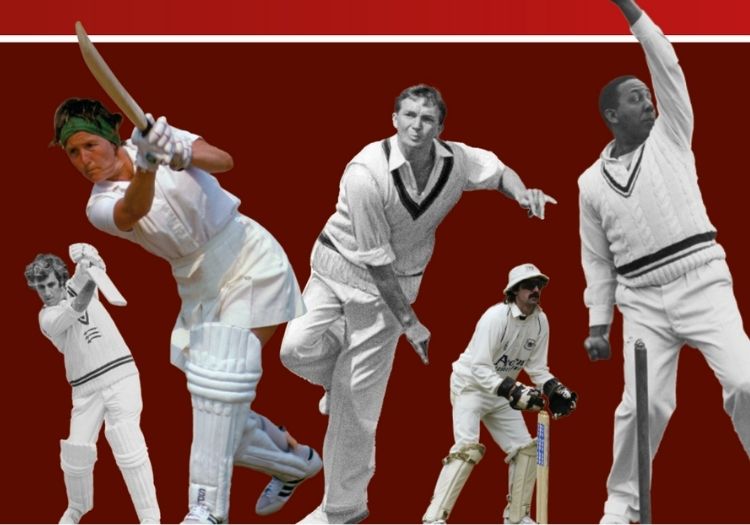
"Warwick Armstrong would be chosen to represent the World against Mars," declared the first issue of this magazine. Thomas Blow selects a best XI from a century of contributors to take on the Red Planet
1. Colin Cowdrey
The first man to play a hundred Tests explained the art of batting on tricky surfaces in his June 3 1966 column: Experience teaches you to play a difficult innings one ball at a time. It is so easy to be overwhelmed in the face of a good bowler exploiting helpful conditions. How I know the awful moment when you feel like giving up the ghost after being beaten all ends up, time and time again early in an innings. This calls for resolution and to think in simple basic terms. A restricted back-lift, with a view to playing down the line of the stumps will help to simplify things. Watch the ball on to the bat with great care yet be prepared to hit the loose ball hard. You will be surprised how a few overs of severe application can suddenly develop confidence.
2. Jack Hobbs
First-class cricket’s leading run-scorer recalled a famous tale involving an old recreational player in the 1921–22 Winter Annual: A cricket match on the village green was in progress, and a “too old” man was batting. A ball was delivered; there was a decided ‘click’; and as the wicketkeeper took the ball a shout went up, “How’s that?” “Out!” said the umpire. The batsman protested that he had not touched the ball, but the whole field, except the wicketkeeper, insisted that they had heard the ‘click’. “You’re all wrong,” said the stumper. “He didn’t go within six inches of the ball. What you heard was the creaking of his joints. It happens every time he moves!”
3. Don Bradman
The Don wrote for The Cricketer many times, penning the following on the hundredth anniversary of Test cricket in the March 1977 issue: What cricket lover could fail to be impressed by the unhurried technical batting skill of Hobbs and Hutton; the unpredictable and exciting genius of Compton; the grace and elegance of Woolley; and the sheer majestic grandeur of Hammond? Who could hope to see wicketkeeping better than Oldfield, Tallon or Evans at their best? Fieldsmen like Chapman and Lock were electrifying; medium-pace bowling beyond compare was shown by Tate and Bedser… My great hope is that the traditions of the past may prove an inspiration to coming generations, and that when the history of the next century comes to be written, it will be no less enthralling than the one just ended.
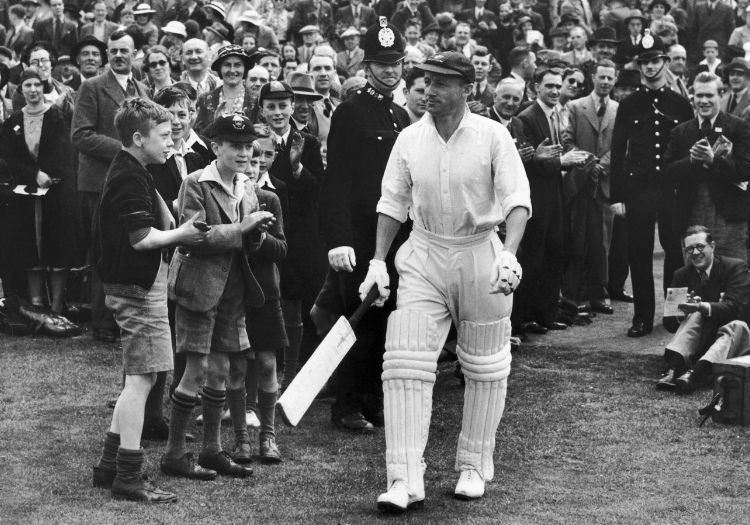
The Don
4. Nasser Hussain
The former England skipper was asked in his Ask Nasser column in the October 2019 issue for his favourite moment of the summer: I’d have to go for the World Cup final. It was the culmination of all that hard work by Trevor Bayliss, Eoin Morgan and his squad. Somebody had said to me, wouldn’t it be great if Jos Buttler needed to hit the last ball for four to win it? And as it turned out it wasn’t far off that, with the Super Over and the chaos that came with that. Brilliant!
5. Rachael Heyhoe Flint
England’s 1973 World Cup-winning captain regularly wrote a column on the women’s game, penning the following report on Young England’s tour of India in the May 1981 issue: The fifth Test was scheduled for the northern city of Jammu; when the English manager Anne Sanders (a former England player) saw the venue she refused to let her side take the field. It emerged that a military parade had taken place on the ground two weeks previously and not only did soldiers parade up and down in all their glory but a convoy of tanks trundled back and forth across the turf which not surprisingly made it extremely uneven! The 50,000 crowd that turned up to watch were angered by the abandonment; a small section rioted and burnt down the gates.
Jack Russell
6. Mike Brearley (captain)
Brearley was yet to make his final comeback to the England captaincy when he penned this analysis of David Gower in the June 1980 issue: When David Gower scored 98 not out in the Sydney Test of our winter tour, more than one critic labelled the innings the best he had ever seen. Yet, a matter of days later, after a dreadful stroke brough his dismissal at Melbourne, Gower was widely condemned as an irresponsible young man who ought to be taught a lesson. Together, these episodes provide illustrations of unfortunate, exaggerations in both praise and criticism… Gower, it must be accepted, plays in a fashion which demands he takes more risks than, for instance, a batsman of Geoffrey Boycott’s style. Yet people expect him to retain his ability to hit the good ball for four with attractive disdain, and at the same time minimise the element of chance.
7. Trevor Bailey
One of England’s finest allrounders (and radio commentators) was paid by us in crates of claret. Here he gave his verdict on the quality of English bowling in the November 1984 issue: The disappointing performances by our national XI in recent years simply underline that we are short of Test class cricketers, which is the direct result of the low standard of so much of the bowling in first-class cricket at the present time. If one excludes the overseas players, the current county attacks are weaker than at any time since immediately after the war, when, though short of pace, seam and swing, every club possessed at least one spinner who could be relied upon to capture over 100 wickets in a season.
8. Richie Benaud
One of The Cricketer’s most illustrious columnists praised a young Geoffrey Boycott in the September 11 1964 issue: I am certain that Boycott will make plenty of runs in Test matches in future years. His determination and application are clearly visible, but I was amused to read that the Australians are responsible for him developing a hunger for runs. The theme of this piece was that Boycott after Manchester [Boycott scored 58 of England’s 611 runs] was determined that when he got the chance to make runs against Australia, he would never throw his innings away. Perhaps I am a trifle cynical, but I must confess to having a had a good chuckle at this one.
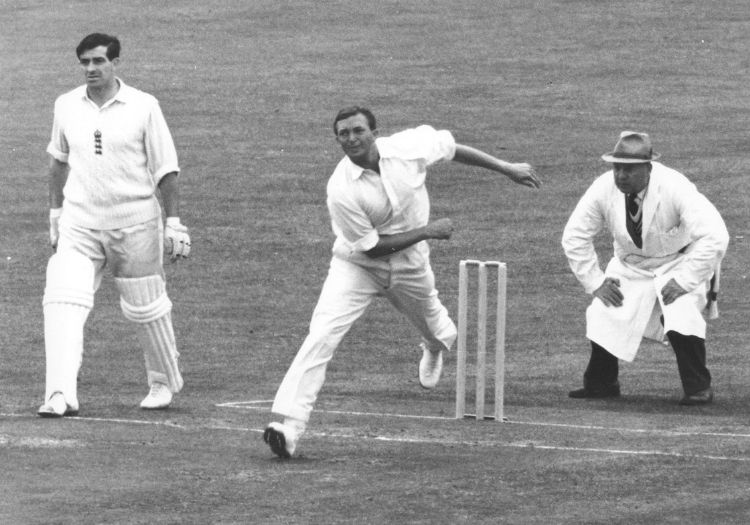
The great, Richie Benaud
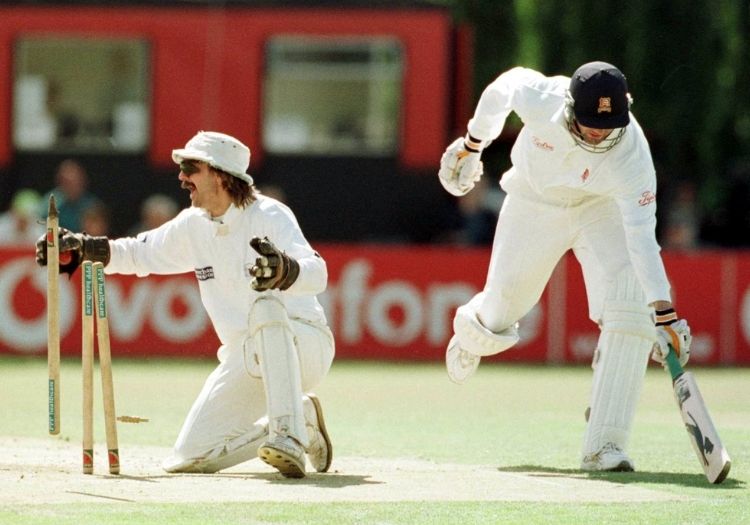
9. Jack Russell (wicketkeeper)
The former England gloveman has been a regular in recent years, remembering his and Mike Atherton’s Johannesburg 1995/96 exploits in the January 2020 issue: I thought, “Right, somebody needs to pull their finger out and help Athers”. Donald threw the kitchen sink at us. I was nearly caught and I vowed to make that count. Athers was an inspiration. I kept reminding him of Barbados 1990, when I’d been caught at 5.15 and we lost with 15 minutes left. Afterwards he said: “Hold on, I didn’t even play that Test!”
10. Learie Constantine
Adding some much-needed pace (and overseas flavour) to the attack is Constantine, who penned the following tribute to his friend Wally Hammond in the June 30 1965 issue: There are many stories told and known about Wally, but what I admired most was his friendliness and his determination never to refuse a challenge… History will keep his deeds and his name for ever before us and those who follow us; but those of us who were fortunate enough to have watched him and played against him will always remember him.
11. Maurice Tate
The accidental pace bowler explained how he discovered his ability to produce a quicker ball in the 1927/28 Annual: It was during the Eastbourne cricket week, 1921, that I first discovered that I could make the ball come very fast off the wicket, and I had been bowling to that great player, Philip Mead, for some considerable time when I tried a faster ball, and this particular delivery made great haste off the pitch and clean bowled Mead. It was not my run-up to the wicket which produced extra pace, but a last-minute body action, which a lot of rising bowlers lack today.
This article was published in the April edition of The Cricketer - the home of the best cricket analysis and commentary, covering the international, county, women's and amateur game