
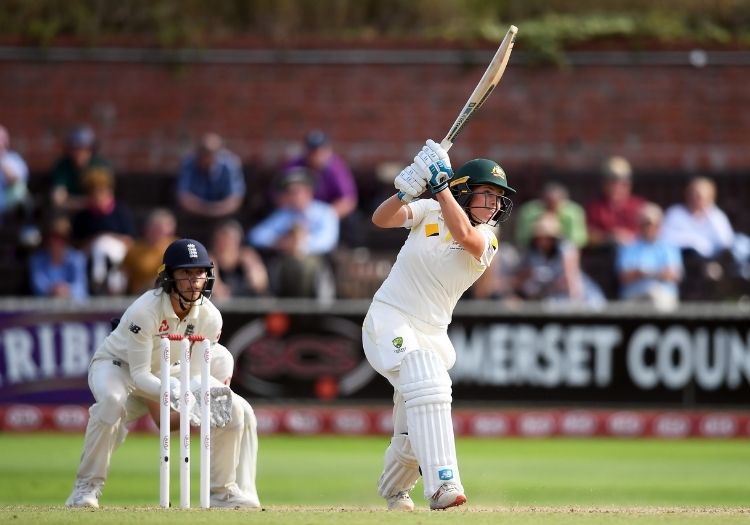
TANYA ALDRED: Making young women comfortable playing the game seems a more than fair swap for the loss of Victorian notions of purity
Close your eyes for a moment and picture a cricket match. What do you see? Verdant grass? Forget-me-not sky? Deckchairs round the boundary? The pavilion. A dog – probably a collie – phlegmatic, old. And the players. Look harder – what are they wearing? Whites of course!
That association between cricket and white flannels is hard-grained, instant. The white-clad figures on the green grass are aesthetically pleasing too, the colours of summer: daisies in a field, cow parsley on the roadside.
Frederick Gale, a 19th century writer who played a couple of first-class games and aptly went by the nom de plume ‘Old Buffer’ summed up these romantic notions.
“White is the colour for the cricket field, so put on your white flannel suit. And you shall have a piece of dandyism if you wear a straw hat and you may wear a band ribbon, provided it is a good ribbon… And your straw hat must be good and shapely, and not fit your head like a beefsteak pudding.”
And yet. Cricketers only started wearing white towards the end of the 19th century. Before that, players threw on their own clothes, waistcoats and top hats for the upper-class gents, something more earthy for the agricultural workers. In John Ritchie’s 1855 oil painting Village Cricket, there is not a pair of whites to be seen, though there is a weary-looking horse and some chilly spectators. Club colours began to appear with the establishment of I Zingari, and MCC’s first uniform was azure blue.
Why is this important? To illustrate that cricket and white clothing haven’t always gone hand in hand, it was more a whim of the late Victorians, who, as the fashion for bustles and huge leg of mutton sleeves showed, were oddly far-fetched when it came to matters of dress.
The backstop: Unhappy Streak's sorrowful tale
Whites look lovely, work well against the red ball, and reflect heat (not usually a problem in the UK unless you’re playing a Test at Lord’s in high summer) but are hugely impractical. They show up every grass stain, every mud slide, every bit of polish from the red ball. They are particularly inappropriate for teenage girls who, as well as having to navigate their own changing bodies, often have irregular and heavy periods. I’ve never yet met a woman who would choose to wear white trousers when she has her period, yet many cricket clubs still unthinkingly expect young women to wear them for an afternoon’s sport, running around on a cricket field, bending down in the slips.
There isn’t actually any ruling from the ECB that says cricket clubs should wear white. In fact, in higher level women’s cricket, the players spend virtually all their time in coloured clothes hitting a white ball. The one-off Test against India that – Covid permitting – is due to take place this summer will be the first time England captain Heather Knight has worn whites for two years. When the counties moved to white-ball cricket a few years ago, most chose to play in black trousers, because that is what the players wanted. Lots of clubs, at least in their T20 competitions, and district sides have already made that move. Wiltshire girls are one of many that play in black leggings. But not every club and league has yet made the switch.
Other sports have also been slow to make what seems a simple decision. Scotland and Leicester City footballer Sophie Howard told The Athletic that “white shorts are just not made for
female football players”. Despite that 10 of the 13 clubs that have played in the Women’s Super League in the last few seasons have worn white shorts as part of their home kits.
Australian netball is addressing a different but similar issue, having insisted for years that girls wear sleeveless dresses to play even in freezing sports halls. The issue there is a desire to preserve a kind of old-fashioned idea of femininity, something that was in fact putting off many of the players they were trying to attract. Cricket ditched skirts more than 20 years ago; calling time on white trousers is a much easier decision.
Making young women comfortable playing the game seems a more than fair swap for the loss of Victorian notions of purity.
This article was published in the May edition of The Cricketer - the home of the best cricket analysis and commentary, covering the international, county, women's and amateur game