
NICK HOWSON: The captain could have thrown grenades the way of the BCCI and ICC. But instead, he suggested ways his side and the game can grow in a measured response to one of the most damaging defeats of his tenure


India v England: 3rd Test scorecard
India complete 10-wicket win in Ahmedabad
Two-day shambles and Axar better late than never ... TEST MATCH TALKING POINTS
Lesser leaders would have sharpened their tongues, shined their armour and turned the siege mentality up to 11. But Joe Root refused to come out swinging. This was not the Churchillian response a sector of England supporters may have desired after a damaging defeat to India in Ahmedabad when there was seemingly plenty of people to blame, but it was a reasoned insight into one of the most damaging defeats of his tenure.
There is no disgrace in losing to India, who are now bound for the World Test Championship final. Nor is it humiliating being dominated by Rohit Sharma and Ravichandran Ashwin, both remarkable players in their own right.
Mustering 193 across both of their innings cannot be justified, of course, but the tourists went down to probing bowling, a "day eight" pitch as Rob Key has described and a pink ball which acted as a vector of destruction.
When Sir Alastair Cook, who captained the last international team to beat India in a series and averaged 53.13 in Asia, is left totally perplexed by conditions it is ok to feel helpless.
He said on Channel 4: "I've sat here today thinking how would I have played Ashwin today? I couldn't work out a gameplan on that wicket, against the pink ball, to be successful for a long period of time."

His successor as the England Test skipper was unwilling to go down a similar route. For some, this would be an opportunity to rant and rave, throw verbal grenades the way of the ground staff, the BCCI, a passive ICC and even some of his own players.
Instead, the shortest Test since 1935 and lowest-scoring in the sub-continent presents an opportunity for reflection. And that begins at home.
ECB chiefs Ian Watmore and Tom Harrison were both in attendance in Ahmedabad, and head an organisation that dock points for counties who prepare pitches that spin. Root clearly feels England's toils run deeper than what unfolded over their two bites of the cherry.
"I look at county cricket and if I'm being honest if we're going to have to make serious progress going forward we need to play on better wickets more consistently," he said.
"Sides need to get used to scoring 400-500 runs, so batsmen get used to really big hundreds and get used to dealing with scoreboard pressure batting second which in turn allows spinners to bowl and brings them in the game.
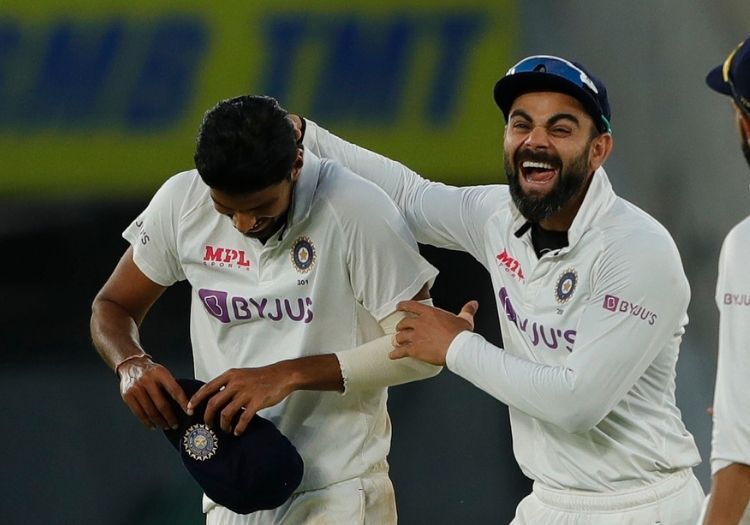
India swung the match back in their favour in the third innings
"You can't ask seamers to bowl 20 overs and get 4-30 or whatever. That is something we need to look at.
"Every now and again coming across a wicket like that will open peoples eyes and give them an experience and every now and again expect on a rare occasion to have to deal with a surface quite challenging."
India cannot expect any action from the ICC which would affect their hopes of qualifying for the WTC final, as per the governing bodies' own rules. Australia were given a four-point penalty for their slow over-rate in Melbourne last year but unfit pitches do not impact the host nation.
The ICC's regulations state that a surface can be deemed poor if "the pitch offers excessive assistance to spin bowlers, especially early in the match". But any action will be against the Narendra Modi Stadium, rather than the team.
"This surface is a very difficult one, a very challenging one and it is not for players to decide whether it is fit for purpose or not," explained Root. "That's for the ICC.
"As players, we have to encounter what is in front of us as best we can. Whether it is fit for purpose is more a question for the ICC than a player."
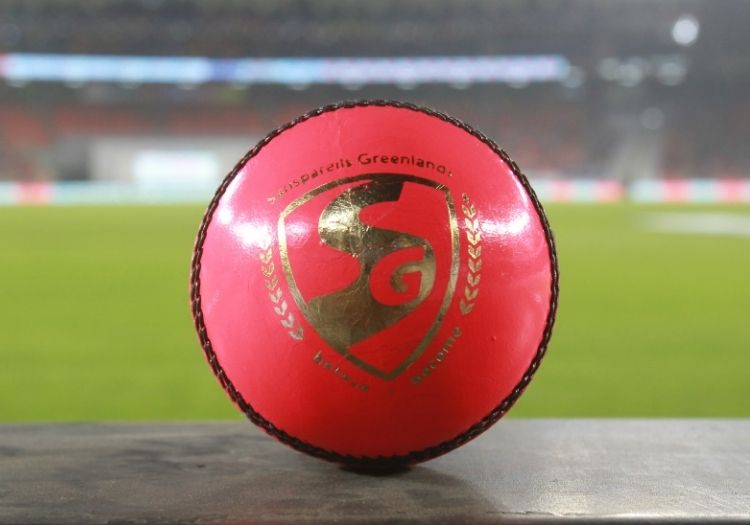
Few teams have mastered the pink ball
The idea of a pink-ball day-night Test coming in the middle of this series was a fascinating dynamic to introduce to an intriguing series. But it is leading to some bizarre cricket. Six completed innings have ended with double-figure scores, another 16 haven't been above 200. Six have been won by an innings. And there have only been 16 Tests under these conditions.
While 28 out of 30 dismissals falling to spin isn't out of the ordinary in Asia, it is perhaps surprising that 21 were from straight deliveries. Often it was about the balls that didn't spin as the ones that did, as the ball applied with an extra plastic lacquer leapt off the pitch.
"The ball had a big factor," Root explained. "The plastic coating compared to the red SG meant that it gathered pace off the wicket.
"If it didn't hit the seam it almost gathered pace and a lot of the dismissals for both teams were due to be beaten by pace not necessarily on the inside.
"If you look back at the replays the batsmen end up in the right position and would have covered the ball.
"But the nature of it gathering pace off the wicket played a big part in things and credit to Axar in particular who utilised that and exploited that well. He made it very challenging."
Images courtesy of BCCI

Welcome to www.thecricketer.com - the online home of the world’s oldest cricket magazine. Breaking news, interviews, opinion and cricket goodness from every corner of our beautiful sport, from village green to national arena.