
NICK FRIEND AT LEICESTER: It was fitting that Lea Tahuhu should put an end to any lingering doubts, swinging away three fours and a six that bore plenty of the same authority as her devastating spell with the ball
Leicester: England 178, New Zealand 181-7 - New Zealand win by three wickets
England woke up this morning to the news that Australia had made mincemeat of India, having gone to bed on the development that they would no longer be touring Pakistan at the end of the month. With a World Cup on the horizon and the three ODIs stitched onto the back of that historic proposed trip consigned to the scrapheap, that tournament has just inched a little bit nearer.
Plenty can change in the next five 50-over games – two against New Zealand and three as part of the Women’s Ashes – before the defence of their 2017 crown gets underway, but as it stands it will come around with a batting line-up searching for its very best form.
Lisa Keightley and Heather Knight appear to know the core of their preferred team, but they might be concerned by a pattern that has emerged over time: it was December 12, 2019, when England last batted through their full allocation. Of course, that figure is blurred by the circumstances of a pandemic that meant England went 716 days without playing an ODI, but it remains a growing trend ahead of a global competition.
They have batted first on five occasions since making 327 for 4 in Kuala Lumpur against Pakistan, losing the toss in four of those, failing to pass 241 in the same timeframe and being bowled out in every one. This was their lowest total of the set and, like at Worcester just two days ago, that it was ultimately competitive was a consequence of the work of the lower order, who bailed out the top six through a tenth-wicket partnership between Danni Wyatt and Tash Farrant on Sunday.
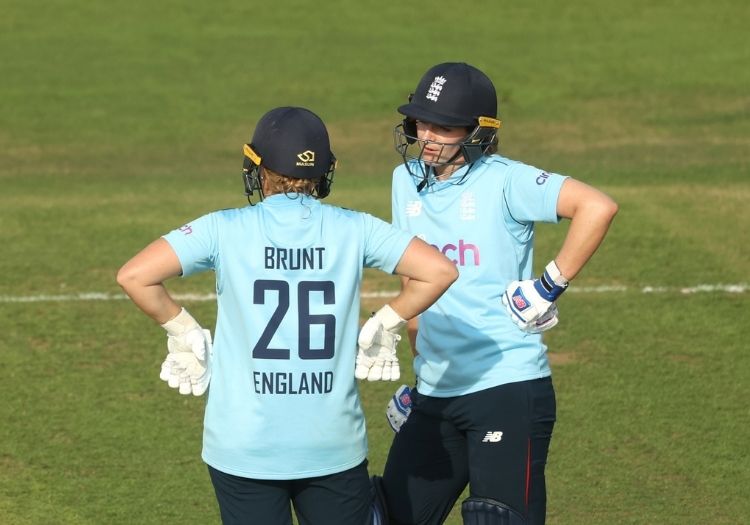
That theme was reprised at Leicester on an excellent surface with a rapid outfield, where Lea Tahuhu ran through England’s engine room and forced another rearguard action – this time between Katherine Brunt, who was also a willing partner for Knight in the first ODI, and Kate Cross, who reached her highest international score.
“It wasn’t a game we deserved to win, to be honest,” Knight admitted afterwards, even if they showed their mettle to make a thrilling game of it in the second half. “Partnerships is a big word. We’ve lost wickets in clusters throughout this series.”
That the batting of England’s tail-end has so improved has perhaps papered over some of those cracks. Knight praised her bowlers, calling their returns with the bat “reward for hard work they’ve done”, while simultaneously acknowledging that this was a part of the job she’d rather see left to her top order.
England have hit just seven hundreds since the conclusion of the 2017 World Cup, three fewer than the previous cycle, with six fewer fifties and just one more six.
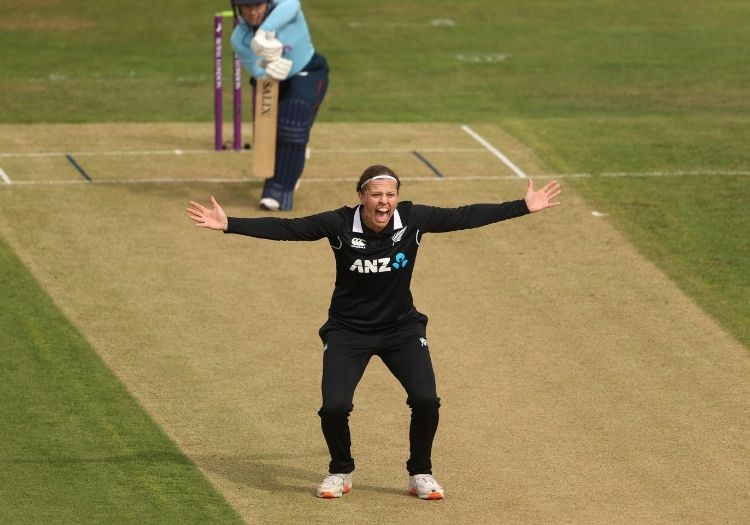
Lea Tahuhu was a match-winning presence with bat and ball for New Zealand
But Brunt has averaged 32 over the last four years, 14 runs higher than across the equivalent earlier time period, while Cross has started to bring some of her domestic form to the international game. Keightley has spoken regularly of Sophie Ecclestone’s potential with the bat, with Sarah Glenn – yet to feature in this ODI series – a former opener in the Kia Super League.
Anya Shrubsole has been recovering from a sprained ankle but smashed 47 off 33 balls in the standalone Test against India earlier this summer, and Farrant made her highest England score on Sunday, following up in accomplished fashion here. Charlie Dean, meanwhile, batted at No.4 in a win over New Zealand last month as part of an England Academy side. At present, Freya Davies might be the only member of the player pool for whom bowling-allrounder status might be a stretch, but that is a characteristic that Keightley has asked for from her tailenders.
“I think the more batters the better and the more allrounders, the better,” she told The Cricketer two years ago, when she was setting out her philosophy for a white-ball side in her image.
“I suppose that’s a challenge I’ve set out for all the bowlers – we want them to be able to bat and win us matches. The days of being a bowler – you’ve got to do it really well and be consistently picked in teams. I think we’re starting to get those players who can do two or three facets of the game.”
England v New Zealand: Player ratings
And although Keightley was likely referring there to the next generation of England cricketer, benefiting from the introduction of professional domestic contracts to develop their games as individuals all-year round, it is testament to Brunt’s powers of longevity that she remains the gold standard.
England were never better placed in this game than when she was at the crease, either muscling her way to an unbeaten 49 – only once in international cricket has she faced more deliveries in an innings – or charging in as part of a four-wicket haul that took her past 300 in her England career. “A warrior,” came Knight’s post-match description. She learned from Tahuhu’s earlier five-wicket burst, running her fingers down the ball to extract the necessary smidgeon of movement.
In the absence of Nat Sciver, resting as England look to manage the workload of the talismanic allrounder-come-vice-captain, her role was accentuated: she was in the middle as early as the 18th over, after Tahuhu – a “caged animal” in the words of her captain, Sophie Devine – had blown the game wide open for the visitors, who had to win to keep the series alive and were playing only a matter of hours after the report of a “threatening email” relating to the tourists.
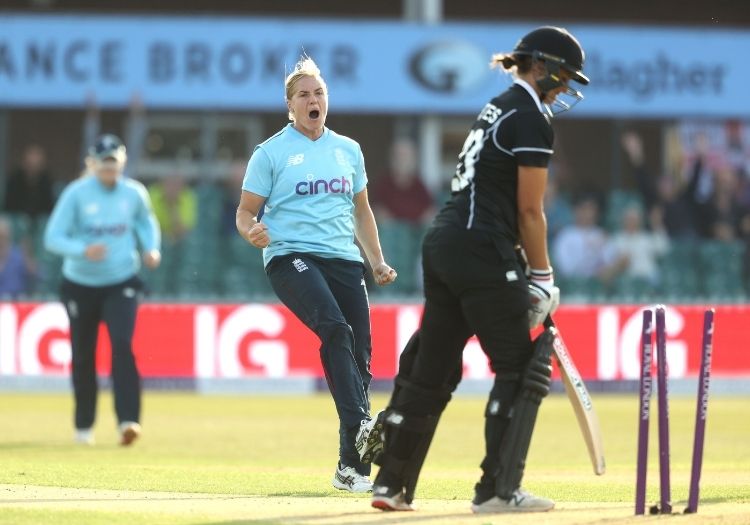
Katherine Brunt was "a warrior" with bat and ball, said Heather Knight
Having won just once in 17 ODIs since February 2019, though, this win felt like a doubly important result – not only in the context of moving past the unpleasantness of the last 24 hours, but also in rediscovering the taste of victory. They have become good at losing since then – and if that sounds unfair, it isn’t meant to be. For, New Zealand are so much better than what they have produced during that slump, and they have played enough good cricket against England this year for that record to look quite different.
But like all teams that temporarily forget how to win, the last step is the hardest. They have wilted in the crucial moments, tumbling into the final hurdle in such a way that it becomes a habit. Having done so much right today, they threatened to re-fashion that same ending through a tension that was inflicted as much by their own devout uncertainty as England’s excellence in squeezing a team with several proven match-winners but lacking in confidence.
Maddy Green was gutsy, though, spending an eternity in the forties without ever losing her composure and ending not out on 70. New Zealand needed one of their top order to do the legwork, and she spent 153 minutes marshaling her teammates towards the finish line, before finally finding a partner willing to flick the switch and take a risk by adopting an aerial approach. England stretched it out for as long as possible, and when Katey Martin and Hayley Jensen fell cheaply, one can only have imagined the air of silent panic in the White Ferns’ dugout, even if Devine insisted there were no nerves in the away dressing room.
But it was fitting that Tahuhu should put an end to any lingering doubts, swinging away three fours and a six that bore plenty of the same authority as her devastating spell with the ball that ultimately proved to be the difference.

Welcome to www.thecricketer.com - the online home of the world’s oldest cricket magazine. Breaking news, interviews, opinion and cricket goodness from every corner of our beautiful sport, from village green to national arena.