
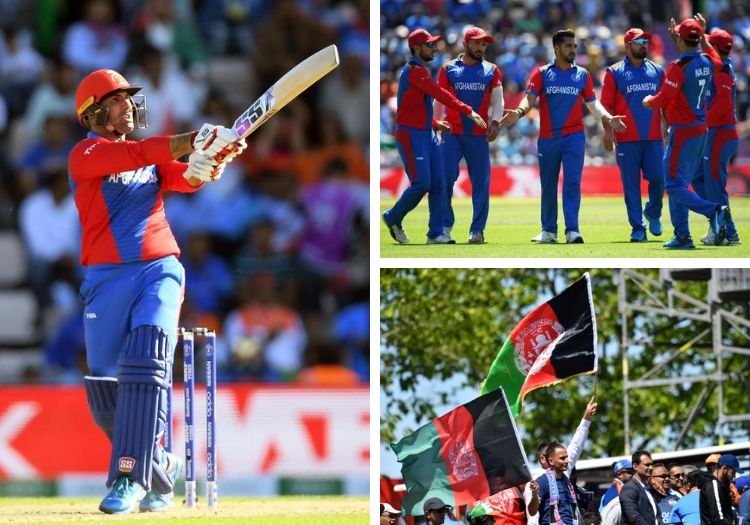
SAM MORSHEAD AT THE HAMPSHIRE BOWL: When Mohammad Nabi swivelled on his axis to pump Jasprit Bumrah for six, the Indian crowd were silenced. Afghanistan had turned the volume off, and even though it was just for a moment, it was significant
Scorecard| Ratings | Talking Points
In the end it was not to be.
The scorecard will say India were winners by 11 runs in Southampton, that Virat Kohli was the game’s topscorer and Mohammed Shami rounded off victory with a hat-trick.
It will show that Afghanistan were always behind the rate, left too much to do too late and relied too heavily on their lower middle order.
It will retain for posterity that they got close, but never close enough.
What the scorecard will not record, however, is just how important this defeat was to Afghanistan - not for the result, of course, but for the performance.
Afghanistan, remember, are not just here to make up the numbers - as much as their displays might have suggested otherwise in the early weeks of the competition.
This is a team which has competed with and beaten many of the traditionally ‘stronger’ countries over recent months, a team which tied with India as recently as last September, a team blessed with tremendous hitting power and brain-bending spin, a team with four IPL contract-holders among its ranks.
The problem has been, in this World Cup at least, that Afghanistan have not been a team.
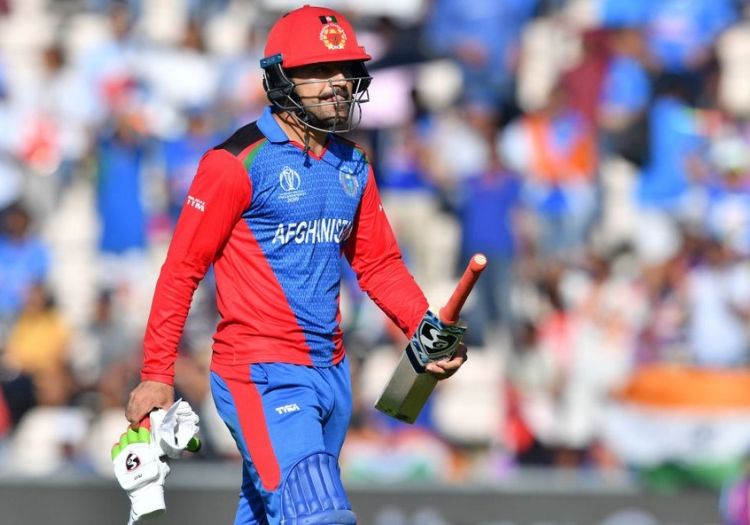
Rashid Khan walks off after being dismissed
Backdoor politics has caused division in the ranks - the abrupt removal of Asghar Afghan as captain is perhaps the most prominent example but there have been plenty more besides.
Mohammad Shahzad was cut from the squad 10 days into the World Cup, with management citing a knee injury despite it being abundantly clear that Shahzad’s knee was no less likely to fail a fitness test than it would have been at the start of the tournament. Since when have Afghanistan required fitness tests of their portly wicketkeeper anyway? Shahzad landed in Kabul and told local media he was ready to retire because of the way he felt he had been treated.
“My heart isn’t in cricket anymore,” he said.
His teammates’ heads weren’t in the game on Monday night in Manchester, either. An incident in a restaurant less than 12 hours before they were due to play England resulted in police being called. The players had taken exception to being filmed by a member of the public - a relatively innocuous happenstance during a World Cup, you might think. But they have been on edge, and it takes just a snowflake to launch an avalanche.
VISIT THE WORLD CUP PORTAL
By the time Eoin Morgan began picking off sixes, Afghanistan appeared to be collapsing in on themselves, their groundwork becoming clumsy and haphazard, fielders fumbling and tripping like drunks making their way home in the snow.
Everything seemed to be heading for an uncomfortable, unhappy end. Established cricket writers were questioning whether they warrant a place at the tournament - an absurd suggestion but one to which they had not given a figurative middle finger.
Then, in the second innings against England, they rediscovered themselves; they rediscovered their belief; they rediscovered what it means to work together.
In his press conference after the game, Gulbadin Naib picked out the fact that his side had batted throughout their 50 overs as a positive to take from a difficult day. In the aftermath of such a mauling, it was easy to scoff at the captain’s views, but less than a week later it is really very clear how much good that performance has done.
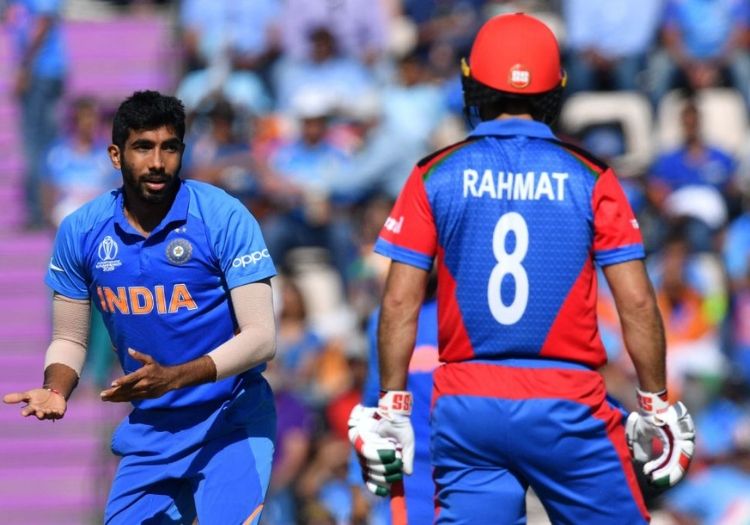
Jasprit Bumrah stares down Rahmat Shah
The conviction has returned to this talented, if enigmatic group. The confidence is back, too.
Rashid Khan, who went for 110 in nine overs on Tuesday, found the mean average between long-hops and half-volleys, and kept India’s run-laden middle order quiet.
Mohammad Nabi, Naib and Rahmat Shah batted with authority.
Mujeeb Ur Rahman took his week’s work - against the two best teams in the world - to 1-70 from 20 overs, many of them bowled in the first powerplay.
This kid is still only a teenager, and it is far too easy to forget that with the way he gives the ball chance to turn and is not afraid to risk taking tap to generate reward.
He did for Rohit Sharma early, a lovely drifting delivery which dug into the surface and took the top of off - the sort of ball a spinner will rotate through his mind on a lazy Wednesday on the backseat of a coach on the long ride between Manchester and Southampton.
Mujeeb has prior knowledge of the Hampshire Bowl - he played for the county in last season’s T20 Blast, collecting nine wickets at 35s - and, although the ICC have contrived to turn one of the fastest-scoring decks in the country into a pub carpet for this tournament, he used that experience to excellent effect.
The tone was set. Afghanistan took inspiration from their young prodigy’s self-belief, and matched him in the field. The errors were reduced significantly - enough to turn them into a flavoursome jus - and captain Naib rotated his spinners wisely.
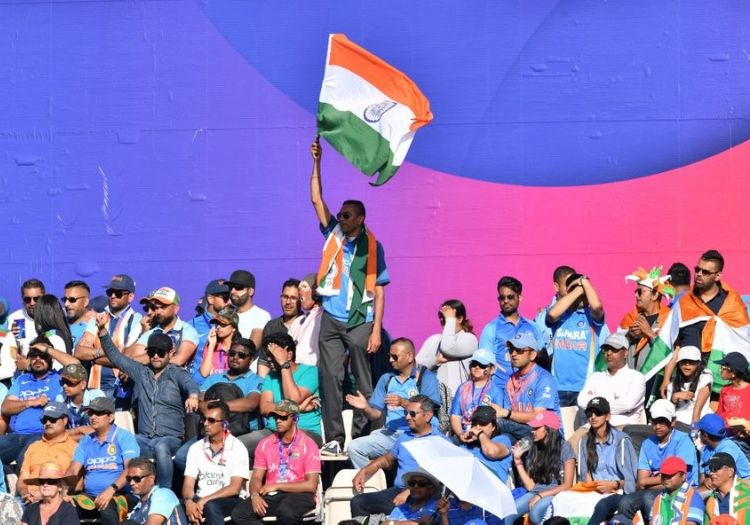
Indian fans were briefly silenced by Afghanistan
No one matches Afghanistan for variety among their spin attack in this competition - the early-overs intelligence of Mujeeb, the directness of Rashid and the pest-like offbreaks of Nabi.
Nabi did to India what he did to Sri Lanka in Cardiff - picked a line and stuck with it, as straight and narrow as a cub scout’s guidebook, more nagging than a haughty aunt on Boxing Day.
“Have you stacked the dishwasher, Virat?”
“Where’s the chocolate log, Virat?”
“When are you going to chip one to backward point?”
Kohli snapped under the strain of constantly having Nabi in his ear and did just that when well set on 67. He was the only India batsman to look comfortable at the crease, and from then on in the hot favourites went cold and rotten.
MS Dhoni’s 28 from 52 balls was a grotty innings, a crabsticks sandwich sort of innings, the kind of innings you would leave on the service station shelves even if it was the only thing left to eat - fishy, stale and out-of-date - and neither Hardik Pandya nor Kedar Jadhav could inject fluency towards the end.
And so Afghanistan, not by pluck or by luck but by simply executing their skills as well as most of us already knew they could, restricted India to 224.
It was gettable - a challenge for a side which has looked at 200 like a baby might view a basketball hoop at this World Cup, but gettable nonetheless.
They were not helped at the top of the order by Hazratullah Zazai swinging like a lumberjack and taking with him only air, but found calmness and stillness in Naib and Rahmat Shah, and then Shah and Hashmatullah Shahidi.
At 106 for 2, with 21-and-a-bit overs left and two batsmen set, there was still a chance. At 190 for 6 with four overs remaining, there was a chance too, and when Nabi swivelled on his axis to pump Jasprit Bumrah over midwicket for six, the 95 per cent Indian crowd inside the Hampshire Bowl were silenced.
Afghanistan had turned the volume off, and even though it was just for a moment, it was significant.
After all they had been through, and after all they had put themselves through, they had found a way back. Together.
This is the story of the day.
Our coverage of the ICC Cricket World Cup 2019 is brought to you in association with Cricket 19, the official video game of the Ashes. Order your copy now at Amazon.co.uk

Welcome to www.thecricketer.com - the online home of the world’s oldest cricket magazine. Breaking news, interviews, opinion and cricket goodness from every corner of our beautiful sport, from village green to national arena.