
New Zealand's tail-enders found today's rescue mission one ask too many, as Bangladesh spun their way into a showdown with India for the World Cup trophy
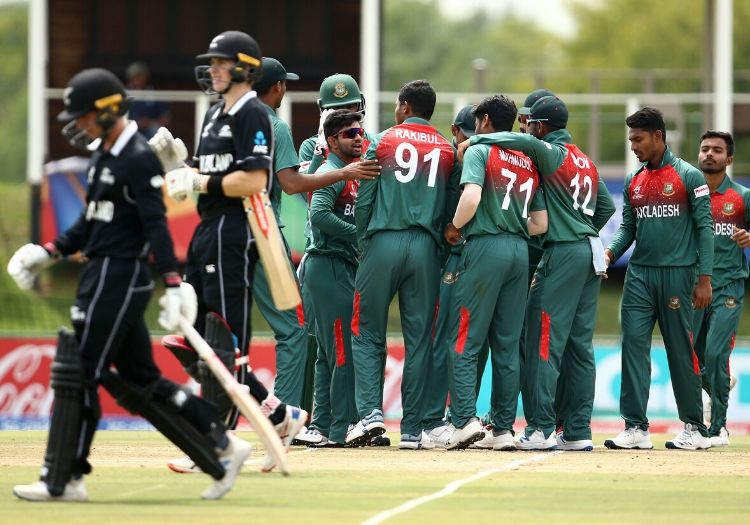
It has long been clear that the future is bright for Bangladesh cricket. While the devastating hurdle of Shakib Al Hasan's suspension has cast something of a shadow over the senior side in recent months, their junior outfit has continued to flourish, and boasts more wins in Under-19 World Cup cricket than anybody other than India since being admitted to the youth game's top table at the second edition in 1998, as well as over the two years since the last Under-19 World Cup.
But never before has the country had a cricket team make the final of any top-tier ICC tournament – before today, semi-final losses at the 2016 Under-19 event and 2017 Champions Trophy were as far as the Tigers had ever progressed. Now, without so much as a stutter in their three-week stay in South Africa, Akbar Ali's team has a real chance at making history.
This tournament has, in many ways, been entirely predictable. With mismatches all over the place and a few close thrillers that became so largely through a lack of pure match experience and temperament that can only be expected at this level, the only major 'upsets' were England and Sri Lanka failing to escape their pools. But even with their respective foes Australia and New Zealand distantly trailing the reputations that precede them, no side can feel shame for falling agonisingly short to teams of their pedigree.
Very much fitting that formbook-obeying trend, Bangladesh's progression makes perfect sense. Theirs is a squad packed with first-class talent and match-winning individuals who have spent the last two years together, churning through Youth ODI cricket in a way that puts more established counterparts to shame. Seven of the 10 most capped players in the format since the 2018 Under-19 World Cup were in action today, and each one was wearing red and green.
After a pair of horrifically one-sided encounters to start, Bangladesh were somewhat fortunate that a nightmare morning in Potchefstroom in the Group C decider was swiftly swept away by the weather. Pakistan's pace battalion had reduced Bangladesh to 106 for 9 before time was called, and the lack of time to reply meant net run rate calculations then largely took that match out of the equation, and Bangladesh cruised through as default group winners. That and that alone is the only time luck has played a part in this run.
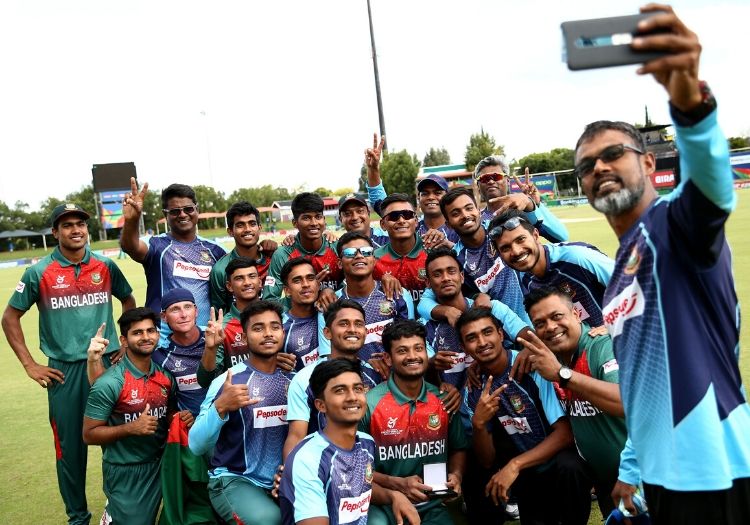
A close-knit Bangladesh side will play India for the tournament trophy on Sunday
Today, very much like Thursday's quarter-final with beleaguered hosts South Africa, saw the formidable Bangladesh team ease to an inevitable victory. Ali put his opponents in, deployed their regular trump card of Shamim Hossain's off-spin with the new ball, and had runaway leading scorer Rhys Mariu pushing outside off and caught comfortably at slip before the second over was out. Rakibul Hasan swapped in his orthodox tweakers before the powerplay was done, started with a maiden, a maiden and a wicket-maiden, and suddenly New Zealand were 31 for 2 and floundering.
The best sides boast talent bases such that if even two or three key players slip up, someone else will lock in and get the job done. Today, that someone was Mahmudul Hasan Joy, who saw both openers fall after iffy starts (14 from 29 for Parvez Hossain, 3 off 9 for Tanzid Hasan) and then took matters into his own hands. By the time he had fallen for his fourth Youth ODI hundred – twice as many as the New Zealand squad combined – and more than doubled his tournament run tally in the process, the job was essentially done, and Ali could once again come in free to finish off the innings however he wished. In other words, it took him two balls.
But Bangladesh did not simply dominate by maintaining composure in the second innings. One should instead look at any number of moments, such as Hasan Joy's immaculate leaping grab to remove the hard-hitting Fergus Lellman, or third-choice spinner Hasan Morad making the most of the place won for him by a tournament-ending injury to seamer Mrittunjoy Chowdhury by uprooting the middle and leg stumps of New Zealand captain Jesse Tashkoff for 10.
India now await in Potchefstroom on Sunday for the teams' seventh meeting in as many months, but now with far more on the line. It is a battle always closely fought, and having the two teams with the best winning records in the two-year tournament cycle meet with the trophy and a place in the history books on the line is a simply majestic way to round out this competition.
New Zealand's run through to this stage of the competition at no stage felt like a foregone conclusion. In fact, it was something of a surprise to even see them make it to the Super League rounds from a pool of death that also featured India and Sri Lanka, the defending champions and the most experienced Youth ODI team since the 2018 contest.
But twice when it mattered New Zealand's tail did what its top order could not, and improbable positions against Sri Lanka and the West Indies turned into tense final-over wins, regardless of whether or not Jesse Tashkoff's XI were truly the stronger squad. Rather than winning out of habit – something they had done just twice in 14 fixtures between the 2018 and 2020 tournaments – their two wins here have come more from the odd stubborn display at a crunch moment.
Full credit must again go to Otagoite allrounder Beckham Wheeler-Greenall, who today entered the game at No.6 with the scoreboard reading 74 for 4 just past the half-way stage of the opening innings. Much like the must-win Group A meeting with Sri Lanka, where his stoic 80 earned player of the match honours in a chase where only two other players mustered anything north of 20, the 17-year-old held firm until he had single-handedly salvaged a modicum of hope for the young Blackcaps.
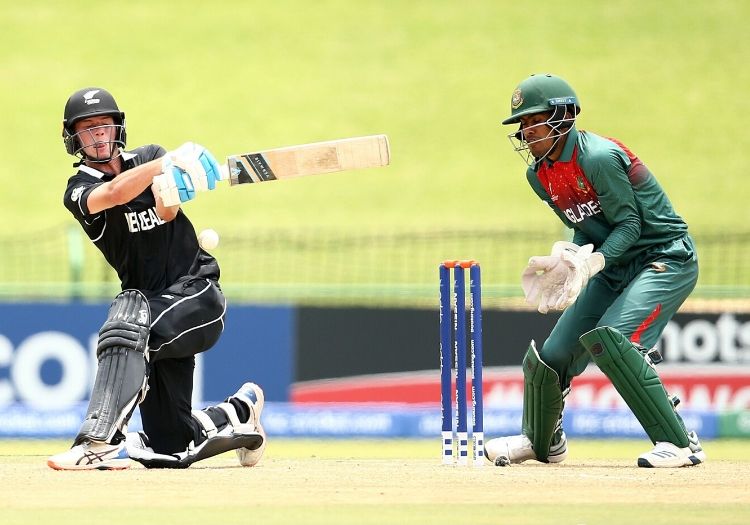
Beckham Wheeler-Greenall struck 75 not out to salvage 211 in the Blackcaps' innings
This time, a score of 75 not out was the fruit of his labour as he nonchalantly steered New Zealand to a 200-plus total that looked highly unlikely even as late on as the start of the final six balls. Wheeler-Greenall struck the productive seamer Shoriful Islam (3-28 at that stage) to the rope with the first two legitimate deliveries of the over, while fellow 17-year-old Adithya Ashok also found the rope amid four more extras to reach a final total of 211 for 8.
That made the end of the innings the very first time New Zealand's run rate had been perched above four at the end of an over since their quarter-final clash with the West Indies eight days prior. The ninth-wicket pair's feats from the final six (plus two wides) had at least ensured the total would not quite go down as the lowest 50-over score of the tournament so far – that indignity remains with Afghanistan's 191 from Sunday's low-scoring side-oval playoff with Australia, which came just two dot balls away from being successfully defended.
Today's result does put paid to any hopes of New Zealand's youngsters making their first final since 1998 – semi-final losses in 2008 and 2012 were both followed by fourth-place finishes, which the team will have a chance to better against Pakistan on Saturday – and means the stellar efforts of a few resilient characters will not be rewarded with a historic best finish.
It's really hard not to love Towhid Hridoy, the stylish No.4 whose final innings before the tournament saw him overtake one Quinton de Kock to become the third-highest run-getter in the 44-year history of Youth ODI cricket.
That innings of 111 against Sri Lanka was the right-hander's third century in as many games – a feat unmatched in the format, and one only 11 men (including de Kock) have gone on to manage at the senior ODI level. In all, since returning from the 2018 World Cup in New Zealand with a maiden hundred to his name at 17, Hridoy has averaged 58.00 from 30 innings. That figure rises to 74.91 in Bangladesh wins, and plummets to 18.12 when they don't, or rather Bangladesh results and hopes appear to rest rather firmly on his confident shoulders.
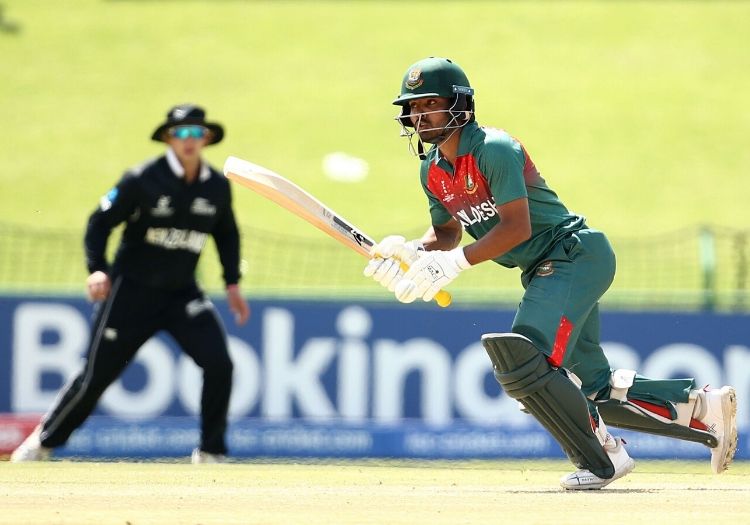
Towhid Hridoy trails only two players in career Youth ODI runs
But having first watched him as Bangladesh and India toured England for a tri-series last summer, and enthused about his solid stroke-making around anyone willing to listen ever since, the opening to his (and his team's) tournament proved a mix of unchallenging and underwhelming. His services were not required against Zimbabwe, as the top three slogged their way to a rain-affected win in 11 overs, and three days later there was little to shout about in the 19 not out he calmly put together to polish off a chase against Scotland with 200 balls to spare.
"On his day, Towhid Hridoy is the most dominant player on the Under-19 circuit," we wrote ahead of the tournament in our run-down of some likely stars. Alas, five games in he is yet to demonstrate it.
Today's innings was almost in danger of ending before it could begin, with an aborted run and some interesting kneeling at the stumps from New Zealand wicketkeeper Quinn Sunde coming just a couple of inches from seeing Hridoy depart with a solitary run to his name.
Fortunately for Bangladesh and independent onlookers alike, Hridoy did at least hang around a little bit today to give a taste of the batting talent that could well prove pivotal in Sunday's showdown with India. Until wandering perhaps lazily down the wicket, today's many of his trademark contributions, today's 40 was cool and largely unflustered, with nary a loss of absolute control.
That running mishap aside, until his dismissal Hridoy offered nothing of note to the fielding side – but then again, there was absolutely no need to. Wheeler-Greenall's late productivity was not anywhere close to making up for New Zealand's early and prolonged struggles to tight lines and well-oiled fielding efforts, and Hridoy's challenge will be to lift up his batting average against India from 17.50 as he goes toe-to-toe with fellow prolific prodigy Yashasvi Jaiswal for the last time at this level before senior stardom looms.

Welcome to www.thecricketer.com - the online home of the world’s oldest cricket magazine. Breaking news, interviews, opinion and cricket goodness from every corner of our beautiful sport, from village green to national arena.