
At Eastbourne College, all pupils have access to the same cricketing education, regardless of age, gender or ability. The Cricketer talks to head of cricket, Rob Ferley, about the school’s cricket programme and ambitions for the future
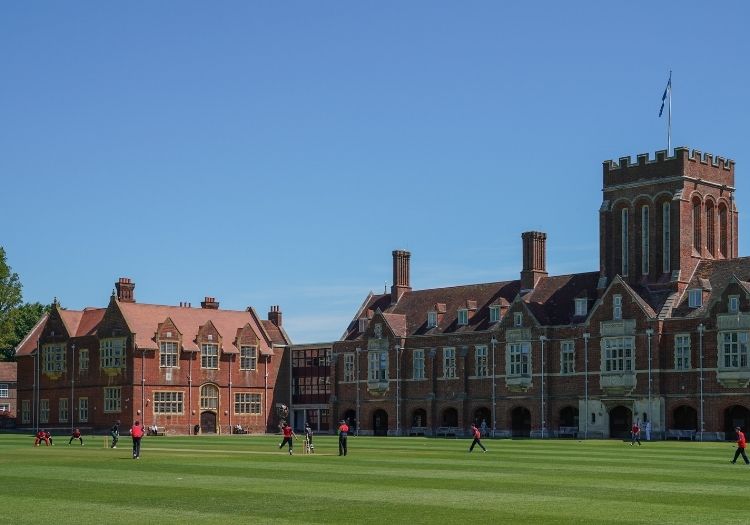
At Eastbourne College in Sussex, inclusivity is at the heart of their cricket programme. Whether it’s specialist coaching sessions targeting a specific skillset, 1:1 coaching, an open net with your friends, or joining a school team, every student has access to the same facilities and opportunities, regardless of age, gender or ability.
"My one instruction to the coaching team is we want to develop good people who enjoy cricket and fulfil their capability, and that’s it," explains head of cricket, and former Kent and Nottinghamshire cricketer, Rob Ferley. "If I want to develop good people, how can I define someone by the fact they play a better cover drive?
"There’s a theory in economics called the Matthew effect which is the rich getting richer and the poor getting poorer. If we just plough ourselves into the best six or seven players, that’s going to happen. We’ve got a duty to see how many people we can get to go on and have a good relationship with sport throughout their whole life.
"The winter programme is voluntary and in the summer, cricket is a games lesson. All of the extras are something anyone can come to. You tend to find that your C team or fourth team players won’t get involved as much but the odd one does. The drills are the same, the skills are the same but when we play games, we’ll use a different scoring system for the better players, almost like a handicap. It keeps everyone involved."
Among the popular initiatives available to all pupils is a summer fantasy cricket league featuring players from across the school’s teams. And not only has it given players outside of the 1st XI fame around the school, but it has also encouraged cricketers of all abilities to take an interest in the teams they’re not involved with.
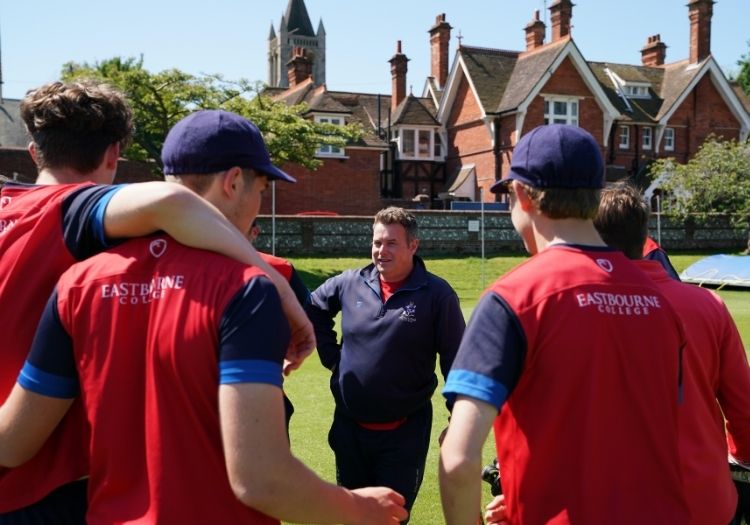
Head of cricket Rob Ferley (centre)
"Quite often the B or C team players are player of the week because they’ve done something ridiculous in a match and that’s brilliant because they walk around like they’re 10 feet tall," enthuses Ferley. "First teamers are looking out to see how the fourths and Cs are getting on because you have to select two players from each team – they all want to know how the other players have gone!"
The school has also capitalised on enthusiasm behind The Hundred to introduce eight-a-side 100-ball matches on Monday evenings throughout the winter. Available to both boys (outdoor) and girls (indoor), the matches are completely voluntary, allowing students to participate in other extra-curricular activities, and currently attract around 30 pupils per week. For Ferley, giving students the opportunity to play matches is crucial to their development as cricketers after being deprived of competitive sport for much of the past 18 months.
"We’re going to play all winter under lights. It absolutely hammered it down a few weeks ago but we just changed the bats to plastic and used an indoor ball," says Ferley. "One thing The Hundred has done is make people think that cricket doesn’t have to be done in just one way. If the balls coming down, you need to make a decision and choose the right shot; it doesn’t matter what ball you’ve got or whether you’ve got all your kit on, it’s about getting out there and playing.
"Game awareness, the tactical side, the mental side, how you perform under pressure, bowling with a wet ball – we try to bring that to life with nets but it’s tricky. You see over the course of a summer, if someone plays 20 games then they’re going to improve immeasurably and they’re going to have 20 games at least this winter, so I’m excited to see how that develops. I’ve said to the people who come that by being here, you’re in the right place if you’re interested in improving your game."
And in a novel step to improve the players’ decision-making and cricket knowledge, Ferley has worked alongside a game develop to produce an app – the P3 App – to offer his pupils a new way of learning the game.
"I got frustrated by people being good in the net and then not being able to and do it in a game," Ferley explains. "You need to put people in the pressure cooker of player a match and the app does that.
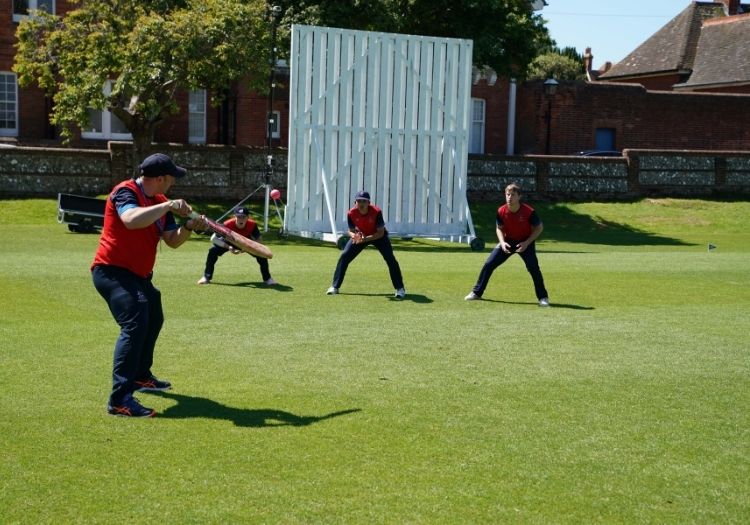
Eastbourne College pupils undertaking fielding practice
"Imagine you are viewing a bowler from the wicketkeeper’s position and when the ball bounces you have to press where it will go, or whether it was off-spin or leg-spin, for example. It’s building on memory recall, so for the next level, it doesn’t bounce. Can you predict where the ball will go based on what you’ve seen before? And it will take you back until the final level where the guy is just releasing the ball and you have to pick the delivery or the trajectory. Or it might ask you to tap the screen where mid-off is and if you get it wrong , it gives you feedback so you can do it right next time.
"It’s a great way of introducing new people to cricket and teaching them about the game because it’s quite complicated."
In the future, Ferley would like to develop a curriculum for the app and incorporate it into games lessons, rather than offering it to pupils purely as an optional extra. However, for now, he and every involved in cricket at Eastbourne College has a different ambition in mind: improving girls’ cricket at the school.
Since being launched around five years ago, the school’s provision of girls’ cricket has grown steadily. The sport is a games option throughout summer term while the school also offers teams at U14, U15, and U18, a voluntary winter training programme, and coaching from current professionals Tara Norris (Southern Vipers, Southern Brave, USA) and Nancy Harman (Trent Rockets). Introducing a new sport hasn’t been easy, but over the next five years the ambition is to run a girls’ programme on a par with that offered to the boys.
"It’s been pretty tough," admits Ferley. "There’s still a bit of reticence from the upper years and in the local area there aren’t a huge number of ladies teams for them to graduate into. But a lot of the prep schools around us have started doing cricket, so we’re starting to see [female players] coming through. It’s the next five years where we’ll see that growth because the girls will have always played cricket
"My biggest goal over the next five years is for the girls’ programme to be equal, or similar to, the boys. What does that mean? We’ve got fewer girls at the school so it’s probably U14 A&B, U15 A&B, and a 1st and 2nd XI. If we get to that point, I think we’d have a really healthy programme.
"There’s a couple of girls in the boys’ sides, but we do tend to find a lot of the girls don’t fancy graduating onto hard ball. I sometimes think, let’s not bother; let’s keep them on soft ball and have a pathway through school for them to do that. That’s not gender specific either. If I could change my C team fixtures to soft ball, I’m sure the boys would find it more enjoyable."
The Cricketer would like to thank Durant Cricket for their ongoing support of our schools cricket coverage. For more on Durant Cricket, including booking a site visit, please click here

Welcome to www.thecricketer.com - the online home of the world’s oldest cricket magazine. Breaking news, interviews, opinion and cricket goodness from every corner of our beautiful sport, from village green to national arena.