
MIKE BREARLEY: South Africa’s rugby triumph may have a societal effect, but for our England side in 1979 it was almost just another a game

November 2, 2019
‘If England/South Africa win today the players’ lives will be changed forever’. In the last minutes before the Rugby World Cup final, between England and South Africa. I keep hearing this cliché rolled out. Or is it a cliché? Is it even true?
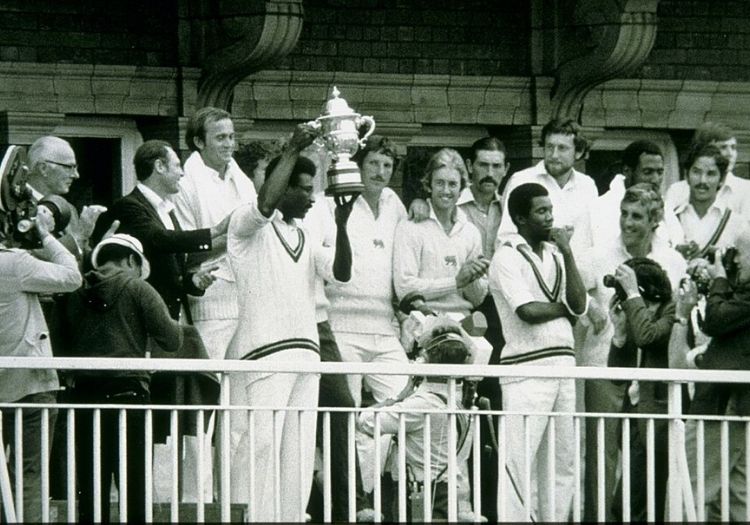
Did we approach the cricket World Cup final with such thoughts, in 1979? I think not. We were, of course, nervous, excited, tense. We had no coach, no plans, no thorough preparation. Our plans were informal. We may or may not have seen clips from the games our opponents had played.
We were probably worried about getting complimentary tickets for our families, or making sure they had got into the ground and found their seats. The World Cup final was another game of cricket, a big one, but not potentially ‘life-changing’. Life went on. On the morning after the match, Phil Edmonds and I were on our way by car to Old Trafford, to play in a regular county Sunday League match that afternoon.
Nor do I think my life would have been changed much had we, improbably, beaten West Indies in that final in 1979. In the short run, the accolades would have been gratifying. Individually, perhaps we would have been more in demand for giving motivational talks to companies. Our children would have been impressed (I’m reminded of a story Ed Smith tells about overhearing his five-year-old son Dexter say: “Yes my daddy played cricket for England, but they soon found someone better”).
In the longer run, I would not, I presume, be waking up a few days a year feeling regret and even remorse about the match; but would no doubt have found plenty of other opportunities for such emotions!
While on the subject of remorse, I have been struck recently by interviewers and members of audiences being surprised that I still do have such feelings about that distant match, 40 years ago. It’s not (as some imagine) that I believed we picked the wrong team (four main bowlers, with the 12 overs remaining to be shared between the not entirely penetrative Geoffrey Boycott, Graham Gooch and Wayne Larkins: as it happened all their overs were bowled to the great Viv Richards and the powerful Collis King. Talk about pea-shooters against cannon!) And we had West Indies 96 for 4.
But my feeling was that we wouldn’t have got to the final if we hadn’t made similar selection decisions in the earlier matches, not least in the semi-final against New Zealand, which we won by nine runs, thanks largely to Derek Randall scoring 42 not out at No.7, and fielding magnificently (as indeed he did to run out Gordon Greenidge at Lord’s in the final). We were, too, hampered by the absence because of injury of Bob Willis, our main strike bowler.
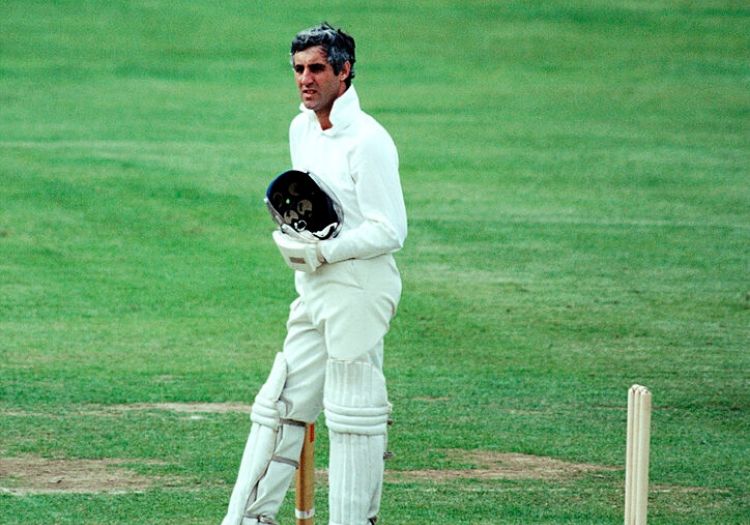
Brearley made 64 in the 1979 World Cup final
No, my remorse was about the batting, mine and Geoffrey’s. We had done reasonably well to get to 79 for no wicket at tea, after 25 overs. There were 35 left, from which we needed 210 to win. I suspect that our opponents were at this point not exactly rattled, but slightly worried.
I don’t forget, in my self-recriminations, that there were no restrictions in those days to the number of fielders that could be placed on the boundary, nor were there stringent rules about wides in one-day cricket. The target of 288 was in those days and in those conditions a very large one. Nor am I likely to forget the speed and accuracy of the main West Indies bowlers – Andy Roberts, Michael Holding, Colin Croft and Joel Garner.
In the semi-final at The Oval, Pakistan, with a terrific batting line-up, had failed to make a similar score to beat them on an even better batting pitch, with an even faster outfield. But the salient fact was that West Indies too had a weaker fifth bowler – either Richards or King. After tea we ought to have thrown the kitchen sink at one or both of these. But though we tried, we didn’t succeed; there was even echoing in my mind some trace of the old professional voice – don’t give it away, wickets in hand – the wrong thoughts in the circumstances. I asked Clive Lloyd earlier this year if he deliberately dropped Boycott at mid-on, off Richards. He simply grinned.
But I notice that people are surprised that moments such as these still hurt, still rankle, still make me feel bad. It’s a bit like leaving a party and remembering the tactless or thoughtless things one said or did. Each time you think of it, you realise you can’t do anything to rectify them.
So despite it all, I can see well that had I (and Boycott) done better, we would still have been unlikely to have beaten the great West Indies, despite the ‘glorious uncertainty of cricket’. Freakishly, India did just that in the next World Cup final, in 1983, in spite of being bowled out for a mere 183. I happened to pass Sunil Gavaskar in the pavilion as they were going out to field. I raised my eyebrows. “We could have done with another hundred runs,” he said, sotto voce. And yet, they won by 43. Stuff happens. But all the same, I don’t think my life would have been much different.
November 3, 2019
And now, the morning after England’s rugby loss to South Africa by the wide margin of 32-12, the England players will of course be down, disappointed. But I hope not devastated. They lost to a side that played better on the day, a side that first won the scrummage battle hands down, then showed flair and brilliance beyond anything we were able to show in this match. South Africa played out of their skins, just as England had done against New Zealand a week before.
But life-changing? Perhaps for the South Africans it will, to an extent, be so. The old Springbok rugby team, most of them from the Afrikaans-speaking heartlands, were seen by many as the pride of the apartheid system and its government.
This symbolism, which shifted several notches when Nelson Mandela famously and generously donned the green jersey, and embraced captain Francois Pienaar after their World Cup victory in 1995, has been taken further now, with 12 players of colour in their squad, a black captain in Siya Kolisi, and wonderfully flamboyant contributions by Lukhanyo Am, Mazakole Mapimpi and Cheslin Kolbe.
Maybe this will make people of all racial backgrounds walk with more pride, with more sense of being in it together, will offer an example of hard work, cooperation and shared passion to a country still divided and still full of corruption.
I used to say that if we did lose a Test match we could console ourselves that we had produced a great deal of happiness in another place. It was of course tongue in cheek, but there was, and is, a measure of truth and reality in it. It is not the end of the world to lose a match, not even a final. One hopes to learn from it, and become stronger. One has to live with it.
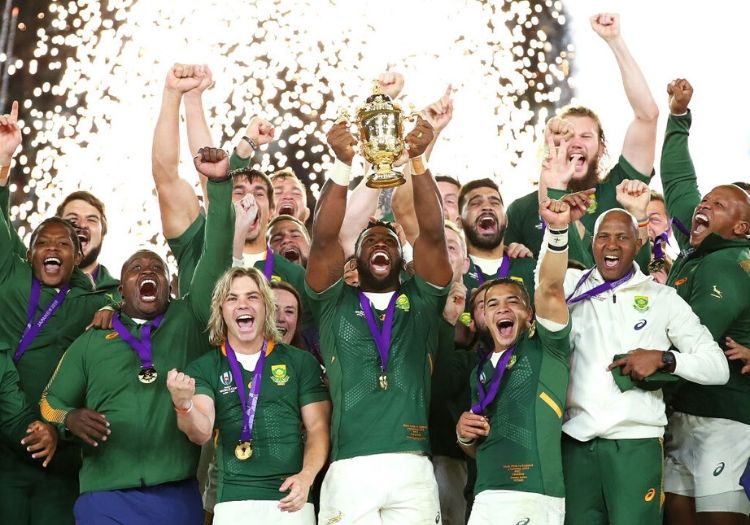
Siya Kolisi lifts the Webb Ellis Cup after South Africa won the 2019 Rugby World Cup
I think England rugby fans, and indeed others who were surprised to enjoy the team’s successes – and particularly that semi-final, only a week before the final – will remember the flair, brilliance, courage and optimism of their play.
Even more important, the matches in both sports, along with the spirit in which they were played, may reinforce and enliven the idea that sport itself is a wonderful opportunity for the development of the self and of the group.
Here is South Africa’s coach, Rassie Erasmus, talking after the game. He was asked whether the “potential for lifting the gloom in a country with so many problems still… had weighed heavily on him and Kolisi this week”.
Part of his answer was: “The All Blacks game in the pool stages was a great test run for us in terms of handling pressure. We were terrible that week, but that taught us a lot about how we handle the knockout stages. In South Africa pressure is not having a job. Pressure is one of your relatives being murdered… We started talking about how rugby shouldn’t be something that puts pressure on you. It should be something that creates hope. We started [to talk] about how we are privileged.”
I agree with this. The privilege is in playing in such a game, win or lose. But I wish we hadn’t let Viv Richards bowl his six overs for only 24! What’s more, now, watching YouTube highlights, I wish we had had a proper fifth bowler. Perhaps I got that wrong, too.
This article was published in the December 2019 edition of The Cricketer - the home of the best cricket analysis and commentary, covering the international, county, women's and amateur game
To remind ourselves of happier times we’re offering a £20.19 subscription to celebrate England’s World Cup win once again. Click here to claim

Welcome to www.thecricketer.com - the online home of the world’s oldest cricket magazine. Breaking news, interviews, opinion and cricket goodness from every corner of our beautiful sport, from village green to national arena.