
RICHARD HOBSON: "He worked harder than anyone else and never gave the impression of labour. He was always relaxed, completely unflappable." Who do you think?
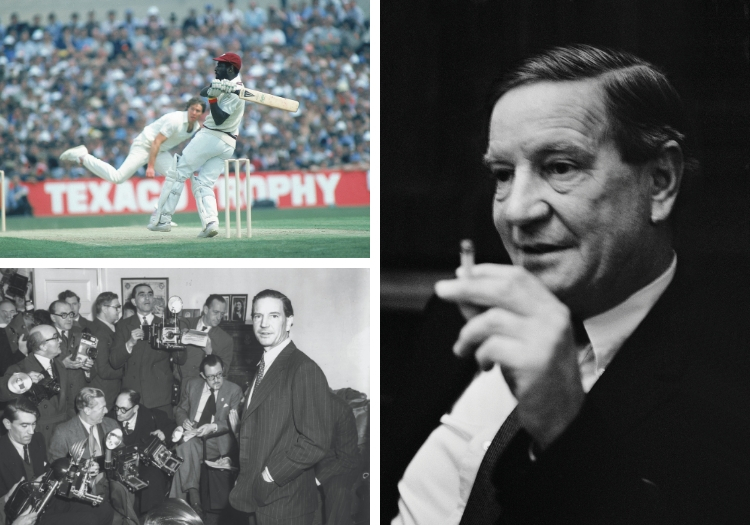

He worked harder than anyone else and never gave the impression of labour. He was always relaxed, completely unflappable.” Who do you think? Neville Cardus on Frank Woolley, perhaps, or John Woodcock on David Gower? The words actually belong to Graham Greene and describe Kim Philby, the most treacherous spy known to British intelligence.
More than half-a-century since defecting to Moscow, Philby is one of those spine-chilling names, like Jack the Ripper and Reggie Kray, that fascinates still. Books tend to gain traction, not least
A Spy Among Friends, by Ben Macintyre, which refers several times to Philby’s passion for cricket. Wherever he sits in the espionage world, Philby is probably the most notorious follower of our sport.
He was part of the spy ring known as the Cambridge Five, who were recruited as young idealists by the Russians in the 1930s. Penetrating deep into the Secret Intelligence Service, he helped colleagues Guy Burgess and Donald Maclean to escape in 1951 and was finally confirmed as the so-called Third Man after fleeing himself in 1963. He received a hero’s funeral in Moscow 25 years later.
As stories grew of his likely emergence in Moscow, The Daily Mail printed a cartoon depicting two well-to-do gentlemen over a newspaper carrying the headline: ‘Philby in Russia?’ One says to the other: “We’ll soon have enough there to start a cricket team.” England were midway through an exciting Test series with West Indies and the drawing conjoined two of the topics of the day.
Cricket terminology is commonplace in the language of this murky world. Here is Macintyre’s account of the interrogation of Philby in Beirut in 1963 – when the game was all but up – by Nicholas Elliott, a friend and hitherto supporter: “Elliott bowled and Philby batted, padding up, stonewalling, leaving the ball, trying to stay at the crease and knowing that the next delivery could end his long, long innings.”
So too in official documents, such as a 1945 report for MI5 by John Masterman, an Oxford University and MCC player who worked in wartime counter-intelligence. Later published in book form, a review on the CIA website noted: “Whole passages are unintelligible unless you know the equivalents of Babe Ruth and Lou Gehrig in cricket.” Those equivalents happened to be Grace and Bradman.
Philby was unmasked 30 years after becoming a Soviet agent (and 23 since joining the SIS) thanks partly to a former Northamptonshire player: Victor Rothschild, better known as part of the banking dynasty, as Government advisor on the poll tax and senior figure in counter-sabotage. Those familiar with Wantage Road might smile at this being incorporated into descriptions of his playboy lifestyle.
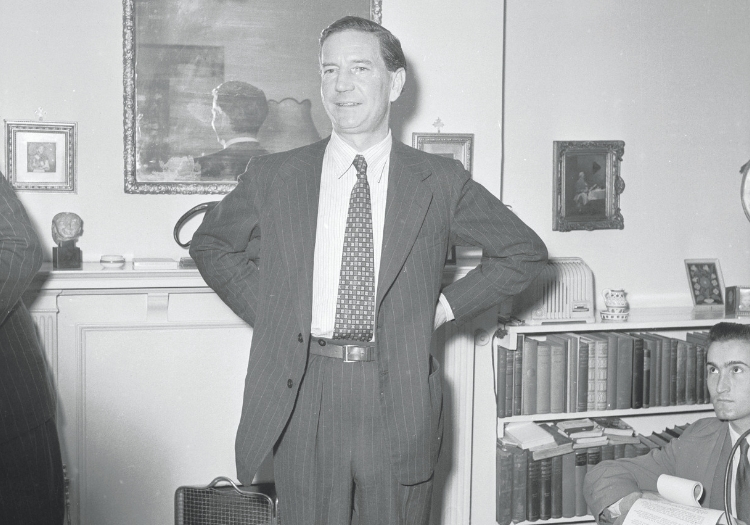
Philby at the British Embassy in Washington, where he was first secretary
As a teenager, he not only faced Harold Larwood, but did so wearing a striped Harrow School cap. This would have been a red rag to the bowler and although The Times report described his innings of 18 as “most courageous” it also noted that “his right foot showed a very natural tendency to retreat towards square leg as the Nottinghamshire fast bowlers delivered the ball.”
Rothschild knew Philby at Cambridge, where he also befriended Maclean and Anthony Blunt, the ‘Fourth Man’. Such connections meant that he was briefly suspected, wrongly, of being a double agent himself.
His part in Philby’s downfall followed a conversation with Flora Solomon, a one-time mistress of the Russian revolutionary Alexander Kerensky, at the Weizmann Institute in Israel. Solomon told Rothschild of her anger at Philby’s anti-Israeli stance in articles for The Observer and asked how he could have been commissioned by the newspaper given his communist past.
As the chat continued, Solomon revealed that Philby had tried to recruit her for the Soviets. Rothschild dutifully reported this to MI5 and persuaded Solomon to repeat her claim. Philby had been under suspicion for years, and even named as a spy in the House of Commons under privilege, but here, at last, was hard evidence.
Perhaps Rothschild wasn’t altogether surprised. At a social event in 1946 he suddenly asked his friend: “And how long have you been a member of the Communist Party?” Used to covering his tracks, Philby faked shock. “Me, Victor?!” At which point Rothschild backtracked. “Just a little joke,” he said. “I try it on everyone.”
But how did – how could – Philby survive for so long? Here are parallels between attitudes within the SIS and inside the ruling guard of cricket. While the sport was divided along class lines between the high-strata amateurs and the working-class professionals, with the upper and upper-middle classes firmly in charge, so the intelligence services were dominated by the elite and their values.
In his autobiography My Silent War, published in 1968 with KGB consent, Philby suggested he went unsuspected because of a “genuine mental block which stubbornly resisted the belief that respectable members of the establishment could do such things”. Think of the famous quote of Lord Hawke, Old Etonian and MCC president: “Pray God no professional shall ever captain England.”
Philby was the main Secret Service operator in Washington when Burgess and Maclean made their escapes. Though asked to resign from the Foreign Office, he rode out greater scrutiny partly through the loyalty of Elliott, another senior figure. “They had joined MI6 together, watched cricket together, dined and drunk together,” Macintyre wrote. “It was simply inconceivable to Elliott that Philby could be a Soviet spy.”
Philby himself had been told by the Soviets to infiltrate the British, but vetting was so perfunctory they wondered whether they were the ones being double-crossed. When the deputy head of MI6 was asked about Philby, he replied: “I know his people.” For Macintyre, this is “an almost perfect definition of how the old-boy network worked.”
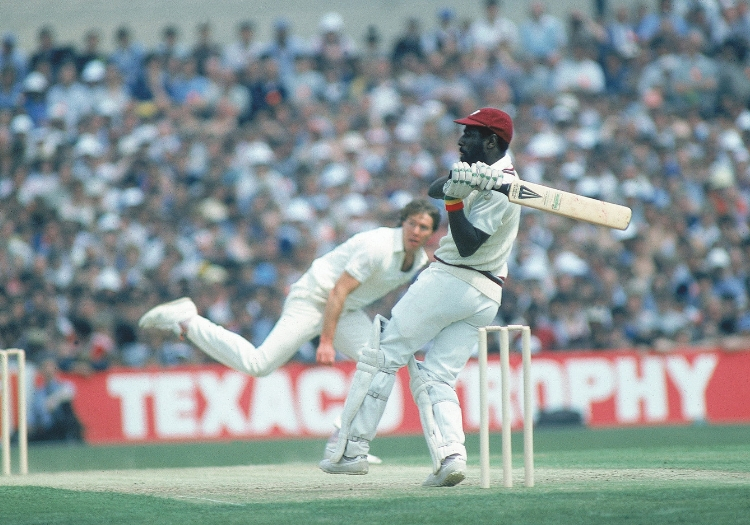
While Philby found the proliferation of one-day cricket boring, he still appreciated the batting of Viv Richards
It operated in cricket, too. Back then, the England cricket team was always led by an amateur, and when it comes to espionage and the game one of the most famous associations occurred during the 1924/25 Ashes tour when the Australian secret service felt the need to monitor Arthur Gilligan, the captain, as a member of the British Fascists suspected of opening groups down under.
Wally Hammond assumed the captaincy in 1938 only when he switched from being a professional; the game’s establishment helped to find him paid work outside the game. Only the dearth of amateur candidates enabled Len Hutton to become the first 20th-century professional appointment in 1954. Had the amateur Peter May been a couple of years older he would doubtless have taken charge.
Elliott himself was a MCC member and it is intriguing to wonder the secrets inadvertently revealed while Denis Compton and Bill Edrich were batting at Lord’s. Philby, wrote Elliott, “enjoyed discussing the English batting averages and spent many a long hour watching from the Mound Stand.” But he hardly played even socially, espousing a theory that serious drinkers, of which he was one, “should never take exercise or make sudden or violent movements.”
One death linked speculatively with Philby feels particularly relevant. Dick Sheepshanks had captained Eton and was sufficiently promising to play for Yorkshire alongside Wilfred Rhodes and Maurice Leyland in 1929. A debonair cousin of Anthony Blunt, sometime boyfriend of Winston Churchill’s daughter, Sarah, and friend of Rothschild, his period at Trinity College, Cambridge, overlapped that of Philby.
He became a reporter for Reuters, covering the Spanish Civil War in 1937 alongside Philby, then of The Times. Part of a five-car press convoy with Franco’s Nationalists heading for the frontline near Teruel, they stopped to find a vantage point when the Republicans suddenly attacked, hitting one of the cars. Sheepshanks, 27, never recovered consciousness and two American passengers were also killed. The survivor, bearing minor wounds to the scalp, was Philby.
Theories have grown however, that Philby was responsible for the deaths. In this contested line, he suspected that Sheepshanks had worked out his allegiance to Russia and was about to blow his cover. The shelling was actually a grenade thrown by Philby having scrambled from the car, or a bomb in the boot.
Sources have included the daughter of Sheepshanks’ then girlfriend, and the man responsible for transporting the coffins home. If it seems far-fetched – Philby would have been gambling with his own life as well as taking a huge risk in being seen – then Sheepshanks might well have been familiar with his socialist connections at Cambridge and was close enough to note odd behaviour in Spain.
Twenty-six more years would pass before Philby was finally recognised as a traitor, leaving behind him in England the question of how yet another escape could have happened. Some analysts believe that he was allowed to leave because a public trial might have revealed evidence strong enough to bring down Harold Macmillan’s government – not least because Macmillan, as foreign secretary, had officially cleared Philby in 1955.
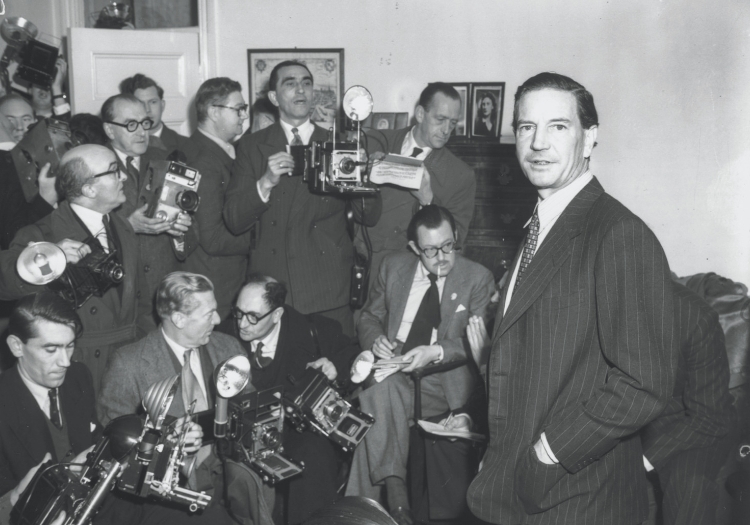
Philby at his mother’s flat in Kensington during a press conference held after he had been mistakenly cleared of spying by Harold Macmillan. Alan Whicker is one of the journalists in attendance
What were they like, those final decades in Moscow? “Possibly his most ardent wish,” Elliott wrote, “was a world revolution after which Tests would still be played for him to watch at Lord’s.”
Opening his heart in 1986 to the author John le Carré, himself part of MI5 and MI6, Elliott suggested again that Philby really wanted to settle down and follow cricket. Le Carré told Jon Snow in 2010 that he’d been personally betrayed by Philby while in Germany, and refused to meet him later in Moscow. “I wouldn’t have trusted him with my cat for the weekend,” le Carré said.
Philby stayed in touch with cricket via copies of The Times, which he ironed before reading. But a photograph in the book Philby, KGB Masterspy, by Phillip Knightley, shows him reading the back page of The Independent with the caption explaining that he “was trying out a new London paper.” Perhaps, like many, he enjoyed the humour of their new iconoclastic cricket correspondent, Martin Johnson.
His love for the game was certainly no secret. When Murray Sayle, an Australian journalist, tried to track down Philby he waited outside Moscow’s foreign post office in the belief that his quarry would come by to read the cricket scores. After a few days, Philby duly appeared, “a man looking like an intellectual of the 1930s, all leather patches on the elbows of his tweed jacket.”
Knightley, an award-winning journalist, spent around 20 years trying to set up his interview and finally spent six days in his company shortly before Philby’s death. In the book, Knightley reprints an extract from a Philby letter, of 1980, having suggested they meet in Mumbai to watch cricket. “I confess to a certain boredom with cricket,” Philby replied.
“Of course, it would be nice to spend a lazy afternoon watching Viv Richards belting them past cover. But I was happy with the County Championship and the Tests, and now with the John Player, Benson & Hedges, Schweppes, Gillette [all then sponsors of the domestic events], aluminium bats, white balls, funny clothes and Uncle Kerry Packer and all, it is too confusing for a gentleman of the old school like myself.”
Knightley was intrigued by Philby’s large flat, near Pushkin Square, which reflected the gratitude of the Soviets towards him. Shelves housed around 12,000 books and it was one of them, a 1972 Wisden, that made news when it went up for auction at Sotheby’s in 1994. Other items offered by his fourth wife, Rufina, included Guy Burgess’s trilby, KGB gifts, manuscripts and letters between Philby and Graham Greene.
The New York Times described the lots as the “detritus of a traitor”, perhaps the least complimentary description of Wisden ever given. Meanwhile, the speaker of the Albanian Parliament wrote to the auction house asking them to donate their commission to the families of those betrayed by Philby. The sale raised more than £150,000 overall, some way above expectations and more evidence of the fascination around him.
We can only speculate at how many lives were lost to his treachery. But as an indication, Miles Copeland, a CIA officer, suggested that from 1944–51 the entire – entire – Western intelligence effort was a minus advantage because of him. “We’d have been better off doing nothing,” Copeland said. No one has batted more destructively for the other side.
This article was published in the January edition of The Cricketer - the home of the best cricket analysis and commentary, covering the international, county, women's and amateur game
To remind ourselves of happier times we’re offering a £20.19 subscription to celebrate England’s World Cup win once again. Click here to claim

Welcome to www.thecricketer.com - the online home of the world’s oldest cricket magazine. Breaking news, interviews, opinion and cricket goodness from every corner of our beautiful sport, from village green to national arena.