
It is where they are most comfortable, sneaking beyond the consciousness of more the headline-making sides, going about their work quietly, with a tidy competency unusual in the gung-ho, uber-machismo world of modern white-ball cricket

Bangladesh and New Zealand are sat exactly where they would want to be; both won their first games, and both are flying quietly beneath the radar.
It is where they are most comfortable, sneaking beyond the consciousness of the headline-making sides, going about their work quietly, with a tidy efficiency unusual in the gung-ho, uber-machismo world of modern white-ball cricket.
Bangladesh, perhaps, have found themselves descending into the mainstream more than has previously been the norm in recent days. Their sheer competency in comprehensively outplaying South Africa appeared to shock some.
Their status as scourges of England’s World Cup scourges of 2015, Champions Trophy semi-finalists in 2017, Asia Cup finalists in 2018 all slipping the minds of many.
The sceptics, you see, had arrived at The Oval on Sunday to watch the developing nation of the late nineties and early noughties – at a time when they had only participated in the 1999 World Cup, when tall, mean fast bowlers would blow their flimsy selves away at will.
The rest of us were at The Oval to watch a side that serves up this kind of elite-level performance on a regular basis. In Tamim Iqbal, Mushfiqur Rahim, Shakib Al Hasan, Mehedy Hasan and Mustafizur Rahman, Bangladesh possess a spine as strong as any in the tournament.
It is quite the five-a-side team: opening batsman, wicketkeeper, all-rounder, spinner, seamer. It is a backbone packed with flair aplenty, bucketloads of longevity and no little consistency. Shakib, for one, has been among the world’s best pound-for-pound all-rounders for many a year.
In previous years, such praise might risk jinxing Steve Rhodes’ team. Not now. What the world witnessed against a below-par South Africa outfit was, quite simply, Exhibit A.
A long batting lineup, all-rounders, multiple spin options and a variety of different kinds of seamer. It is not easy to pick flaws, there is no obvious weak link.
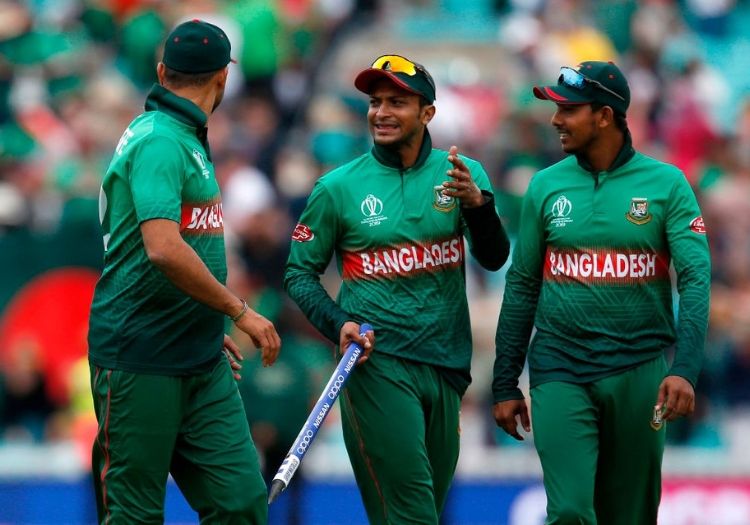
Shakib made 75 in the win against South Africa.
Of course, the same can be said of their opponents. New Zealand ran through Sri Lanka just as New Zealand sides tend to do these days.
Ruthlessly resourceful, one suspects Kane Williamson will be most pleased by where the major contributions came from in their 10-wicket thrashing of Sri Lanka. Colin Munro would, in all likelihood, have been excluded at the expense of Henry Nicholls had he been fit.
He ended unbeaten on 58. Likewise, Matt Henry took three top-order wickets; he benefited from Tim Southee’s absence.
It was typical of Williamson’s side; overseen by a low-profile coach in Gary Stead. They are full of stars – Ross Taylor’s one-day form has been almost peerless in recent times; Williamson exists in a bracket almost of his own among the planet’s greatest batsmen; Boult is a supreme exponent of his skillset; Martin Guptill was the tournament’s highest run-scorer four years ago. But they work as a team. And an excellent team at that.
As the favourites for this competition have been reeled off, New Zealand’s name has rarely popped up. Quite why that is the case is something of a mystery; they were – with Australia – the outstanding side of four years ago. Much of that side remains intact.
What has been lost in Brendon McCullum has been gained in an even more polished version of Williamson, an in-form Taylor, a swashbuckling Munro. Where Daniel Vettori stood now stands Mitchell Santner.
They, like Bangladesh, are a team built on a calm logic, well-balanced and well-led. It should make for a cracking game.
Our coverage of the ICC Cricket World Cup 2019 is brought to you in association with Cricket 19, the official video game of the Ashes. Order your copy now at Amazon.co.uk

Welcome to www.thecricketer.com - the online home of the world’s oldest cricket magazine. Breaking news, interviews, opinion and cricket goodness from every corner of our beautiful sport, from village green to national arena.