
HANNAH THOMPSON: Without providing red-ball opportunities at a domestic level, how can we expect to call for more Tests if the pathway and experience aren’t there?
There has been much talk about introducing multiday cricket at a domestic level of the game, but the uncomfortable truth is that more cricket may not equate to gender parity within our sport if we do not fix the structures first.
We can’t just copy the men’s game and expect everything to fall into place: we have to develop our pathway, our talent pool and most importantly the resources required to professionalise the women’s game for every single player – not just five from each region. Yet without providing red-ball opportunities at a domestic level, how can we expect to call for more Tests if the pathway and experience aren’t there?
Not only that, but we need structures globally to work with us on this. We need to have Test-playing nations at the international level, which will take time and resource. But the appetite is there – players, fans and staff want to see more red-ball cricket across all levels of the women’s game. We just need to make it happen and balance these tensions.
This public conversation would barely have been considered a few years ago. Perhaps it is a sign of progression that no longer is it the same names and faces leading the charge for the women’s game: there is a growing public consciousness of the wants and needs for our sport.
While I support the calls for more playing opportunities, we have to ensure that they are not being used to gloss over the cracks in our game. It remains the case that just five players in each squad are full-time professionals and arguably we need to be calling for all players to be fully professional before we increase the playing calendar once more.
These ongoing conversations are so important, and we are not at the endpoint of our game. That’s what makes women’s cricket so exciting for me, that there is still so much progress to achieve, and we can all play our part in hitting those next milestones. Perhaps this is an unpopular opinion but it's important to remind ourselves of the steps needed to sustain the growth in professionalism to ensure the players can commit and be supported as they should and that they aren’t stretched beyond reasonable expectations. The money and resource have to be there. Equally, a growing talent pool also has to exist. We can’t rush it.
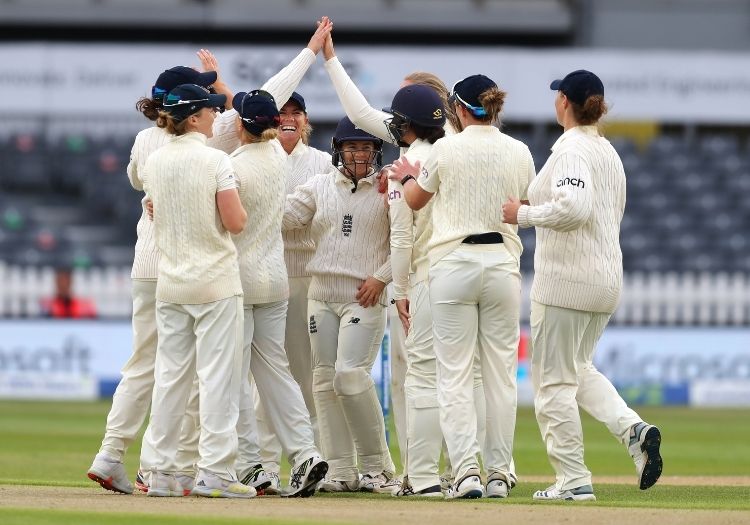
England's Test draw with India has led to calls for more red-ball women's cricket
In the men’s sphere we see players specialising in a particular format, while that is rarely the case in the women’s game. This will change over time; as more women and girls play the game and the talent pool widens, perhaps players’ identities will shape up to particular formats, but that can only happen if the formats exist in the first place.
We need the women’s game to go beyond the short form and reconnect with its previous history, playing regular Tests and multi-day games at domestic level. This isn’t anything new: the first recorded England Test came in December 1934 against Australia. England won by nine wickets thanks to Myrtle Maclagan taking 7 for 10 before hitting 72 in the first innings. In their second Test, Maclagan took 4 for 33 and backed that up with 119, as England declared on 301 for 5, eventually beating Australia by eight wickets.
Maclagan’s name is perhaps little-known by players and fans today, but her contribution merits engraving on any future tournament silverware. She scored the first Test century in the women’s game, played in 14 Test matches, scoring 1,007 runs at an average of 41.95 and taking 60 wickets at 15.58 apiece. A phenomenal cricketer. The class of the 1930s also posted 503 for 5 against New Zealand, with Betty Snowball making 189. Unsurprisingly Maclagan took 5 for 22 in that match too.
More Tests, please
A more familiar name is Enid Bakewell who, at 80 years young, still dons her whites for her local side. A stalwart of the game and a rebel at times, but a name aptly poised for a future three-day Bakewell Shield perhaps. Only recently Bakewell became a viral sensation once again, with her batting in a local club game doing the rounds. Bakewell has been cited as one of the game’s greatest allrounders of all time. In Test cricket, she averaged 59.88 with the bat, scoring 1,078 runs in 12 appearances. With the ball, she claimed 50 wickets at 16.62. There is no doubting her class or impact on the women’s game.
There is a solution that would provide the best of both worlds. Red-ball cricket could be introduced in a North vs South scenario, or where the 41 pros are divided into three teams with the inclusion of England-contracted players . Again, the appetite is there from the players whose voices surely matter most. Why should it be only the men who are afforded the privilege of playing the perceived pinnacle format of the game?
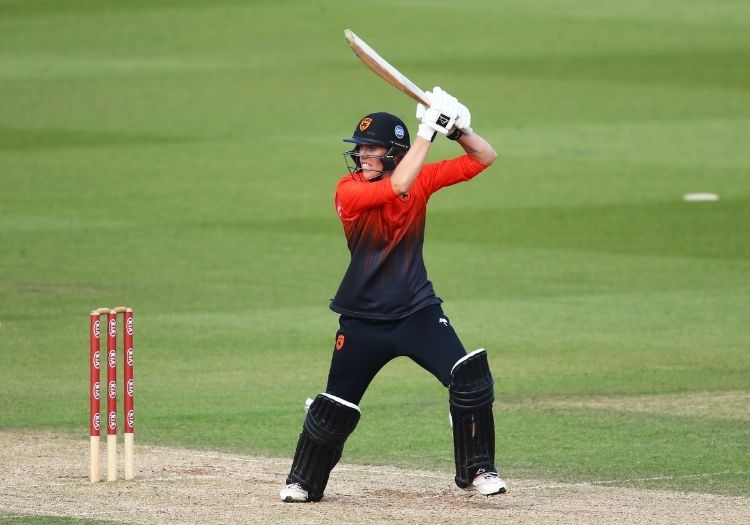
Georgia Adams has called for red-ball cricket at domestic level
The men’s LV=Insurance County Championship will see 180 red-ball matches played this summer, while the women have no official red-ball multiday opportunities domestically. We need to close the gender play gap and create more opportunities as soon as we possibly can while taking into account these complexities. We have to ensure the pathway between club, county, region and England is sufficient and that everyone has the chance to develop through these ranks.
Sparking the calls for more red-ball cricket, an exchange on Twitter between regional captains Georgia Adams and Eve Jones from the Southern Vipers and Central Sparks hinted to fans that a potential friendly between sides could be on the cards in the future.
“I’m a huge advocate for getting red-ball into the domestic game,” said Adams. “I think every region would be happy to get one or two friendlies maybe in May, I would love to see that next year. We all grew up watching it, we are all cricket badgers, we all love the game. I grew up watching my dad play four-day cricket every week and it’s a challenge, it’s a new challenge that we would love to embrace.
“I don’t even think moving forwards in the very near future it needs to be competitive. If the ECB were to, say, match up teams like Vipers vs Sparks for example in a three-day game [in] early May just to get a bit of exposure and just to get a bit of experience to learn how to play the game and learn the tactics of the game, then that would be more than sufficient now.”
Jones acknowledged: “The England Test match last week was a great showcase of the women’s game and I have only seen positive feedback on Twitter which doesn’t happen too often!
“With the way women’s international series are heading, there is a desire for them to play more Test match cricket, so for us to have a few games of the longer format at the domestic level it gives us the opportunity to experience test cricket and showcase our skills,” she added.
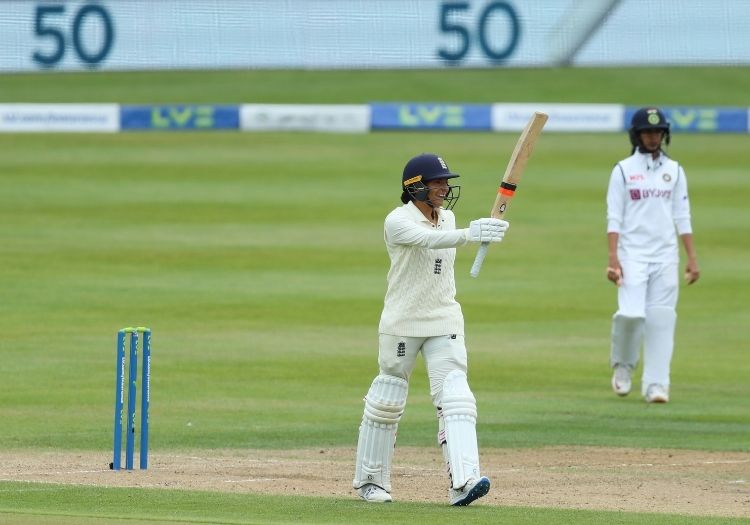
Sophia Dunkley impressed on her Test debut
Adams echoed the sentiment, calling for more long-format cricket to grow the talent pool from which Lisa Keightley could draw in future years.
“I think we have got to get red-ball cricket into the domestic game to grow the England team and develop the team so that they can call upon players who are experienced enough and have had some experience and then you’re not forced – and by no means am I saying Lisa Keightley’s based any decision on who played Test cricket before and who hadn’t – but then it’s less pressure on experienced players and equally less pressure on younger players to come in and have to quickly learn how to play a format they’ve never played before.”
The passion from both captains is clear to see, and the hunger is there. We have already seen the Rachael Heyhoe Flint Trophy produce success stories in its early existence, with the call-ups of South East Stars captain Tash Farrant for the New Zealand tour and Central Sparks seamer Issy Wong as a travelling non-playing member, as well as Wong’s teammate Emily Arlott more recently for the India series.
Sophia Dunkley, meanwhile, settled into Test cricket as seamlessly as a debutante could wish for just a week after earning a first central contract. She looked at home, liked she’d always been a Test player.
Yet her success is built on a backdrop where regular red-ball playing opportunities frankly don’t exist. Just imagine how exciting it would be to see her play the longest format on a more regular occasion. Red-ball cricket shouldn’t be a rarity for the women’s game, where they have to saviour every moment.
Ahead of the Test against India, the media could only speculate on possible selections, wondering how Keightley and Heather Knight might pick a squad for a format no one had played for two years. Imagine if that was a conversation of the past.

Welcome to www.thecricketer.com - the online home of the world’s oldest cricket magazine. Breaking news, interviews, opinion and cricket goodness from every corner of our beautiful sport, from village green to national arena.