
Nat Sciver was steadfast in her denial when she spoke afterwards that England's crawl had ever been part of a plan, but rather the result of good bowling and the regular falling of wickets at the other end
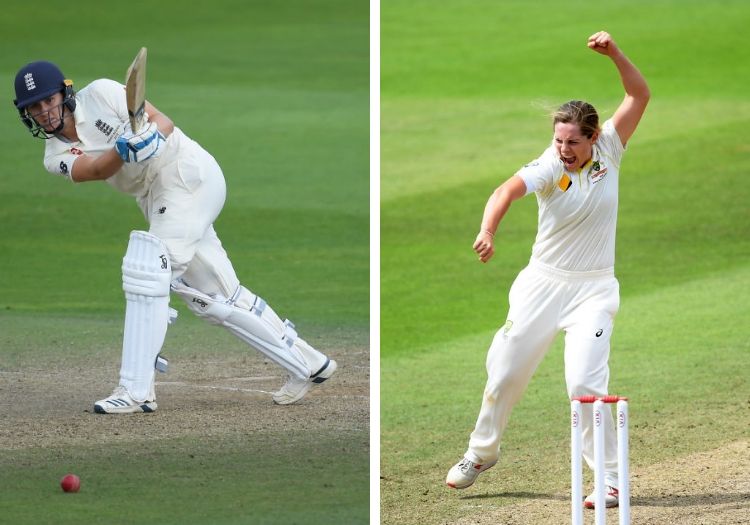
Well, it was lovely while it lasted. In a sense, however, the manner of Amy Jones’ dismissal – driving Sophie Molineux to mid-off – will not concern England.
It may even provide Mark Robinson and his staff with an element of wry satisfaction; if there has been a criticism of England’s batting in this series, it has often been of mindset.
Too often, England’s top order – Tammy Beaumont aside – have looked brittle, physically weaker than Australia’s, unwilling to take them on.
Here, however, Jones stepped up following Beaumont’s own rare failure. She was undone by a good delivery from Ellyse Perry, though one that displayed a slight technical flaw; her bat not coming down straight but from the angle of gully, causing the opener to square herself up as Perry swung her out-swinger past the grope of her outside edge.
Jones, without her partner in crime, weathered the conclusion of Perry’s storm, before taking her chance. When either Jess Jonassen or Sophie Molineux strayed in line or length, she cut and drove with power.
Even the shot to which she finally perished was one that had previously proven fruitful, hitting the spinners over their head. On the final occasion, she struck it well enough but, where she had found the elevation beforehand, she failed on this occasion. It was, though, a shot demanded in the situation as England looked to push the scoring rate.
Regardless of how it ended, it was a knock to reassure and excite in equal measure. It would not be totally unjustified to suggest that Jones had looked almost overawed in the ODI series; not once was she dismissed by a fine piece of bowling, rather she found a way.
On all three occasions, she had fallen to Perry – no disgrace in itself, though the manner of her dismissals will have rankled with a serial run-getter. Once, she top-edged a pull shot to Alyssa Healy, before she mistimed clips to mid-wicket and mid-on in subsequent games.
Thus, this display – one that had Australia on the back foot during an hour that England dominated – will have provided further convincing to Jones herself – on Test debut – that she has the game to dominate at the top of her country’s batting line-up in red-ball cricket as well as white.
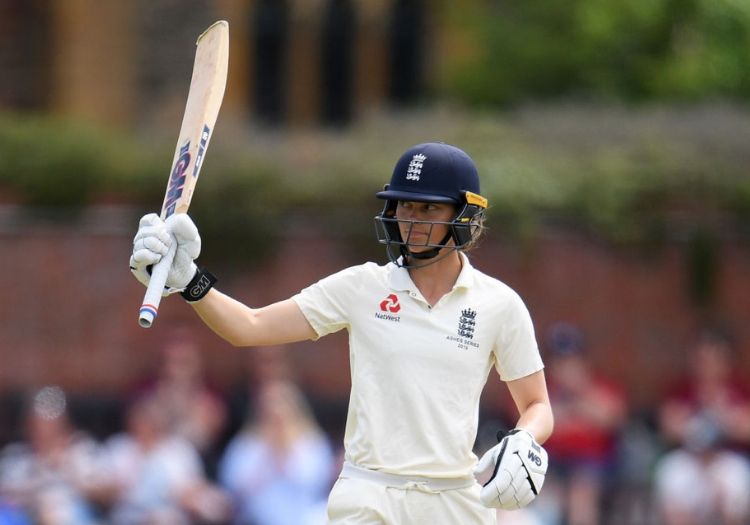
Amy Jones made 64 as England started well enough in response to Australia's 420 for 8
The talk of the town ever since Australia announced their squad for this series, Tayla Vlaeminck was the worst-kept secret of the Women’s Ashes.
There is nothing quite like raw pace. It has forever been the purest form of cricketing fascination; it forces spectators to take note, it persuades batsmen to misbehave, their thinking becomes skewed.
And, frankly, Vlaeminck was no different. She was a fascinating watch. A sprint to the crease, a wild leap, an open-chested hurl like a high-jumper taking flight and then a barrage on release.
She takes out her fury on the turf, banging the ball into the pitch in a way that women’s cricket rarely sees. While many others rely on seam and swing – even Katherine Brunt’s pace is directed closer to her opponent, Vlaeminck hits the surface as if it has caused some offence.
If you are seeking a comparison, then let me offer up Mark Wood – similarly front-on, similarly uninhibited, similarly erratic. Here, it was her unpredictability that both let her down and made her most dangerous.
Her line was often too straight, sometimes too short, occasionally both. But at the same time, in amongst this spray of aggression was a rare thunderbolt destined for the stumps. It was enough to keep England’s batters honest.
That Jones and Heather Knight saw off her initial threat without much alarm was of some testament to the pair. Vlaeminck was all that she seemed likely to be: quick, raw, flawed. But in this most organised of teams, worth persisting with.
Cricket doesn’t help itself sometimes, does it? After losing the afternoon and evening sessions on Friday, why not just start at 10:30am the following day? Yes, play went on in the evening to make up some of that lost time.
Yet, this game’s self-suffocation – this curious desire to discard common sense in favour of arbitrary nonsense – seems a perennial dispute between the outsider and the game itself. It fights a constant battle with its own sense of self.
This four-day Test followed an 11-day break; while both sides took part in practice matches, the time was there to innovate, to allow for the potential of a rain stoppage.
When there is so much on this game – the centrepiece of an Ashes series, a rare opportunity for these women to thrive in the red-ball arena, when there are four points up for grabs as part of this multi-format system – to see it curtailed as a contest by rain seems a crying shame. If there is a result here, it will be partially manufactured.
The same argument, of course, can be made for a lifeless pitch – one that has been low and slow from the start and only began to take serious spin towards the back end of the third day. Does the occasion not deserve more?
This knock will have meant a huge amount to Nat Sciver. A maiden Test half-century is a special moment in itself. However, add to that the sheer scarcity of opportunity available to these women in this format and the volume of Sciver’s innings takes on an additional significance.
She made 49 on her Test bow back in 2014. Ever since then, she has been looking for that extra run. Five years and seven innings later, here it was. Any Test milestone is one worth possessing, but one half a decade in the making is an especially sweet fillip.
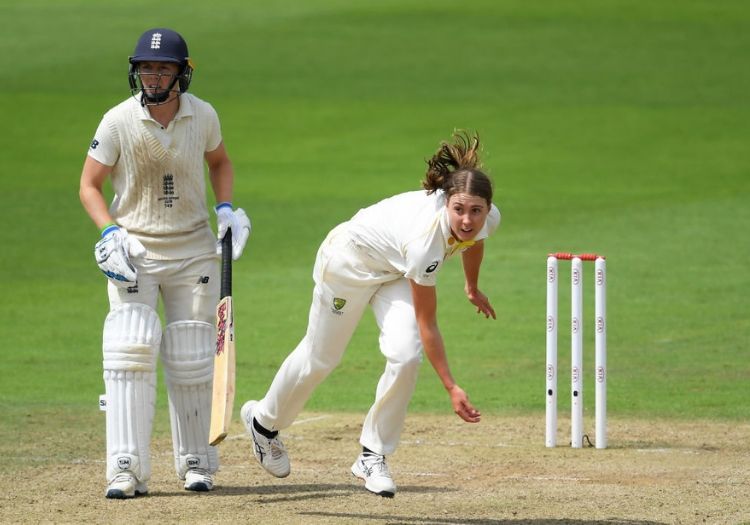
Tayla Vlaeminck bowled quickly for Australia
England fancied it, well at least it seemed that they did. Knight and Jones looked in fine fettle; they added 79 in just over 20 overs for the second wicket. Australia were never overly concerned, but they were briefly forced to defend.
The tactic being discussed among the crowds was a logical one; reach the magic number of 271 as soon as possible - the follow-on target. Reach it and declare. Force Australia to set a target and challenge them: would they be as genuine as they have claimed to be about their ambitions to walk away from Taunton with all four points?
For a while, it seemed that England were singing along to the same tune. But then, a massive, great wall. Australia bowled nicely enough, though no differently to what had come beforehand. England, however, simply stopped looking to score. It was as meek as the previous effort had been enticing.
It was a bizarre period of cricket; whether it was influenced by a lack of faith in England's tail is a valid question. Sciver was steadfast in her denial when she spoke afterwards that England's crawl had ever been part of a plan, but rather the result of good bowling and the regular falling of wickets.
Her partnership with Katherine Brunt yielded 57 runs in almost 27 overs. In the context of what came before, the last 90 minutes were an outlier.
England have shown that they are better than what they showed here throughout Mark Robinson's regime. This evening session was its antithesis - a downright odd episode in an intriguing day.
To celebrate England winning the World Cup you can subscribe to The Cricketer for just £20.19. Click here to learn more

Welcome to www.thecricketer.com - the online home of the world’s oldest cricket magazine. Breaking news, interviews, opinion and cricket goodness from every corner of our beautiful sport, from village green to national arena.