
NICK FRIEND AT EDGBASTON: It was a disappointing end to something that’s been quite joyful. Faced with a big chase on a difficult, increasingly troublesome surface, it all rather collapsed in a heap
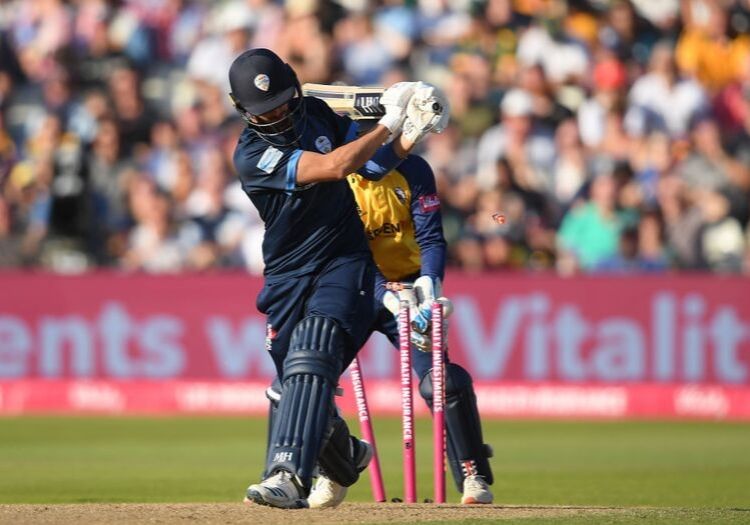
One hundred and eighty-six months later. Here we are. Derbyshire. Finals Day. June 14, 2003. September 21, 2019. It has taken 5,940 days.
Dominic Cork led his side on that occasion – Yorkshire the opponents, Headingley the venue. Michael di Venuto, the Australian opening batsman. Mohammad Kaif, the India star. He fell to Ryan Sidebottom from the second ball he faced.
The game has moved on since then. Cork is Derbyshire’s T20 coach, di Venuto Surrey’s equivalent. Much has changed. But what hasn’t – or hadn’t – was the county’s record in this competition. Never had they reached Finals Day. Until now.
Last year, perhaps, was as strong as they had looked in recent years; the pace triumvirate of Wahab Riaz, Hardus Viljoen and Lockie Ferguson, the top-order hitting of Calum MacLeod. No cigar.
This time around, the beanpole figure of Billy Stanlake had been promised, but never arrived due to injury. He, himself, had replaced Kane Richardson, a white-ball expert called up to Australia’s World Cup squad.
Boyd Rankin came in as a quick fix, Darren Stevens followed on a short-term loan deal – a stint that preceded the 43-year-old’s golden autumn that rewrote the first-class rulebook.
Two signings that might stink of short-termism, but also a pair of investments that highlight the playing field on which Derbyshire are forced to operate.
Quite simply, Derbyshire were written off, cast aside as they so regularly seem to be. Yet, here they were. A side moulded in the image of their captain, Billy Godleman, and performing with the intensity of its coach.
It took Godleman a period of time to ultimately become settled in professional cricket. He began at Middlesex as a prodigiously talented teenager, before taking himself to Essex.
An intense character who spent much of his youth hitting balls, he has found himself and his home at Derbyshire – a fine player across all three formats and, quite visibly, a solid leader of an unheralded side.
And here they were. Marshalled by Godleman, led by experience. Ravi Rampaul is out on his own as the competition’s top wicket-taker; the former West Indies seamer has taken 23 scalps this year, all with an economy rate of 6.70 runs per over.
His slower ball – once so effective and a scourge of IPL batsmen – has been predominantly put away, replaced by a searing yorker, whose threat is accentuated by a skiddy action through the crease.
Here, it did for Ravi Bopara who, in an attempt to innovate, spooned a catch to short third man.
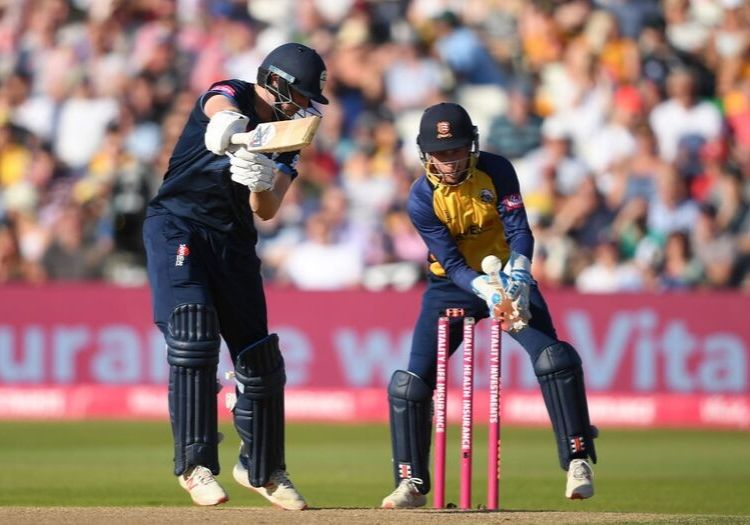
Derbyshire reached the first T20 Finals Day in their history
His departure followed those of Tom Westley and Ryan ten Doeschate, both undone by Luis Reece.
The former Lancashire man is a fascinating cricketer. In the County Championship at least, he opens both the batting and the bowling. My ball, my game, if you will.
Only last week, he followed a five-wicket haul in Sussex’s first innings with a run-a-ball personal best of 184 in Derbyshire’s second effort of that game. His display led, unsurprisingly, to a crushing win – one that ended Sussex’s promotion hopes.
Jogging in with his bleached hair, he is a curious customer performing a curious role. He has carved himself an unusual niche both in his team and in the wider context of today’s game.
When he charged out to open the batting alongside Godleman, he did so with a refreshing sense of reckless abandon. He skipped down the pitch to Jamie Porter, bolshily bashing him back over his head, swinging wildly with – one presumes – total license.
When he fell – somewhat inevitably, it must be said, it had been worth every moment. An attempted scythe at a wide delivery from Aaron Beard was superbly plucked one-handed by Adam Wheater away to his left.
In retrospect, it may have been a knock that reflected Derbyshire’s thoughts on the magnitude of what they faced.
From there on, in truth, there was an element of procession to it all. Aaron Nijjar, brought in to play just his second T20 match of his career, took the key wicket of Wayne Madsen.
Whether the left-arm spinner had been drafted into Essex’s squad specifically to deal with Madsen, a key player but with a weakness against Nijjar’s type, is not certain. Either way, on a wearing pitch, it was a decision made on the grounds of sound logic.
Godleman had already fallen to a wonderful delivery from the peerless Simon Harmer, county cricket’s finest spinner by some distance. And the South African would better himself shortly afterwards, turning the ideal finger-spinner’s delivery past the outside edge of Leus du Plooy and onto his off-bail.
That, in reality, was that. In all honesty, Essex had made too many on a dry surface suffering at the end of a long, testing season. With the ball, Derbyshire had recovered a fairly worrisome situation wonderfully well.
With Essex 93 for one after nine overs, chasing 161 may well have felt like a triumph in itself. That they fell so far short acted as a brutal awakener, an indication of the importance of Cameron Delport – the only man to truly break free of the shackles in either semi-final.
It was a disappointing end to something that’s been quite joyful. Here they were, finally on this bizarre, brilliant stage in the domestic calendar.
Faced with a big chase on a difficult, increasingly troublesome surface, it all collapsed in a heap. Sometimes, though, it’s about the journey as well.

Welcome to www.thecricketer.com - the online home of the world’s oldest cricket magazine. Breaking news, interviews, opinion and cricket goodness from every corner of our beautiful sport, from village green to national arena.