
JAMES COYNE: Bangladesh are fighting to make their first World Cup semi-final. Forty years ago they pitched up in the wettest and coldest May in England since 1722 to try to qualify for the first time
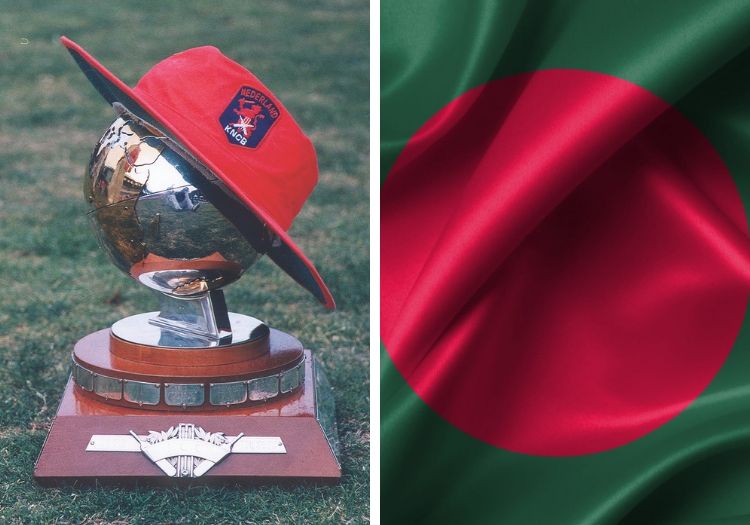

Famously, there are no Associate nations in this World Cup, for the first time ever. But Sri Lanka, Bangladesh and Afghanistan were Associates once, and they had to start somewhere.
Indeed, Bangladesh – who could still shock the favourites to make their first World Cup semi-final – were one of 14 Associate nations who pitched up to England in 1979 for the wettest and coldest May since 1722, in an attempt to qualify for the World Cup.
Ahead of the first World Cup in 1975, Sri Lanka and East Africa had received late invites to join the six Test teams. But several rival Associates were miffed at being overlooked, and pressed for a global qualifying event four years later. The first ICC Trophy was to be held in the English west midlands just ahead of the World Cup.
Prudential, the World Cup sponsors, were not prepared to put in any extra money, so the Associates had to raise their own funds. John Gardiner, secretary of the USA Cricket Association, donated the ICC Trophy itself and winners’ medals, and he and his daughter did the bulk of the organisation.
All the fixtures were allocated by the Midlands Club Cricket Conference, and played within 40 miles of Birmingham. More than 100 local clubs hosted competitive or friendly matches, with many cancelling their own Sunday fixtures to meet more exotic opposition.
Bangladesh allrounder Ashraful Haque told The Cricketer: “It was a massive feat of organisation by the Midlands Club Cricket Conference to put all those matches on. I’m not sure how they did it. But all the clubs treated us wonderfully.”
VISIT THE WORLD CUP PORTAL
So it was especially sad to learn at the start of this season that the MCCC would be folding in September, due to a lack of clubs taking up membership.
Fourteen Associate squads crammed into two hotels in Solihull, and shared one minibus between two teams; the Test nations playing in the World Cup all had their own transport. The two victorious Trophy semi-finalists would stay on to play in the World Cup.
There were notable absentees: Zimbabwe was yet to emerge from a bloody independence war; Hong Kong were unable to meet player eligibility rules; West Africa got their application in too late; and Gibraltar withdrew as the event clashed with a hockey tournament. Wales – not a separate ICC member – filled in, but were not allowed to qualify.
Alas, the weather did not play ball. Seven of the 33 Trophy matches were either abandoned, or reduced by rain or hail. There were seven totals under 100, and not one batsman scored a century.
Israel’s participation was a political hot potato. They were carefully kept out of the groups containing the two majority Islamic countries, Bangladesh and Malaysia, whose governments did not recognise the Jewish state. Sri Lanka were drawn alongside Israel instead, but had to forfeit two points when their government forbade them to take the field against them.
Bangladesh, meanwhile, had gained hard-won independence from Pakistan in 1971 and, after lobbying in The Cricketer magazine by Robin Marlar (‘Whither Bangla Desh’, February 1976), they joined the ICC in 1977. That year, an MCC team played in front of 90,000 people at Dacca.
Ashraful said: “Only a few of us in Bangladesh had played first-class cricket, back in the Pakistani days. There was no money or sponsorship in Bangladesh cricket – the players funded it ourselves, bringing our own match balls and lunches. The government dismissed cricket as a sport of the bourgeoisie. But this was our first international tournament as a new nation, and that carried us through.”
Bangladesh made their international debut against Fiji at Water Orton, a club ground now located near the M6 Toll. Fiji’s Ilkena Vuli was the cover star of the July 1979 issue of The Cricketer: ‘From Fiji, not Fenners’ read the headline. Some of their batsmen went out to bat in bare feet.
"Most Indian restaurants in England are actually run by Bangladeshis, so we had free meals every night"
Ashraful said: “Bengalis living in England, the Bangladesh ambassador and our high commissioner all made it there, though I’m not sure how they managed to find the ground.”
The Tigers managed just 103, Omar Khaled top-scoring with 28, and the Fijians were 40 for 2 when off-spinner Ashraful was thrown the ball.
Ashraful said: “My skipper [Raqibul Hasan] said to us: ‘The high commissioner will be disappointed if we go down easily here, so just try to keep the match going as long as possible.’
“The Fijians were big guys, much bigger than us, and they tried to smash us out of the ground. I do remember that one six almost landed in another village. But they kept getting out too, and collapsed quite quickly.”
Fiji were all out for 81, Ashraful took 7 for 23, and he was carried off shoulder-high by his team-mates.
“As you know, most Indian restaurants in England are actually run by Bangladeshis, so we had free meals every night after that! They didn’t care that it was Fiji we had beaten. My picture was on the back page of the Evening Standard and all the papers back home.”
Bangladesh lost to Canada by 49 runs at Lichfield, and beat Malaysia by seven wickets at Walsall.
But their dreams of a World Cup debut were snuffed out by Denmark at Kings Heath. Keld Kristensen scored 74, opening the batting with Ole Mortensen, the 21-year-old trainee tax inspector who ended up at Derbyshire – and was once asked by Mike Gatting if he was eligible to play for England. Mortensen had a 28-yard run-up at the time, and took all 10 of his tournament wickets either bowled or lbw. Ashraful struck 31, but Bangladesh fell 11 runs short of chasing 166.
The finalists, Sri Lanka and Canada, took their place in the World Cup before reconvening to play the ICC Trophy final at New Road on Midsummer’s Day.
It would take another five ICC Trophies for Bangladesh to make it to the business end of an ICC Trophy and into a World Cup – and even after that there was plenty of pain between then and becoming a major force in world cricket.
But they have truly arrived now.
This is an edited extract of an article from the September 2018 edition of The Cricketer. To order a back copy, click here
Subscribe to The Cricketer for exclusive content every day: The inside track on England's Test tour with George Dobell in Pakistan, award-winning analysis, breaking news and interviews and the only place for in-depth county coverage all year round. Plus: An ad-free app experience at your fingertips. Subscribe to thecricketer.com today for just £1.

Welcome to www.thecricketer.com - the online home of the world’s oldest cricket magazine. Breaking news, interviews, opinion and cricket goodness from every corner of our beautiful sport, from village green to national arena.