
The Cricketer looks back at some of the standout performances at this T20 World Cup from associate nation cricketers
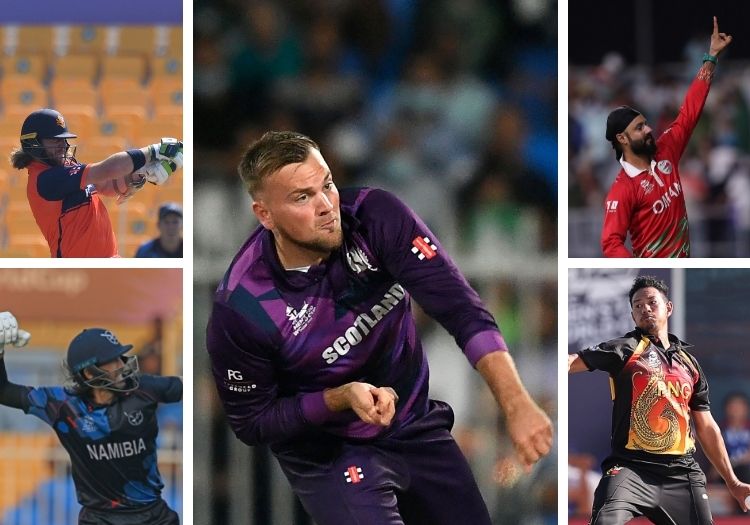
A fortnight to forget for the Netherlands, of whom plenty more was expected than ultimately delivered. O’Dowd was one of few to emerge with much credit, among the 12 players in the tournament to record two half centuries. Both, though, came in defeats by Ireland and Namibia.
That the 27-year-old is the only Dutchman in this composite side is hardly surprising. Their struggles were an unedifying way for Ryan ten Doeschate to finish his tremendous career, left out for their final group game against Sri Lanka – his own call, according to head coach Ryan Campbell – as his countrymen were bundled out for just 44.
Like O’Dowd, the Omani opener’s time at the T20 World Cup was all too brief, and his country’s exit might just have hinged on the mix-up that saw Jatinder run out just two balls into a qualification decider against Scotland.
The right-hander had been in prime touch, unbeaten on 73 to ensure there were no hiccups in a comfortable chase against Papua New Guinea, before adding 40 against Bangladesh – a knock that, while it was going, had Mahmudullah’s side worried.
His numbers might not necessarily back up this claim, but for Namibia’s captain this was a tremendous breakout tournament. At their first global tournament in 18 years, Erasmus was an impeccable leader, fittingly at the crease – unbeaten on 53 – to see his country over the line against Ireland and into the Super 12s.
In a competition full of emotive, memorable moments, that one was right up among them. “We run a tight ship: a small country, a small number of people playing cricket – we should be proud of ourselves,” he said following that game. Thereafter, his productivity waned, but only once he had broken his finger. Needless to say, he didn’t let that stop him.
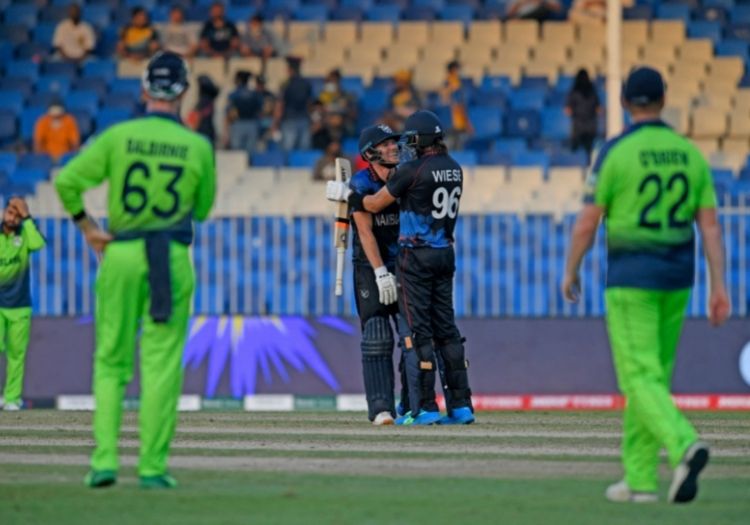
David Wiese and Gerhard Erasmus embrace after guiding Namibia to a famous win over Ireland
An unusual tournament for a veteran of Scottish cricket, who combined fifties against Papua New Guinea and Pakistan with ducks against India, Namibia and Afghanistan – a list of nations that highlights quite what a journey his side enjoyed in the UAE.
It was only right that he was at the crease to see his country over the line against Oman, unbeaten on 31, to reach the Super 12s – an achievement that was met with some quite wonderful scenes on the boundary edge. Scotland had waited so long for a moment like that, with Berrington at its fore.
Ahead of the final, the fifth-highest run-scorer in the competition and second – behind Jos Buttler – on the six list. The presence of the former South Africa allrounder in Namibia’s ranks was met ahead of time with plenty of intrigue – he wasn’t the first man to represent two countries at a T20 World Cup – but still in a minority of three (alongside Dirk Nannes and Roelof van der Merwe).
Wiese, though, had insisted beforehand that it meant plenty to be turning out for his father’s homeland, and he made the most of his opportunity. There was a match-winning half century against the Netherlands – Namibia’s first-ever World Cup victory – and vital cameos in almost every other game. Just once did he fall in single figures.
And he understood that he was joining his teammates’ journey at a privileged moment. “I don't think I deserve to be sitting here,” he said, named man of the match after the Ireland win. “I think the captain Gerhard Erasmus deserves it. This is really his moment and the rest of the team, who have put in so much work before now to be here.”
Tied with Australia’s Matthew Wade heading into Sunday’s final, no wicketkeeper has been involved in more dismissals through this tournament than Cross. He was quiet with the bat but conceded just a single bye in eight games, completing a pair of stumpings for good measure – both off Mark Watt’s left-arm darts.
Alongside Berrington, he was key in seeing Scotland home against Oman for one of the country’s most significant, celebrated victories.
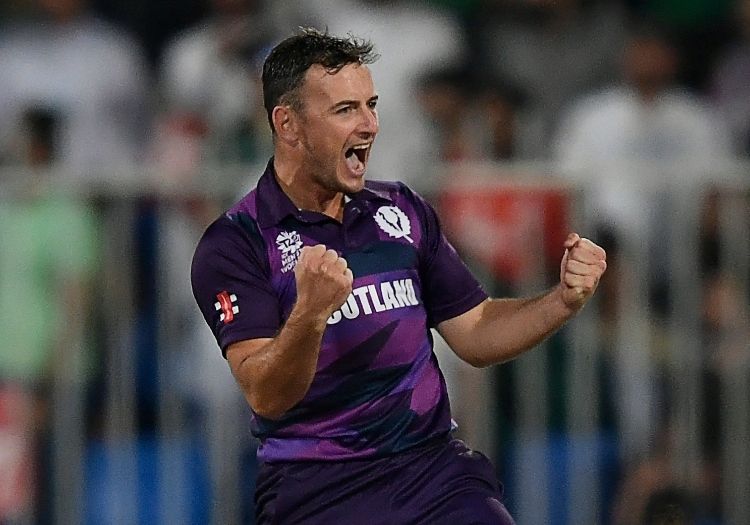
Chris Greaves produced arguably the best performance from an associate player against a full-member nation
His impact waned after his initial heroics against Bangladesh, but what a night that was. Arguably, it was the best individual performance across the tournament by an associate player against a full-member nation: the Amazon delivery driver turned international allrounder, who only made his T20I debut in a pre-tournament warmup match against Papua New Guinea.
Scotland’s batting never really fired throughout, and it was from a situation of crisis that Greaves came to prominence: they were 52 for 5 when he arrived at the crease, smashing 45 to guide his adopted nation – he was born in South Africa – to 140 for 9. Given the pattern that would develop in night-time games, Scotland’s win – defending a total – was all the more remarkable: Greaves dismissed Mushfiqur Rahim and Shakib Al Hasan in three overs of leg spin to write his name into history.
If Greaves enjoyed a one-off night of glory, then Watt was comfortably Scotland’s player of the tournament. Of every associate cricketer on show, his was perhaps the breakthrough month that others craved. His record was outrageous, his skillset completely uncomplicated.
In eight games, he was hit for just seven fours and eight sixes, watching the batter until the very point of release and following him at all costs. He rarely looked to spin the ball, instead darting it in at the toes: few can have nailed their yorker with greater consistency.
Interest and offers should swell off the back of this: he is already off to the Abu Dhabi T10 League this winter, while the least you’d hope for Watt would be a T20 Blast gig and a chance in The Hundred, where he would count as a local player.
Another Namibian left-armer. Frylinck went under the radar somewhat: slower than Trumpelmann, less heralded than JJ Smit, older at 27 than both.
But he – alongside Scotland’s Josh Davey, who played just five games – was the leading associate wicket-taker in the tournament, picking up nine in seven matches, ending with the scalp of Rohit Sharma. Having first featured in qualifying for this tournament as captain against Swaziland back in 2018, that represents some ride. He didn’t even bowl that day.
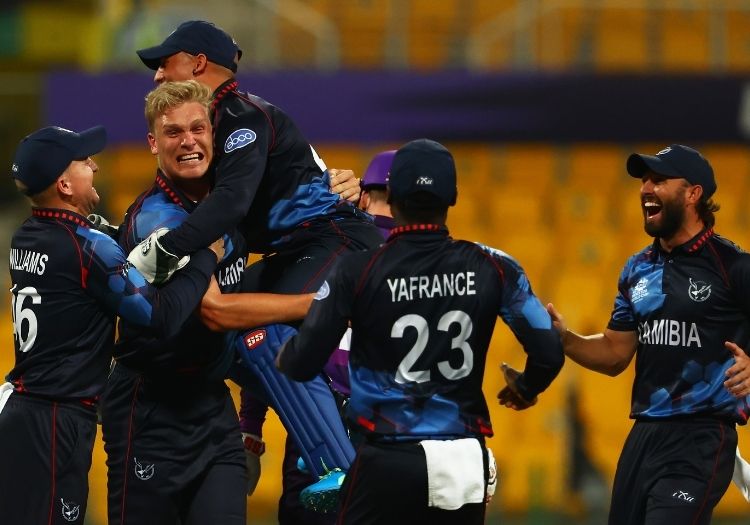
Ruben Trumpelmann impressed for Namibia, swinging the new ball at pace
Durban-born but making his name in the colours of Namibia, Trumpelmann is the first of a trio of left-arm seamers in this team. He peaked in a remarkable first over against Scotland, claiming three wickets that led his country to a first-ever Super 12s victory.
Still only 23, he comes with plenty of potential to improve further, already with pace to burn and the ability to swing the new ball back into the shins of right-handed batters. Given the franchise circuit’s thirst for left-armers, he might just have a chance. “I want to become the best associate bowler in the world,” he said in an interview with the host broadcaster. All being well, this is just the start.
For three games, Morea took a wicket every ten deliveries, swinging the new ball and returning at the death with a slower ball that seemed to hoop prodigiously in the air.
Papua New Guinea had plenty of glorious moments on their debut in a competition like this: Charles Amini had a highlights reel to rival any, only without a defining contribution; Assad Vala – a veteran of tournaments a decade ago in Buenos Aires as part of the World Cricket League era – made a T20 World Cup half century as captain of his country.
Morea, who took the wickets of Imam-ul-Haq and Sanju Samson in Under-19 World Cups, added Bangladesh’s Mohammad Naim and Scotland’s Kyle Coetzer among his six scalps, four of which came against Scotland.

Welcome to www.thecricketer.com - the online home of the world’s oldest cricket magazine. Breaking news, interviews, opinion and cricket goodness from every corner of our beautiful sport, from village green to national arena.