
England’s 1995/96 tour to South Africa was fractious at times, though there were some highlights, with ‘the great escape’ at The Wanderers and meeting Nelson Mandela. Huw Turbervill recalls the trip, with Jack Russell, Mark Ilott and Angus Fraser
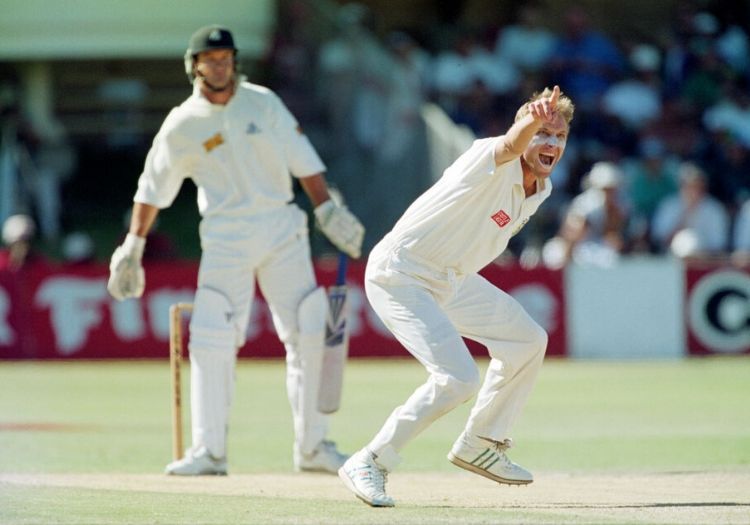

England’s tour to South Africa in 1995/96 was an intriguingly new experience for so many fans. It was England’s first there since 1964/65, after the hosts’ readmission to the international game in 1991.
I was a student, so had hours – no, days – on my hands to devour almost every ball on Sky (in the pub) and radio. The fact that the first four Tests were drawn didn’t bother me. The fact that England tossed the last Test away to lose an evenly contested series until then did. It was England’s fourth away series defeat in a row, the third under Mike Atherton’s captaincy.
It was a political tour – not just because of the end of apartheid and the England team meeting president Nelson Mandela. There were power games going on between Ray Illingworth and Atherton. The former had not found the chairman of selectors role to be enough. He’d been frustrated watching coach Keith Fletcher in Australia the winter before.
He wanted absolute power – to be ‘supremo’. He’d also been sceptical about the leadership skills – or maybe it was the independent streak – of his captain. The ‘dirt-in-the-pocket’ affair (during the Lord’s Test against South Africa in 1994) convinced the Yorkshireman that he had the Lancastrian where he wanted him now however – in his, err, pocket.
When Atherton expressed his preference for Peter Martin to play instead of Angus Fraser at Durban, Illingworth wrote: “I told him for the first time that he was now becoming a good captain, because he had just made a cricketing decision above friendship.”
Illingworth tried to remodel Devon Malcolm’s action in the early weeks of the tour. It turned nasty, and the fall-out played a part in seeing Illingworth going back to being ‘just’ chairman of selectors once again, before eventually stepping away altogether in 1997.
There was memorable cricket though: with the emergence of Shaun Pollock to form his partnership with Allan Donald – and for Atherton and Jack Russell, it was their greatest tours.
The first Test at Centurion was ruined by rain (as was a lot of the series, with nearly eight days off). Only one innings was completed, Graeme Hick making 141, probably his best Test knock (“As well as I’ve seen him play,” said Illingworth). Atherton and Illy built bridges by – ahem – playing bridge most of the time.
The second Test at The Wanderers, Johannesburg, is famous for the incredible 277-minute stand by Atherton (185 not out) and Russell (29 not out) that saved the match. Russell also took a record 11 catches. Malcolm had a good Test, taking 6 for 127.
The third Test at Kingsmead, Durban, saw only 15 wickets fall in the match. It is probably best remembered for a minor ball-tampering row involving Craig Matthews and Pollock.
The fourth Test at Port Elizabeth was another draw that saw ‘leg theory’ deployed by Atherton to waste time. Trevor Bailey criticised it on the radio… oh, the irony!
The fifth Test, at Newlands, Cape Town, saw England collapse twice. Allan Donald took 5 for 46 in the first innings. A last-wicket stand of 73 in 15 overs between David Richardson and Paul Adams took the hosts into a strong position, with Illingworth blaming Malcolm for failing to part them. Pollock then took 5 for 32 to hurry England to defeat.
Captain Hansie Cronje pressured umpires to refer a run-out against Graham Thorpe. Although it was out, Cronje was fined 50 per cent of his match fee. I know it’s difficult to believe, but England lost six wickets for 19.
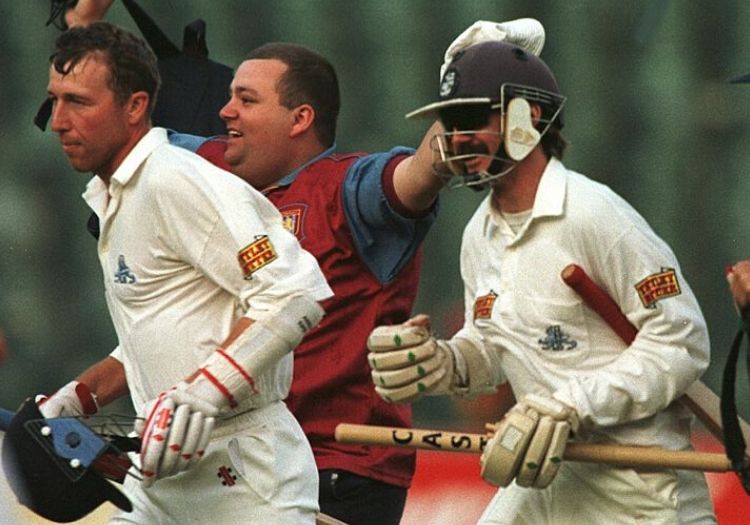
Michael Atherton and Jack Russell pulled off 'the great escape' at The Wanderers
The talking points
Malcolm was the ‘destroyer’ of South Africa, after taking 9 for 57 (“You guys are history!”) against them at The Oval 1994. They must have feared him… Alas the England management decided to change his action, and the consequences were dire. He played in only two Tests, taking six wickets. Can a leopard change its spots? In this case, no. Why, oh why did they tamper?
According to Jack Bannister, in the book One-Man Committee: The Complete Story of His Controversial Reign, Illingworth and bowling coach Peter Lever wanted to fine-tune Malcolm’s action. “Lever and Illy will go to their graves swearing that, at no time in their dealings with the fast bowler did they attempt to change his action to any radical degree. They just wanted to make him more repetitive and consistent in his action,” wrote Bannister.
Illingworth had tried to settle and assure Malcolm by telling him, at the end of the summer, that he was going on tour, something he didn’t tell anyone else (although one suspects Atherton had a clue he was making the plane). “All I wanted from him was a recognition of a basic fault which we all wanted to cure,” said Illingworth.
Malcolm disagreed, however. “They had radical plans for me,” he said. “They wanted to re-model my action. I had passed my 32nd birthday, taken over a hundred wickets in more than 30 Tests, yet it was time to ‘streamline’ me, and overhaul my action. I’d always seen myself as an instinctive fast bowler. I should have been stubborn, digging my heels in right away, but instead I gave it a go. It’s ironic that later Illingworth thought I’d been stubborn and too resistant to change. He never gave me any credit for at least listening to his scheme and trying to make it work.”
Initial efforts were hampered by his knee operation in the September, and Malcolm spent the early weeks of the tour limping, and favouring his left leg. It did not help either that no one knew how to operate the video machine, so Malcolm could not be shown what the coaches were trying to achieve. Atherton eventually persuaded Illingworth to let Malcolm do what he wanted. “Fine, do what you want, but you’re on your own,” was the reply.
Malcolm told journalists that they were trying to make him into a medium-pacer, and things came to a head in the nets ahead of the fourth Test. Malcolm was trying to coach a young local bowler, but Illingworth found it a distraction. Malcolm claimed he was told to f*** off; Illingworth insisted he merely said p*** off. Malcolm called it the “most humiliating moment of his career”. He said they also tried to tinker with Darren Gough’s action. “He couldn’t handle it. Illingworth ended up telling him to go back to what he did instinctively.”
Malcolm wrote that he lost respect for Atherton: “It baffled me that he should have looked so uncomfortable… he failed to speak up for me.” Malcolm was not picked for the third Test “when conditions were ideal for seam, and swing”, and he was devastated. He was anxious going out at night, fearing an attack by an extremist. South Africa coach Bob Woolmer felt he was never fit all tour.
His biggest failure, as Illingworth saw it, was being unable to knock over Adams, batting with Richardson, in the final Test (although he nearly did when Adams inside-edged him for four). Malcolm was told to pepper him, but managed only one authentic bouncer.
“You bowled crap and probably cost us the Test,” said Illingworth. “I stared at him and whistled,” said Malcolm. “He was purple in his face. I was grateful that I hadn’t succumbed to the temptation to punch him on the nose.”
The row dragged on after the tour, and Malcolm told his story to The Daily Express. “The reporter who wrote the articles asked if I felt that Illingworth’s hostility to me was racially motivated,” wrote Malcolm.
“Certainly, his behaviour to me had been irrational and I had racked my brains trying to work out what had motivated him. At no stage did I say he’d been racist towards me. I gave a rhetorical answer to the Express reporter, ‘I don’t know, you tell me’. It was naïve of me, I ought to have smashed that line of enquiry flat. It was a cry for help – my only regret was that the race card was played. I never wanted financial gain: I just wanted the press to know what had happened.”
Illingworth and people who knew him in the game were outraged by the claim. He was fined by the Test and County Cricket Board, but that was later rescinded.
Atherton was glad: “I had no desire to see a man who had given much to English cricket leave with a black mark against his name. I could see both sides of the argument and it was clear that both parties were to some extent at fault. Equally Illingworth’s propensity to wash our dirty linen in public was damaging, not only to Malcolm but the team as a whole.”
Now, 23 years later, this is how Russell saw it: “I wasn’t privy to any tension. But Devon was our Exocet. After his 9 for 57, the South Africans were worried about him. He didn’t play in the first Test and that was soul-destroying for us. Devon was fast but no one knew where the ball was going.
“He fell away and brought the ball back in, which was actually handy – see Colin Croft. Occasionally he swung it. Obviously in hindsight it was best to leave him alone, like they did with John Snow. I wouldn’t have tinkered. Just let a bowler like that play and do his thing! Illy was old-school. What I will say about him was that he was the best reader of a pitch I’ve seen. Alan Knott said he was the best captain he’d play under.
“He was either for or against you, there was no halfway house. [Batting coach] John Edrich was brilliant though. He drove to Bristol for sessions with me. He got me really balanced. I watched him as a kid score 175 against Australia in 1975. He was a fellow left-hander of course, and it was great to be coached by him.”
Angus Fraser says he could see both sides of the argument. “If you started with a blank piece of paper, you wouldn’t bowl like Devon,” he said. “I could see what they were trying to do – refine a raw diamond. He had pace and he was a bloody good bowler on his day. The question was the manner in which they went about it.
“Peter Lever was a lovely bloke, but Illy was old-school. He told you how to improve, rather than working with you. They tried to change me, told me I needed to start swinging the ball. The thing is I averaged 27, Devon 37. The 1990s saw a tug of war between England and the counties – they didn’t want to release players, before central contracts in 2000 resolved that.”
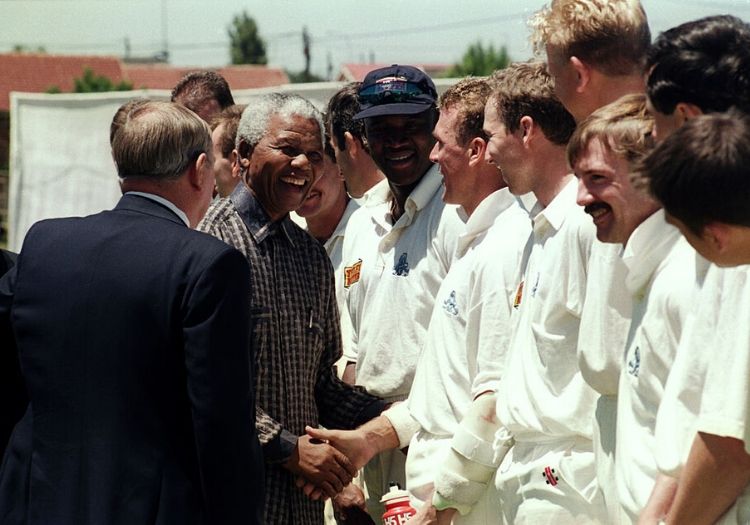
England's players met Nelson Mandela
“I know you, you’re the destroyer.”
South Africa’s president Nelson Mandela had dropped in by helicopter to Soweto, for the inaugural first-class cricket match to be played in a black township. He met the teams, and had
clearly heard about Malcolm’s exploits at The Oval.
“The pride swelled up inside me,” wrote Malcolm. “Apart from Jenny giving birth to my three children, it was the greatest day of my life. Meeting Mandela made me feel as strong as Samson. Could it be that Illingworth was annoyed at all the attention I had received from President Mandela?”
Malcolm was asked to play in the match as an icon to the black youngsters watching. He was not ready. He bowled 14 innocuous overs, then his knee was iced up. “He got carried away a bit [after meeting Mandela] and it was difficult to focus him on the job in hand,” said Illingworth.
Fraser recalls: “We stopped playing on the first morning, and everyone was in awe of him. He was so gracious. ‘Thank you for coming to my country,’ he said. There were thousands of children there. It was like we were magnetised by him, following him around the pitch. It was an amazing day.
“Only twice in my life have I been in the company of people where I have thought, ‘Woah!’; the other was at the BBC Sports Personality of the Year, when Muhammad Ali walked past me.” Mark Ilott said: “Mr Mandela came up to me and said the ‘pleasure is all his’. I couldn’t believe it – one of the world’s greatest statesmen, saying this to me! It was truly humbling.”
I have argued in these pages that Illingworth was England’s greatest captain, and the tour of Australia in 1970/71 one of our finest expeditions. He could have been superb as coach in the 1980s, when England had one of their most talented teams, but produced a decade of disappointment and inconsistency. But he was perhaps too old by the 1990s, and this trip was arduous for a 63-year-old.
“His style of decision-making was certainly autocratic and gave the impression, to the outside world at least, that he was in control,” said Atherton. He was a hard man. He banned the Reverend Andrew Wingfield-Digby from the England dressing room. Malcolm said his presence may have helped.
His record of identifying England players was mixed. He received flak for favouring Craig White, but he came good. But was Steve Rhodes really better than Russell? He never seemed to have full confidence in Thorpe or Fraser.
“I was in the middle of my best period as a batsman,” said Atherton. “For a short time in the mid-1990s I was the best player in the England team and the wicket most prized by the opposition. Johannesburg was the pinnacle for me, and afterwards the curve of the graph was mainly downwards.”
“He played as well as I have ever seen him,” said Illingworth. “It was one of the greatest innings ever played. He closed his mind to everything except the next ball.”
It was Atherton’s highest Test score, and lasted 643 minutes, at the time the fourth longest Test innings for England, behind Len Hutton’s 364 against Australia at The Oval in 1938 (797 minutes); Ken Barrington’s 256 v Australia at Old Trafford in 1964 (683); and Clive Radley’s 158 v New Zealand at Auckland in 1978 (648).
Russell said: “It was an awesome effort. If they were dedicated enough, players could play similar knocks now, but it would be difficult as T20 has changed techniques. Mike only played two or three shots all day. That’s all you need.” Fraser said: “None of us moved. At drinks we all raced off for a pee. I was half-padded up. We had an awesome evening. It was a few miles from the hotel. Ian Botham had a bet with Atherton that he wouldn’t save the match, and they got legless. I jogged home and was b******ed by security.”
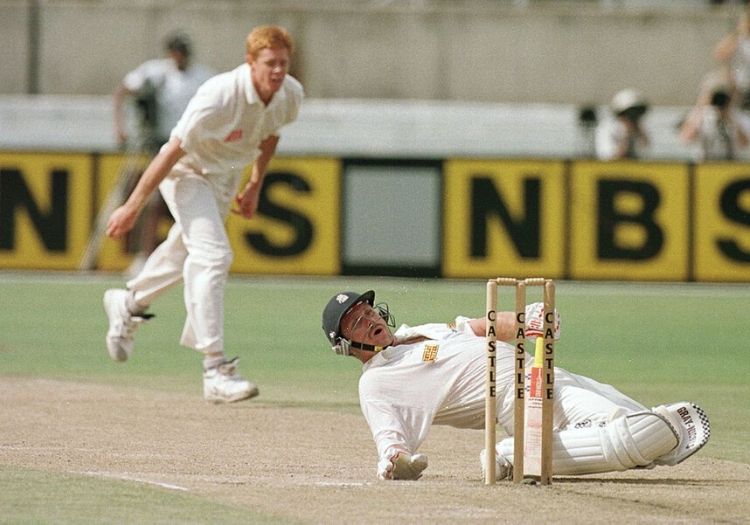
The series saw Shaun Pollock arrive on the Test scene
The Gloucestershire gloveman survived for 274 minutes for his unbeaten 29 at The Wanderers. “I was supposed to be nought not out. I hit a four late on and gave myself a b*******ing. Robin Smith was caught at third man as he was prone to. I thought, ‘Right, somebody needs to pull their finger out and help Athers’. Donald threw the kitchen sink at us. I was nearly caught and I vowed to make that count.
“Athers was an inspiration. I kept reminding him of Barbados 1990, when I’d been caught at 5.15 and we lost with 15 minutes left. Afterwards he said, ‘Hold on, I didn’t even play that Test!’ I did pester him and we kept each other going.” Russell also scored 129 against Boland in the tour match afterwards. “I hadn’t expected to play! My wife turned up, the only time she came on tour. It was my favourite tour. On days off I painted. It was amazing to paint Rorke’s Drift after seeing Michael Caine in Zulu. I went back the next week!”
The slow left-arm googly bowler emerged on this tour. As Neil Manthorp wrote: “Batsmen were hopelessly caught in the blurry glare of the impossible contortion.” “Amazingly they gave us a sighter when he was picked for South Africa A,” said Russell.
He took 4 for 65 and 5 for 116. “I thought, ‘What is this?’ I cannot understand why we kept getting out to him. He was just like an off-spinner really.” Illingworth said: “He diddled us at Kimberley.” He played the third Test, then resisted England in the fourth, prompting Illingworth (probably) to use a word stronger than ‘diddled’.
He debuted in this series at 22, but it was his fifth Test that saw him prove a matchwinner. “He ended up being the difference,” said Russell. “It had been tight but that spell changed everything. He was not lightning quick, but it hurried you a bit, kicked up off a length.” He took 421 wickets in 108 Tests.
• Illingworth and Atherton believed England were hampered by the absence of central contracts, in contrast to their hosts. Illingworth asked in 1995, but they didn’t come until 2000.
• A few decisions went against England. Bannister cited over-appealing by the tourists as a factor. He also criticised an itinerary that saw England not play at the any of the Test grounds before the Tests themselves (look at tours nowadays!).
• Illingworth cited the disruptive arrival of England players’ wives and children after the third Test. They had a travelling party of 64. Fraser confirmed: “There was the fiasco with the wives, and the senior players were disgruntled. Then we lost the final Test in three days. The management agreed we’d play an extra ODI for the fans. It would have been nice to have been asked!”
“We didn’t have too much to complain about,” said Ilott, “as we’d escaped at Johannesburg. I was just happy to be there. I wasn’t too aware of what went on between Illingworth and Malcolm. I knew there wasn’t much love lost. It was a shame they tried to change his action on the tour. He’d reached the elite level with it as it was.”
While the Tests had been relatively close, the one-day series was not. England lost 6-1, rounding off a winter of discontent.
This article was published in the January 2020 edition of The Cricketer - the home of the best cricket analysis and commentary, covering the international, county, women's and amateur game
To remind ourselves of happier times we’re offering a £20.19 subscription to celebrate England’s World Cup win once again. Click here to claim

Welcome to www.thecricketer.com - the online home of the world’s oldest cricket magazine. Breaking news, interviews, opinion and cricket goodness from every corner of our beautiful sport, from village green to national arena.