
NICK FRIEND looks back on the key moments as India clinched a crucial victory over England in the penultimate match of their multiformat series

Tammy Beaumont will make more eye-catching fifties for England, but few will be as quietly accomplished as this: a knock built on the perfection of her cut shot and then adapted against India’s spinners to take advantage of a bare legside field that gave her a boundary option anywhere squarer than deep midwicket.
It eventually proved her downfall, trapped in front – albeit a long way down the wicket – by Deepti Sharma, but not before she had profited frequently from the tactic, frequently stepping inside the line to manufacture a stroke into the legside.
Once Beaumont fell, however, she was followed almost immediately by Heather Knight, with whom she had put together a 75-run stand. Her wicket was somewhat controversial, with the ball ricocheting onto the stumps via the ankle of Sharma, whose dive appeared to obstruct Knight from making her ground.
What happened next should concern England, whose sense of calm disappeared in the face of a still-comfortable asking rate and a long batting line-up. First, Sophia Dunkley ran herself out via a mid-pitch miscommunication with Amy Jones – the third runout of the innings.
Then, Jones fell into the same trap as Beaumont, enticed by the vacant legside boundary but only able to scoop into the hands of square leg, waiting on the edge of the ring for that precise error. Mady Villiers was the fourth England player caught short, dawdling as a throw came in from long-on.
Thus, from 106 for 2 the hosts struggled to 140 for 8: in 120 deliveries, only Beaumont and Knight hit fours, with Jones striking the solitary six of an innings that never quite got going but should still have had enough in the tank to creep over the line. A lack of strike rotation dug a hole and, as Knight put it herself, England simply weren’t “ruthless” enough.
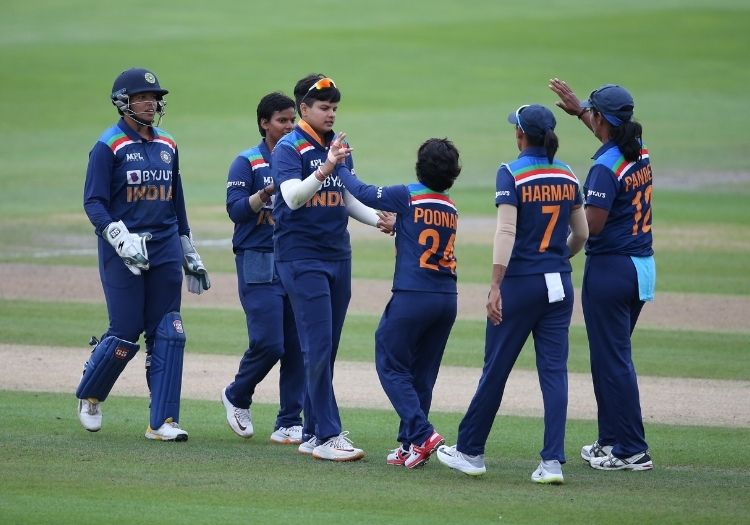
As it is, both teams head to Chelmsford with the result of this multiformat series still undecided. An England win – and they should have won at Hove – would have wrapped it up once and for all. But their lack of composure, coupled with a fine effort from Poonam Yadav, Sne Rana and Deepti Sharma, whose 12 overs combined cost just 56 runs, means India can square things up with a victory on Wednesday in the final game of their trip.
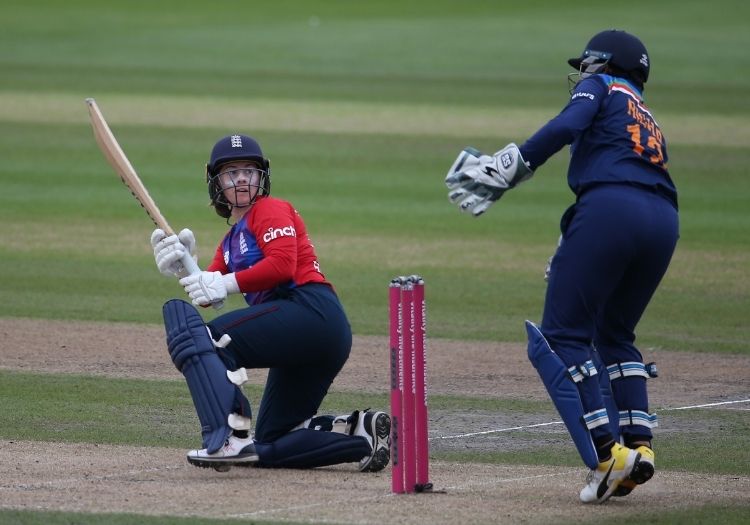
Tammy Beaumont's half century looked to have set England on their way
Perhaps there is no higher praise than to say that Shafali Verma made Sophie Ecclestone and Katherine Brunt look ordinary. But the powerplay was such a festival of youthful exuberance and generational hand-eye that Smriti Mandhana was content simply to hand over the strike to her younger teammate. It gave her the best seat in the house as the 17-year-old took aim.
Needless to say, neither Brunt nor Ecclestone are remotely ordinary: one is the world’s top-ranked T20I bowler, the other a legend of the women’s game. Yet, just for a few fleeting moments, they had no answer. Verma slog-swept Ecclestone for four and then six; in the next over, she unloaded on Brunt. Their battle over the course of the last month has been one of the highlights of India’s tour of these shores.
After a Mandhana single – her trademark amid the carnage ensuing 22 yards away – the apprentice took the master for five consecutive boundaries. Each was different: balls on the same line and length were carved backward of point and smeared through midwicket.
It was evident that Verma had used the last 24 hours to work at the trigger movement that had begun to cause her problems as this series has worn on: it was less pronounced and gave her a more stable base from which to belt England’s bowlers.
At one stage, she had 38 from 17 balls, having plundered Brunt’s second over had cost 21 runs; England were rattled, with both Ecclestone and Brunt wicketless halfway through their respective spells – and that does not happen often.
Her dismissal was a reminder of her fledgling naivety, slog-sweeping Mady Villiers to long-on just a matter of deliveries after Mandhana’s own demise. Verma’s job, having seen out the powerplay, was surely to make the most of her platform rather than to chance her arm when India needed a few minutes’ consolidation. England tied her up well, however, in the preceding overs: she made just 10 off the last 21 balls she faced, including an Ecclestone maiden. A reminder – and Heather Knight’s side briefly needed one – that Verma, with her T20I strike rate of 145.8, is human after all.
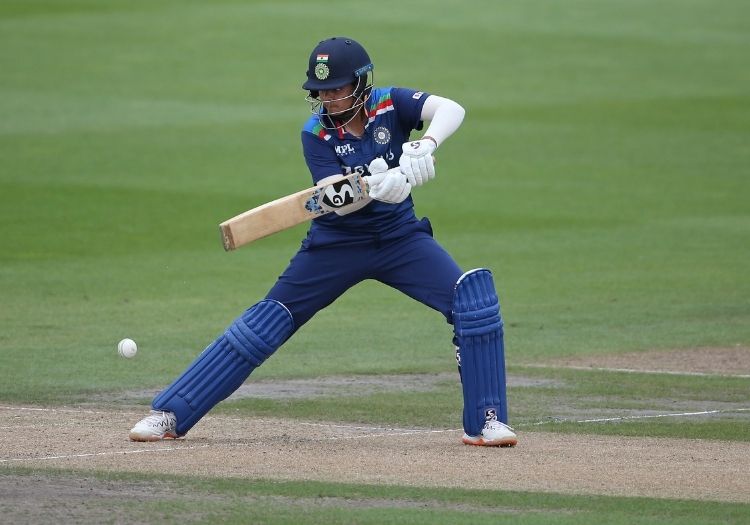
Shafali Verma gave India the perfect start
For so long, Ellyse Perry monopolised the status of the leading allrounder in the women’s game. But since the appointment of Lisa Keightley as England’s head coach – as well as injury issues for the Australian great – Nat Sciver’s profile has stradily increased. Mark Robinson, too, had spoken in similarly glowing terms.
When she strode to the crease early on in England’s innings, Mel Jones on commentary introduced her with the title once reserved for Perry. And though Sciver would run herself out before she could make any significant impact, she had already starred as the home side’s best seamer: four overs for 20 constituted a fine effort in the circumstances, especially with Brunt and Freya Davies proving expensive.
Only 48 hours earlier, she had shown her danger with the bat, hammering as brutal a half century as you might reasonably be likely to witness in a T20I. Twice in three balls, Arundhati Reddy was forced to take evasive action to avoid having her head dislodged in her follow-through.
If there has been a criticism in recent times of Sciver, it has been her struggle to put together a complete performance with both bat and ball – the notion that both have rarely fired on the same day. Whatever the merits of that argument, it is difficult to debate her position at the moment as England’s vital talisman.

Welcome to www.thecricketer.com - the online home of the world’s oldest cricket magazine. Breaking news, interviews, opinion and cricket goodness from every corner of our beautiful sport, from village green to national arena.