
NICK FRIEND AT THE INCORA COUNTY GROUND: This night – autumnally chilly by the end – marked the cutting of the ribbon: an opportunity for months of pent-up momentum to release itself like a racehorse from its starting gate
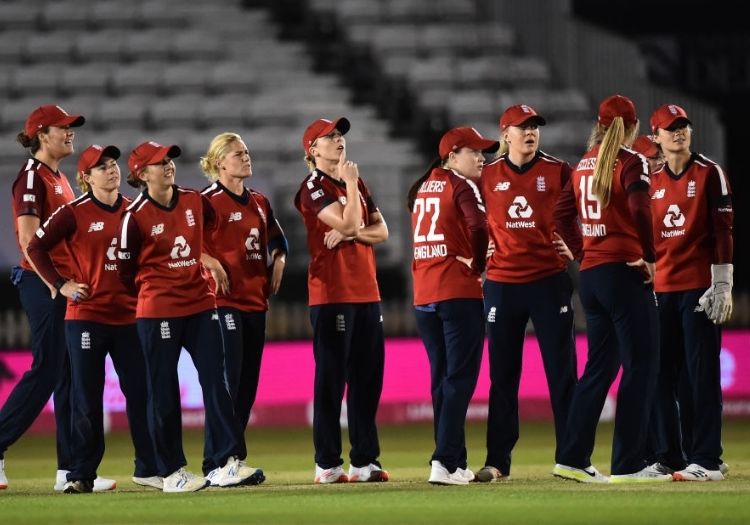

Tonight mattered more than any scorecard might reasonably suggest. You could hear it in Heather Knight's voice at the toss; you could see it in England's vigour in the field; you could sense it in the authority of Deandra Dottin's resolute response.
After months of uncertainty, an unusually balmy Derby evening in the late-September sunshine was the least that everyone involved both needed and deserved.
Where the women’s game is concerned, ‘momentum’ has been the buzzword of recent years – everything has been a build-up to the next stop along the sport’s growth train.
A Lord’s sell-out three years ago for a World Cup final that captured the imagination of the cricketing world was a pinnacle for the time, but also merely a single step on a journey towards a grander plan.
Every year since, further strides have been made, culminating in the remarkable scenes of mid-March – images that now feel like those of a different world or, at the very least, of a bygone era. Australia have long-since driven the game’s upward curve – as much in its wider commitment to hoisting levels of audience engagement as in on-field dominance.
They pledged to use this year’s T20 World Cup to take the women’s game to a place where it had never previously been, and they delivered. A final figure of 1.1 billion video views across the ICC’s digital channels is the second-highest figure of all time for any global tournament and the highest by a considerable margin for a women’s event – a twentyfold increase on the 2018 competition, for one.
As India were blown away by Australia in the final, 1.78 billion viewing minutes of live coverage were raked in – a number that exponentially dwarfs the equivalent event two years ago.
That evening, wrapped around the MCG, 86,174 spectators watched on – not quite a world record, but still an exceptional, landscape-shifting occasion that laid the foundations for a thrilling summer in England, where India and South Africa would tour, both looking as strong as they have done for some time. All three nations would use the series presumably to prepare their assaults on the 50-over World Cup scheduled for February in New Zealand, who also – on home soil – would offer a stern test.
Right there, momentum by the bucketload – more perhaps than the women’s game has ever had, with The Hundred beginning in the coming months and the ECB putting £20m into a substantial, significant revamp of the sport’s domestic infrastructure.
But none of that happened, for reasons far beyond the control of any governing body. India and South Africa opted out of their visits due to coronavirus-related travel restrictions, while next year’s World Cup is now nearer 18 months away – so long as the pandemic permits.
.jpg)
Katherine Brunt bowled sharply for England
In the short-term, West Indies have come to the rescue, but suddenly the wider outlook appears less certain. India found a way of successfully diverting the Indian Premier League to the United Arab Emirates but could not do the same for its women to tour England. South Africa’s players have been training but international sport’s return has not yet been given the go-ahead. A qualifying tournament for next year’s World Cup, involving – among others – Sri Lanka, Pakistan and Ireland, is still to be rescheduled.
And so, the time and expense devoted by the ECB to keeping this summer alive represent a truly remarkable feat, even more so given the curveballs launched along the way.
But this may not be achievable worldwide, where finances – not to mention priorities – are different. Ahead of this series, Heather Knight warned: “There’s a real chance that a lot of women’s teams won’t play much cricket because there’s obviously a lot more that goes into playing cricket at the moment – in terms of secure bubbles, time, effort and money that is required.
“I think now is a real time for the ICC to step up and support those countries and get women’s cricket on. It’s going to be a huge boost to obviously get us back playing but we want people to play against and we want high competition throughout world cricket.
“You just hope now that boards do take women’s cricket seriously and do put it on. It’s important now that all cricket continues, and women’s cricket is a part of that.”
And so, to Derbyshire’s Incora County Ground – the safehouse of England’s summer. There were 86,174 fewer fans in attendance than the last time two full member nations took part in a women’s international match, but arguably this one was equally important.
In the field, England gave every indication that this meant a huge amount; for a side that has spent much of its summer bubble-bound, unsure of its opposition, they were impressively sharp. During the intra-squad matches that followed news of South Africa’s withdrawal, Lisa Keightley ensured that there were individual awards involved in order to retain all sense of competition – presumably with this in mind.
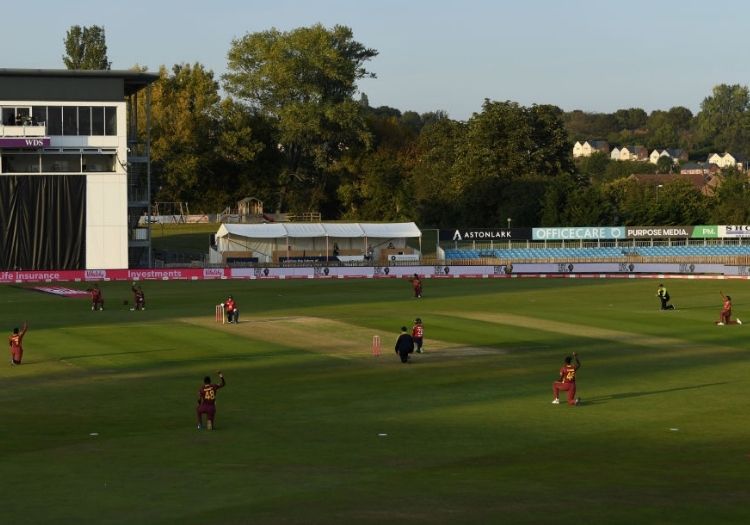
Both sides took a knee ahead of the start of the match
There were clear blue skies and a playing surface that looked in fine fettle. The visitors – somewhere between guests and saviours – were noticeably louder than their hosts, and there was an echo that swarmed the venue throughout.
There were no signs of Katy Perry, nor any of the visible fanfare that has come to characterise England’s home games. But the evening still oozed with significance: a fitting mirror image of the men’s game, with English cricket indebted to Cricket West Indies.
Tammy Beaumont sparkled, while there were cameos from Knight and Amy Jones, reprising her role in the middle order, having lost her opening berth during a poor run of form in the early months of the year. England will have been disappointed to lose 6 for 50, but pleased enough with 163 for 8 in their first competitive T20 match for 204 days. Katherine Brunt's four overs cost her just eight runs.
It is unarguable that women’s sport – on a wider plain than cricket alone – was plunged onto a backseat in the industry’s initial post-lockdown revival. As the Premier League returned, the Women’s Super League was curtailed. As West Indies, Ireland, Pakistan and Australia all boarded chartered flights to face sides led by Joe Root and Eoin Morgan, Knight and her teammates watched on and waited.
Speaking to The Cricketer in August, Kate Cross observed: “Not as a cricketer but as a female athlete, I saw how much effort was going into getting men’s sport on and then the women’s stuff seemed immediately to get cancelled. Again, I think that’s where the ECB can be really proud of what they’ve done.
“I think it really became clear how governing bodies of all sports generally felt about the women’s side of their sport. And I think it was – if anything – an opportunity for a lot of sports to really push the women’s side of their game. Unfortunately, some people have missed those opportunities.
“But for us, once we knew that we had the backing of the ECB, it almost became business as usual.”
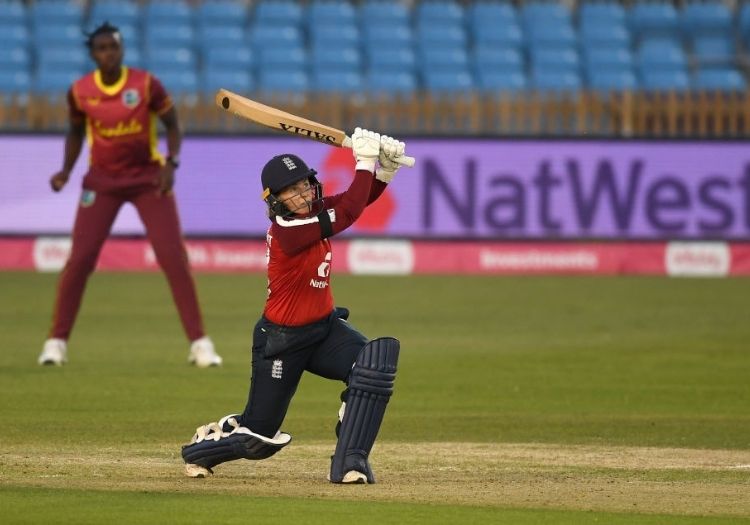
Tammy Beaumont made a fine half century for England
Clare Connor, the ECB’s managing director of women’s cricket, had outlined the summer’s nuances at its outset, stressing the financial necessity to protect the schedule of the men’s team, while also laying on the table her own emotions as an icon of the women’s game. English cricket could scarcely have a better figure in charge at the moment.
“I would be devastated if there was no international women’s cricket this summer – no one would be more disappointed,” Connor, capped 111 times by England, said at the time.
As a dose of realism, she added: “If we have to play less international women’s cricket this summer to safeguard the longer-term future and investment and building the infrastructure for a more stable and sustainable women’s game, that is probably a hit we might have to take.”
She – and her colleagues – deserve huge credit for the way in which they have managed recent months. To re-read the piece I wrote for this website documenting the key aspects of Connor’s press conference on May 6 provides an eye-opening reminder of how much has been accomplished. The summer has worked out almost entirely as she set out then. Given the complexities attached, that in itself is a quite staggering effort.
Officially, Germany and Austria were the first two teams to return to women’s international action following the Covid-enforced global shutdown, with Anuradha Doddaballapur – who recorded figures of 5 for 1 in the fourth match – leading her German teammates to a five-match whitewash victory in mid-August.
If this seems trivial, it shouldn’t; arranging competitive sport in these times is a challenge like no other – just ask Connor.
But this night – autumnally chilly by the end – marked the cutting of the ribbon: an opportunity for months of pent-up momentum to release itself at the end of a summer that almost never happened, an evening where the meaning of a jampacked MCG was channelled, albeit in these contrasting, twisted surroundings.
Hiatus complete, it was wonderful to have it back. For cricket to truly have come through this unique summer, it was vital that tonight happened.
The game – and the growth – goes on.
For unrivalled coverage of the county season, subscribe to The Cricketer and receive 3 issues for £5

Welcome to www.thecricketer.com - the online home of the world’s oldest cricket magazine. Breaking news, interviews, opinion and cricket goodness from every corner of our beautiful sport, from village green to national arena.