
SHUBI ARUN: Key didn't rock the boat as much as firmly steer it in the right direction. His strength lay in his clarity of judgement. He chose to focus on changing just one thing - mentality


The decision to appoint Rob Key as the managing director of the English men's team last April was a left-field one.
The last time a Sky Sports analyst swapped the studio for a management position, he had a 36 per cent win rate, lost 7-0 to Barcelona and was chased out of Valencia after four months.
To say Key has fared better than Gary Neville would be an understatement. The former Kent captain completed one year in his role on April 17, a period in which he has overseen a scarcely believable rise of this English team.
Since Key's appointment, England have won 10 of 12 Tests. Fourth-innings chases of 277, 299 and 296 were completed in successive games against New Zealand in Key's debut series at the helm, followed by a record 378 chase against India. South Africa were the next team steamrolled by the England juggernaut that summer followed by Pakistan, who were whitewashed 3-0 in their own backyard. It was a historic feat, given England had only ever won two Tests in Pakistan prior.
On the white-ball front, a Jos Buttler led side romped to the T20 World Cup in Australia and go into the ODI World Cup later this year as favourites.
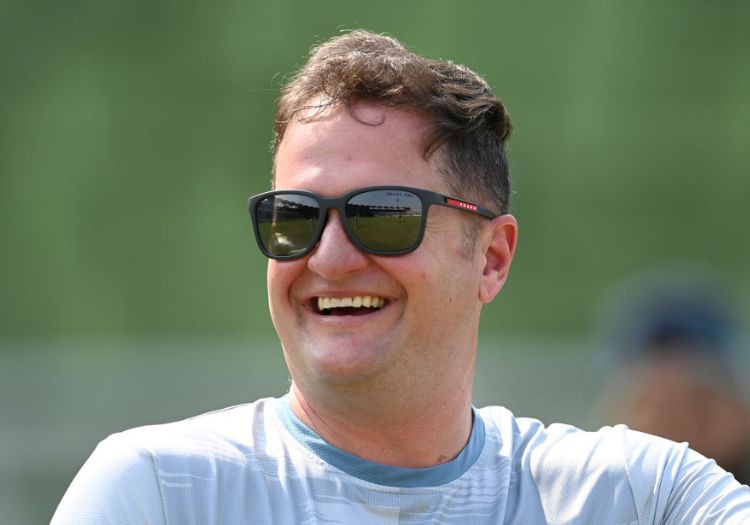
Rob Key laughs while on tour in Bangladesh in 2023 [AFP via Getty Images]
Beyond the scale, it's the manner of success that stands out. In 2022, England had a staggering run rate of 4.7 an over in Tests. Against Pakistan, they were going at 5.5 an over, the highest series run rate in Test history. In the T20 World Cup semi-final, they chased down India's 168 in 16 overs without losing a wicket. In June last year, they broke the world record for the highest score in ODIs, posting 498 against Netherlands.
The turnaround in Tests has been as seismic as it has been startling. In the year prior to Key's appointment, England had won just once in 14 Tests, including a 4-0 drubbing in the Ashes. They are riding the high waves of success now but for the longest time, England were lost at sea.
Key didn't rock the boat as much as firmly steer it in the right direction. His strength lay in his clarity of judgement. It would have been easy to just throw everything out and start from scratch with a team that at the time was without a coach or captain. He chose to focus on changing just one thing - mentality.
"When sports people fail, most think it's because they are not trying hard enough or they don't want it badly enough, or they are not tough enough, all those things. I felt they [the Test team] were trying too hard, and wanted it too badly and were almost suffocated by it.
"I felt they needed to have a bit of pressure taken off them and to think positively; not to play a certain way necessarily, but just to have the right mentality," he said in an interview with The Times.
While Brendon McCullum's appointment as Test coach felt heretical at the time, Key's thinking behind the decision feels logical. The team didn't need someone to change their approach, they needed someone to help them trust their own. Bazball was implemented as much on the field as it was off it.
From New Zealand to Kolkata Knight Riders, the common thread running through McCullum's teams as coach and captain has been them being more than the sum of their parts. It's why players like Ollie Pope and Zak Crawley have thrived under a leadership style built around self-expression. For both, unsurprisingly 2022 was their best runs-wise.
Revolutions often come at the cost of the old guard but the shift in approach didn't disrupt the status quo. Joe Root remained England's highest run-getter last year and the grizzled duo of James Anderson and Stuart Broad remained atop the wicket charts. They didn't need McCullum to tell them to be themselves on the field.
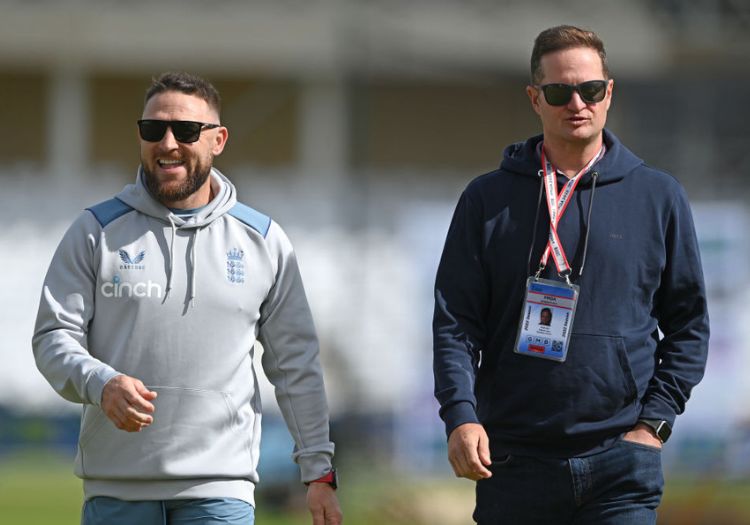
Rob Key with England men's Test head coach Brendon McCullum in 2022 [Getty Images]
As McCullum said after last summer: "I don't really do a lot, to be honest. I just let the guys do what they're born to do – play cricket in the style and manner they want and try to bring the group together and make sure they're enjoying themselves."
This 'don't fix what isn't broken' methodology carried over into Key's approach to the white-ball game, with Matthew Mott's appointment as coach and Jos Buttler's promotion to captaincy following Eoin Morgan's retirement being completely seamless.
Key hasn't built a brand, he's built an identity. Boldness and wiliness have become the defining features of an English cricketer today. It's a mentality rival international boards are trying to imbue into their teams and T20 franchises are trying to buy into.
There were more than 60 English players involved in the winter T20 leagues last year. The 27 English players in this year's IPL auction was the most for any foreign country. The 13 Englishmen in this year's edition is the joint highest, along with Australia.
But ultimately, this will also be Key's biggest obstacle moving forward - the players who will pick the quick payday of a franchise T20 league over playing for the country.
"We're lucky: our summer doesn't run alongside these things. If you're in Australia, your domestic players are going to get taken to these leagues that are running at the same time," he said in an interview to Wisden Cricket Monthly.
"The global game, the international game, has to have a serious think and get-together about what it's going to do to make sure that there's meaning in the cricket that we play. That's the key: it's not just about money, we need the meaning to be there to make people want to play (international cricket)."
But in the shorter term, Key's focus will be on the upcoming home Ashes series. Winning back the urn would be a further vindication of all that he has (and hasn't) done.

Welcome to www.thecricketer.com - the online home of the world’s oldest cricket magazine. Breaking news, interviews, opinion and cricket goodness from every corner of our beautiful sport, from village green to national arena.