
NICK FRIEND: Test cricket lives on a permanent trial; in a modern day obsessed with immediacy and entertainment, each five-day game is an exercise in proving its worth. Surfaces like this do little to help the cause for the defence
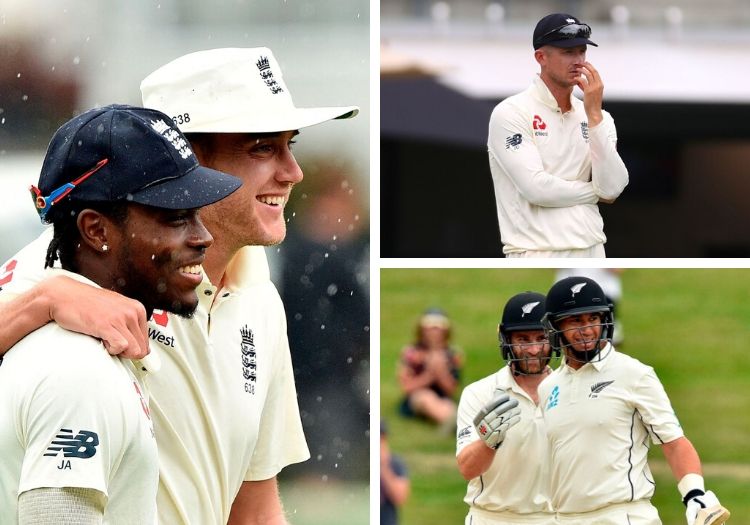

Five centuries in the match – one a double. Four more scores above fifty. Across five days – three of which were interrupted at one point or another, 22 wickets fell in 367 overs.
On the final morning, Kane Williamson and Ross Taylor made hay. Chanceless hay. Easy hay. Gun-barrel straight hay. Two of the finest players of their generation, they carry 72 international hundreds between them. They will have faced more taxing net sessions.
Before them, Joe Root had made a chanceless 226, while Rory Burns had made a terrific century of his own. If he was guilty of playing with fire during a skittish, chaotic beginning on the second evening, his display on the third day was supreme. Before all this – and it feels like some time ago, Tom Latham became the game’s first centurion.
The nature of Test cricket is such that its protagonists exist to be challenged. Batsmen are a mistake away from the end of their involvement; bowlers are selected as part of a wider cartel – if one underperforms, the other takes his place. Here, however, one was far too easy, the other a thankless task. A five-day pitch should develop over the course of five days. This didn't.
It was hard not to symapthise with the bowlers. England picked five seamers in the forlorn hope that a smattering of live grass would assist an attack centred around lateral movement – both in the air and off the pitch. Nothing. Nowt. It was only midway through the final day when Joe Root, bowling his part-time off-breaks, forced one delivery to spin sharply.
New Zealand, similarly, were left unable to extract something out of a sedate surface giving nothing. Neil Wagner’s five-wicket haul was an exercise in squeezing life out of the lifeless. He is a whole-hearted character like few others. England had Ben Stokes, who toiled away without reward in a similar manner, but Wagner just possesses a remarkable knack – that’s four five-wicket hauls in successive Tests for the left-armer. On these surfaces, that is some effort.
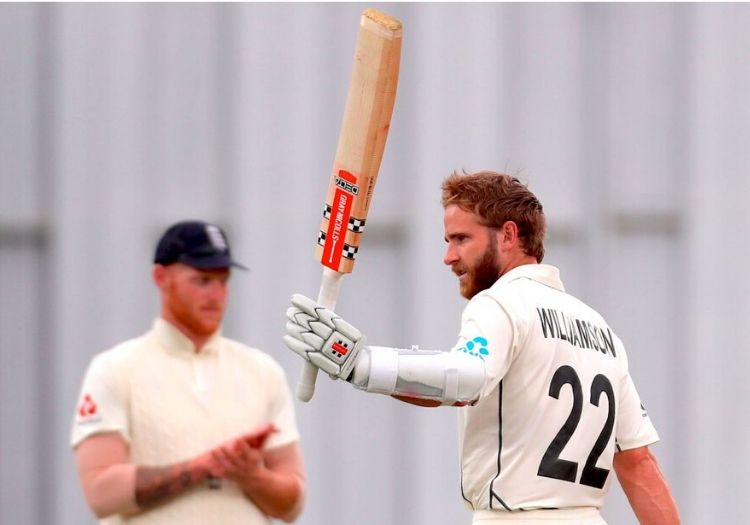
Kane Williamson made his 21st Test century
Test cricket lives on a permanent trial; in a modern day obsessed with immediacy and entertainment, each five-day game is an exercise in proving its worth to its doubters. We are told that it is running on life-support. There are nations where most are no longer interested – empty seats wherever you look. And games like this do little to help the cause for the defence.
Even the commentary team, so effervescent and bubbly throughout, began to beg for rain – and only half-jokingly. Calling this game was, presumably, like watching it unfold – awaiting a tedious inevitability. When the rain did finally come, it arrived as a blessing. Williamson and Taylor had reached fine hundreds and then the heavens opened. Just like that.
Perhaps, it was a higher mercy, a divine intervention. The result of this game had been evident for some time. Too much time, I would hasten to argue. This is a sport of nuance, but the elements in Hamilton lacked any at all.
The wicket just never really deteriorated. The odd ball jumped, while occasionally one would shoot lower than it otherwise should have done. Had previous sessions not been lost to rain, perhaps the pitch may have broken up more than it did.
But it was, quite frankly, boring for long periods. For too long, too little happened. Even as England looked to push the game along on the fourth day, the pitch was slow and never conducive to scoring quickly. When Taylor sensed he had three balls to reach his ton before the rain, he was able to swipe a four and consecutive sixes with total surety.
It would be easy to be critical of England for not picking a spinner here; I, for one, find it absurd on principle. For what it’s worth, there is never a time when five seamers are necessary. If conditions are helpful, four will do the job with plenty to spare. If there is no assistance, then having five is as good as having none at all. A spinner, one would hope, might have been able to affect some kind of movement.
Yet, none of Root, Denly nor Mitch Santner found an iota of deviation. Whether Matt Parkinson’s leg-breaks could have been a point of difference, we will never know. Quite why he wasn’t given his chance across two games with no World Test Championship points up for grabs, however, was curious.
It is hard to truly believe that five days like this are good for the game. England performed their game plan almost exactly as they would have mapped it out. It was a replica of New Zealand’s strategy at Mount Maunganui and, having admitted he would also have bowled had he won the toss at Hamilton, it is what Williamson was looking to carry out here as well.
Effectively, England gave themselves four sessions to take 10 wickets and knock off any remaining runs. In theory, a strong concept. In reality, a nonsense. Not through their own doing, but because this was virtually as good a pitch for batting now as it was when the coin first landed on it.
Crucially at Tauranga, the surface did break up – Santner came into the game with sharp turn on offer, while the surface sped up as the game wore on, allowing Wagner’s bouncers to take effect.
There was no such excitement second time around.
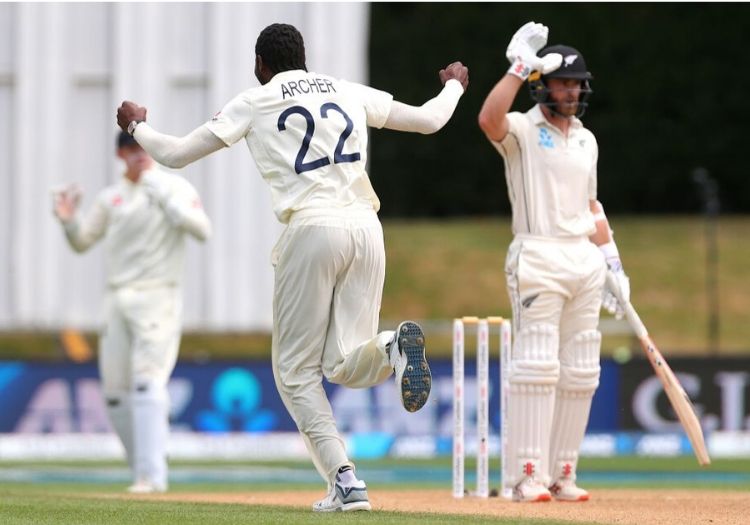
Jofra Archer thought he had dismissed Williamson, only for Joe Denly - inexplicably - to put him down
Lord’s. Day five. The Ashes. Jofra Archer to Tim Paine. A pull shot, not entirely middled but hit well enough. Out of nowhere, Joe Denly flew to his left – his weaker left arm outstretched. He clenched his fist and clung on. An outrageous catch. Mobbed by his teammates, he hurled the ball up in hysteria. The 33-year-old is one of England’s finest fielder.
And then this. Proof, indeed, that it happens to the best of us.
Seddon Park. Day five. New Zealand v England. Jofra Archer to Kane Williamson. A well-disguised knuckle-ball, not picked by the Blackcaps skipper, chipped straight to midwicket. In it went, into the buckets. Archer ran off to begin his celebrations – there have been slim pickings for English cricket’s new fast-bowling toy since touching down in New Zealand.
And then, arms aloft as he wheeled away to toast his third wicket of the series, he bent his neck to his right as none of his colleagues came to join him. The ball sat on the ground.
Don't really know how to describe this.
— The Cricketer (@TheCricketerMag) December 2, 2019
Guess we've all been there...#NZvENG pic.twitter.com/im9knizXSo
Joe Root held his head in his hands, Ben Stokes turned away to hide his expression, Zak Crawley – a county teammate of Denly – chuckled away, Stuart Broad’s hands covered his mouth – the same expression he pulled when Stokes took that catch at Trent Bridge to dismiss Adam Voges. Even Williamson wore the visage of a man who could scarcely believe his fortune. Denly was the only man not laughing.
The talk that followed was of whether this might just be the worst drop in Test history. The Kent batsman saw his name trending on Twitter. As ever with these things, there is a tendency to grossly exaggerate in the moment.
Mike Gatting’s drop of Kiran More in 1993 immediately came to mind, even if he had motioned towards the sun on that occasion in mitigation. Andrew Strauss’ effort for Middlesex during the Stanford T20 series was also spectacular – he couldn’t help but laugh at himself.
On a drab final morning on a tough pitch as England’s victory hopes petered out, this represented a highlight of sorts – at the very least, a spot of entertainment in amongst a thoroughly turgid session.
It is one of the beauties of the sport. As is so often said, there is no team game so reliant on individuals. And perhaps cricket's greatness comes in all that follows Denly's split-second of horror.
His teammates, rather than glaring, giggling away in plain sight. His adversaries, not ignoring the moment, but allowing a momentary chuckle. All at his expense, but also – in a manner unique to cricket – very much laughing with him as well, safe in the knowledge that this game is a cruel mistress. As both sides left the field afterwards, Denly and Williamson embraced – "You owe me one," he appeared to joke. All around them smiled. He will never hear the end of it.
We've all been there, and those that say they haven't are lying. At one point or another, this game swallows up everyone. There will have been a beer waiting for Denly in the changing room and a toast to his momentary incompetence.
It is a story he will have for the rest of his life and a tale that 21 others will recount with glee. They will be thankful that they witnessed it, but even more so that it didn't happen to them.
Subscribe to The Cricketer this Christmas and receive a £20 John Lewis voucher or Alastair Cook's autobiography. Claim your free gift here

Welcome to www.thecricketer.com - the online home of the world’s oldest cricket magazine. Breaking news, interviews, opinion and cricket goodness from every corner of our beautiful sport, from village green to national arena.