
NICK HOWSON: As South Africa destroy England at Centurion Temba Bavuma adds to his impressive ODI career and Tabraiz Shamsi defies the world champions
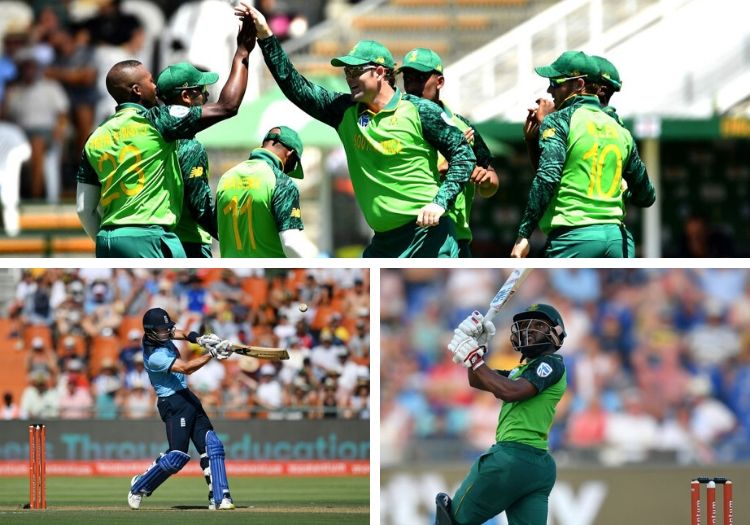

Though installed as permanent captain in place of Faf du Plessis, this was De Kock's fifth outing as South Africa captain across both white-ball formats.
The uncomfortable truth is this is a job interview - perhaps the first stage when the potential employer just to find out you're not a moron - for the Test role which Du Plessis will surely abandon in the coming weeks.
Thanks to some woeful England batting and a fine Temba Bavumba catch, the tourists were 105 for 5 and then 131 for 6, and staring down the barrel of a sub-par total on their 50-over return.
With Joe Denly and Chris Woakes clearly looking to control things before having a dart at the end, De Kock slightly misread the situation.
His fields were defensive, allowing England to rotate the strike without much alarm. The accelerator was released, and the visitors were very much off the hook.
Woakes' innings of 40 from 42 balls included just two boundaries. Vital for England, of course, but it is one of the easier scores the Warwickshire seamer will make at this level.
At 27, and with experience in some of the highest pressure environments world cricket has to offer, De Kock is hardly alien to these kinds of stages. He'll know better than anyone that he let England off the hook and allowed them to make a decent score. It took a masterful century of his own to mask over the cracks in his leadership (though some may argue that effort more than made up for it).
But there will not be much room for being so pedestrian going forward. Should he be handed the captaincy of the T20 team, as is expected, then he will have to be dynamic behind the stumps, think on his feet and be proactive rather than reactive.
It is not an easy job, particularly given it must be combined with taking the gloves and opening the innings. But that is the problem facing South African cricket at the top level. There are few other options.
A fine knock from the new skipper 👏#SAvENGpic.twitter.com/5YbIodVHBt
— The Cricketer (@TheCricketerMag) February 4, 2020
As far as underappreciated England cricketers of the modern era go, the Kent batsman is surely close to taking the title all for himself.
Cherished when he succeeds, derided when he fails. Joe can never win in the eyes of the fairweather cricket fan. He's either the unlikely source of salvation or the expected route for failure.
There is still major division over the white-ball contract he was handed last September. Many saw it as a golden handshake after he was unceremoniously dropped from the World Cup squad. Other cynical bystanders questioned the move completely, given the challenges to come.
The reality is Denly is not a player who has ever intentionally let down his country. If he is dropped for the Sri Lanka Test series it will be after one single-figure score in his last seven innings. The wait for a century goes on, but he is so much more than just a run-scorer.
At Newlands, England needed a man of the hour. Their premier batsman, most likely showing a bit of ring rust after a few months on the sidelines, had failed miserably.
Denly applied himself perfectly to the situation. He quickly assessed a pitch that lacked pace but would get easier to bat on the longer you occupied it and adapted to the conditions. Do the hard yards now and reap the benefits later, he concluded.
At one stage he was 15 off 27 balls - an innings which betrays recent trends in the 50-over game. But this contest did not ask for cross-batted shots, shuffles down the wicket or ramps into the galleries. It was a play straight and play safe kind of situation.
Perhaps Denly is too conventional for the modern-day game, and arguably on other surfaces, his effort would have been genuinely obstructive. But teams are not going to blast bowling attacks away on a consistent basis. You are going to get pitches that do a bit. And sometimes, your best players will have a brain-fade. All at once.
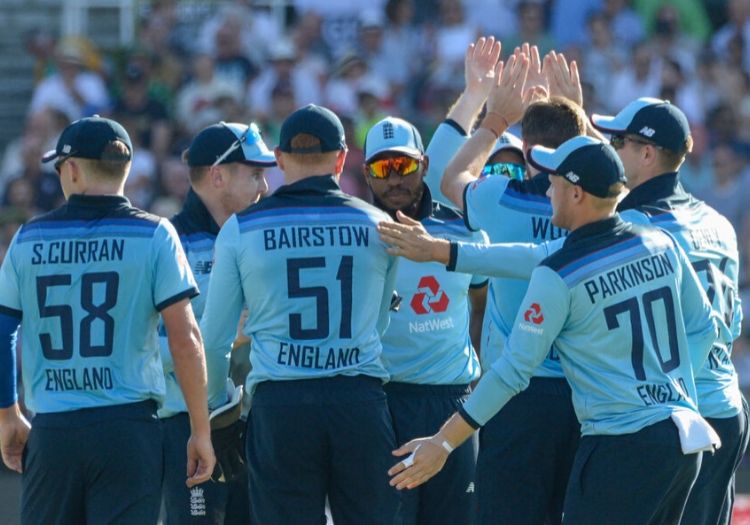
England initially had plenty to celebrate
The 33-year-old was considered yet probing and as South Africa backed off, he stepped forward as England's best performer. His career-best 87 came at 84.46, the fastest he has ever accumulated a score at this level.
By few metrics is Denly one of England's best available white-ball players. He might not even be one of the best two dozen.
But he plays the situation incredibly well. And, amid the fireworks which are expected of the modern-day batsman, there is still space for such a skill to be indulged. It remains to be seen for how long England will persist.
There was a time when his problems against left-arm spin was the greatest crisis facing Kevin Pietersen's England career. It was a simpler time.
It didn't matter whether it was Daniel Vettori, Pragyan Ojha or Zafar Ansari, but KP had a serious issue which he really never conquered. Or as he would likely put it, was never allowed to.
Those problems resurfaced again in the form of Tabraiz Shamsi, who tore through England's trusty middle-order to give South Africa the early initiative.
There was nothing particularly mysterious about the 29-year-old, who didn't exhibit a great deal of loop or benefit from much turn. Yet, he was beating England's batsman in flight and that was enough.
A fine knock from the new skipper 👏#SAvENGpic.twitter.com/5YbIodVHBt
— The Cricketer (@TheCricketerMag) February 4, 2020
Eoin Morgan sliced one to slip for Bavuma to grab, Tom Banton played naively across the line and Sam Curran was bowled around his legs. They should have been harmless deliveries but England turned them into ways to get out needlessly.
A largely unimpressive international career the Johannesburg-native might have, but the variety he offers to an attack which bangs it in and hopes for some inspiration was much-needed. Indeed, it was England's failures against seam which meant they were unable to go after Shamsi in the way they would have liked. That might change as the series goes on.
Shamsi's responsibilities are likely to grow in the coming weeks. He will surely be among the squad which goes to India in March and alongside Keshav Maharaj be among the chief spinners on display for the tourists.
But before that, he has more pain to inflict upon England.
South Africa have yet to clear up whey Bavuma was omitted from the Test squad until the fourth game in Johannesburg. By then it was too late for him to have much of an impact, with the home side at a low ebb and all the momentum with England.
Having been asked to go away and find some form with the bat in first-class cricket, that at least ensured that Bavuma was in good touch for this series.
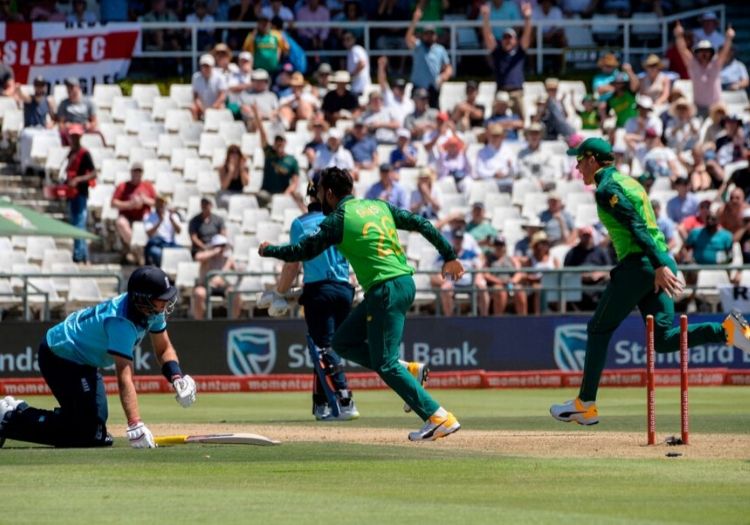
The run-out of Joe Root came after a fine bit of fielding from Rassie van der Dussen
Rocking up to Newlands, he couldn't have asked for a better pitch to bat on. A slower surface that got more turgid as the game went on. If you were patient the rewards were obvious.
On just his third ODI outing, Bavuma continued his encouraging start to his career in the format. He is a naturally smooth player to watch, his strokes free-flowing. There is nothing mechanical about his technique nor his footwork. On his toes all the time, he makes bowlers come to him and punishes them effectively.
That is not to say that he overhits the ball. His boundaries were well struck, but he never tried to batter the leather off the ball. When he needed to use the pace on the delivery to guide it behind square he would. When he drove or cut through cover or mid-off he would do so with aplomb.
It would be foolish to look at his numbers and conclude that Bavuma is made for this level of the sport. Despite the broadcasters' desire to analyse his start to life as an ODI player, it is largely irrelevant after three outings.
However, there is plenty to like about his technique. And given the options South Africa have in that position - Faf du Plessis has been rested/dropped for the series - there is enough to be optimistic about.

Welcome to www.thecricketer.com - the online home of the world’s oldest cricket magazine. Breaking news, interviews, opinion and cricket goodness from every corner of our beautiful sport, from village green to national arena.