
Following Kent's win over Lancashire at Trent Bridge, The Cricketer looks back at the standout performers in the Royal London Cup
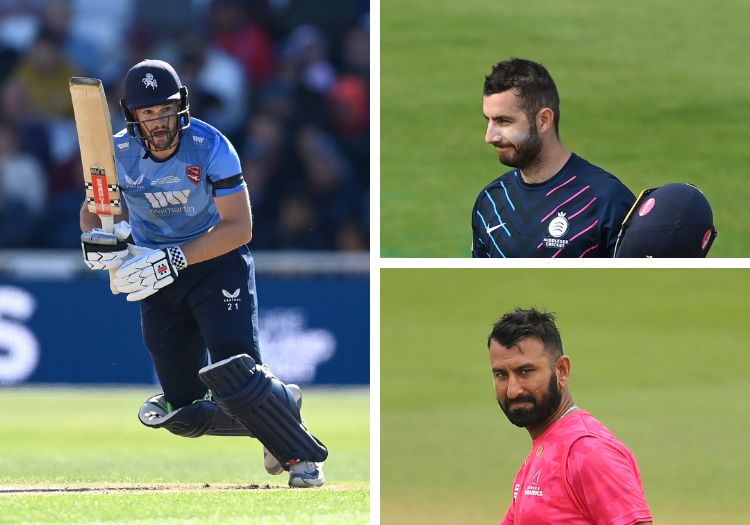
Earmarked before the Royal London Cup began as a player genuinely unfortunate not to have picked up a Hundred deal, Eskinazi made his point in remarkable fashion. There were four centuries – among them Middlesex's highest List A score and a world record for three consecutive 130+ efforts – in a spell that made a mockery both of a tricky home surface at Radlett and the decision by eight Hundred teams to overlook him.
He made his England Lions debut shortly before the competition began and ended it as the highest run-scorer despite Middlesex – whose batting line-up fired throughout – not making it out of their group.
A solid, unspectacular opener when he first came into Sussex's team as a red-ball player, a subtle change in trigger movement and a growth in confidence have led to an eye-catching shift in Orr's game.
In the absence of Tom Haines, who missed much of the tournament with a broken hand, the tall left-hander gave Sussex a sense of authority at the top of the innings, hitting his second List A century and turning it into the joint-third-highest List A score ever made in England. Whatever anyone's opinion of the Royal London Cup, a 21-year-old with a 50-over double hundred is not to be sniffed at. A possible bolter for an England Lions berth this winter.
Sent out on loan by Kent during the T20 Blast at a time when the county couldn't fit him into their white-ball plans, he made that assessment look mightily foolish when he stepped into the Royal London Cup with a double hundred against Worcestershire that set Kent on their way in the group stage for a run that would ultimately end in the final at Trent Bridge.
That wasn't Robinson's only major contribution: it was lost in the aftermath of Darren Stevens' heroics, but it was the 23-year-old's 95 after Kent had lost two powerplay wickets that ultimately set his side up to win the semi-final at the Ageas Bowl. At 23, he is a fine player with an exciting future and promises to be a significant loss to Kent if, as expected, he departs at the end of the season.
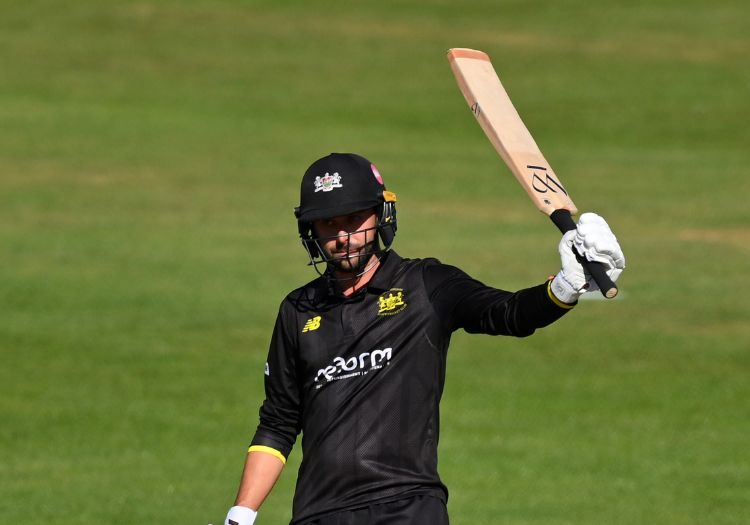
Jack Taylor enjoyed a remarkable tournament for Gloucestershire (Dan Mullan/Getty Images)
If Eskinazi was palpably the standout player of the first half of the group stage, it's hard to shake the idea that Pujara was the player of the tournament: 624 runs in nine games, averaging 89.14, only tells a fraction of the story.
The extent of his contribution is more nuanced than that, however: his runs on their own were vital in Sussex's run to the semi-finals, but his teammates – Orr, Tom Alsop and Tom Clark – were all lifted by batting alongside the Indian great, while Ari Karvelas told The Cricketer it was simply "a privilege" to be captained by the 34-year-old. His composure got the most possible out of a young team who, for a while in their semi-final against Lancashire, looked to be primed for the final.
An excellent tournament for the South African allrounder, for whom its conclusion was followed by a recall to his country's Test team. There was a single century to go with five other scores above fifty – only Eskinazi and Pujara scored more runs – not to mention 14 wickets, a haul only bettered by nine others. It would be wrong to call it a breakthrough competition for the 24-year-old overseas player, but he played for Leicestershire with an authority and sense of responsibility that perhaps belied his years.
While he was at the crease, anything was possible – in the first game of the tournament, he guided them to their seventh-highest List A score with 116 not out; in their quarter-final defeat, the game was only lost once he fell for 81.
Another established county pro who, like Eskinazi, could count himself genuinely unfortunate not to have picked up a Hundred deal, given his success at Gloucestershire in T20 cricket. But 401 runs in eight innings from the middle order was a fine effort, done in a manner that ought to have captured attention elsewhere.
No one in the competition hit more sixes than his 23, and he only missed out on a hundred against Nottinghamshire when he failed in trying to reach the milestone – and end the game – with a six. He played the finishing role with a remarkable consistency, averaging 66.83 and striking at 115.22, never once falling for a score below 22. A former off-spinner before coming into problems with his action, he took 11 wickets in 43 overs with his recently developed leg-spin.
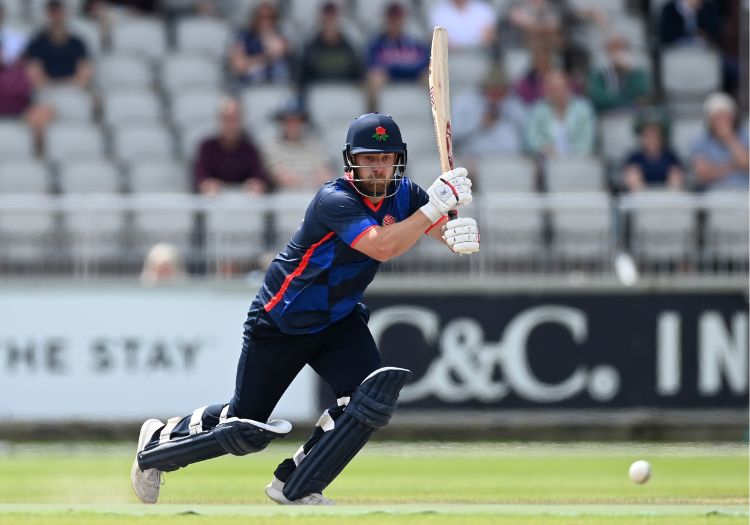
Steven Croft almost dragged Lancashire to victory (Gareth Copley/Getty Images)
For all the pre-final talk of Darren Stevens, Lancashire's own veteran has quietly enjoyed been one of the county cricketers of 2022. After finishing the T20 Blast as its fourth-highest run-scorer, he churned out 385 runs at an average of 64.16 as his county reached their second white-ball final of the summer, only to come out second-best once again. Had Croft batted for another half-hour at Trent Bridge – he and Keaton Jennings both made 72 – the result might well have been different.
But Lancashire might not even have reached the final without his century in the quarter-finals against Nottinghamshire at Blackpool where, chasing 339 to win, he carried the chase with 115 not out – one of three unbeaten efforts across his competition, which also included an invaluable 87 in an early win over Derbyshire.
This was the toughest position to fill in this composite team, though, given quite how many runs were scored across the board. Stevens was one option, Joey Evison another, while youngsters Toby Albert and Tom Lawes both enjoyed terrific, promising campaigns at Hampshire and Surrey.
There is a difference between a development competition, which the Royal London Cup isn't, and a competition which provides opportunities for development, which the Royal London Cup most certainly is. Without it, there is no way that Turner – a student at Exeter University and a product of South African cricket – would have found his way into Hampshire's first team, given the presence of Mohammad Abbas, Kyle Abbott and Keith Barker. But with the trio mostly rested through August, Hampshire's next generation took their chance spectacularly.
Nick Gubbins went so far as to compare some of Turner's spells to Abbott following their semi-final defeat by Kent, and those links were well founded. Turner, yet to make his County Championship debut, took 20 wickets at 16.7 apiece with five-wicket hauls against Lancashire and Yorkshire. His fellow youngsters, Scott Currie and Jack Campbell, picked up 18 and 17, respectively. They are well stocked on the south coast.
One of the stories of the summer in county cricket: the Greek international who had to leave early from a T20 World Cup qualifying event in Finland in order to reach Lord's for his Sussex debut. That was in the County Championship, shortly before he would become the focal point of his new club's seam attack in the Royal London Cup. He claimed 20 wickets in nine matches, among them Eskinazi, James Bracey, Marcus Harris and Matt Renshaw.
Having trialled for years to earn his chance at 28, it's hard not to feel quite chuffed for him, given how it's turned out. "I'm grateful to have this opportunity for however long it lasts," he told The Cricketer during the group stages. "I've waited a long time for this, so I'm going to look to enjoy it." It is understood that a more permanent deal – his initial stint was essentially on a trial basis – might well be in the offing.
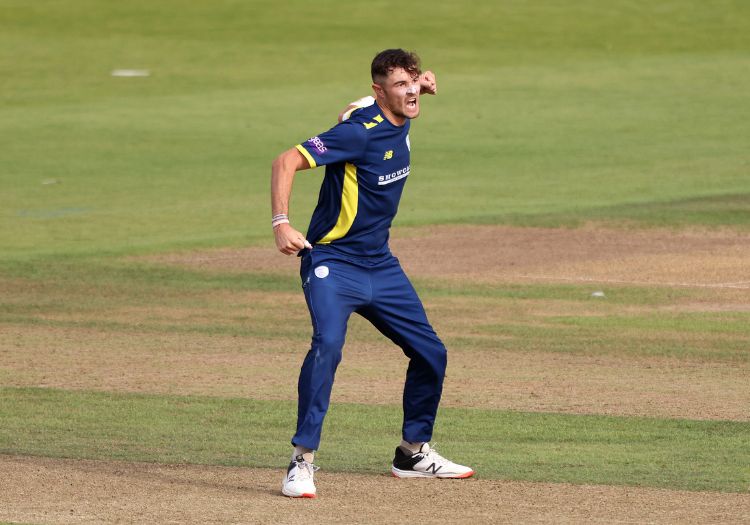
Jack Campbell began the season with Durham but joined Hampshire ahead of the Royal London Cup (Charlie Crowhurst/Getty Images)
Where Michael Hogan, Chris Rushworth, Ryan ten Doeschate and Ben Sanderson dominated in 2021, see Brett Hutton, Chris Wright and Olly Hannon-Dalby for 2022's stable of experienced county seamers who ended up cleaning up in the Royal London Cup. Hutton ended as the leading wicket-taker, helped somewhat – after an unspectacular start – by a remarkable seven-wicket haul in a win for Nottinghamshire over Leicestershire, where Wright also took six wickets.
That performance was followed by consecutive three-wicket spells against Surrey and Lancashire, and suddenly he had more than doubled his tally for the rest of the tournament. He was an experienced head in a mostly young team that at times flew beneath the radar under the captaincy of Haseeb Hameed, before losing a high-scoring quarter-final against Lancashire.
Very nearly the first man to reach the final in both years of the Royal London Cup in his current guise, the left-armer was another of the youngsters to impress in Hampshire's bowling attack, a year after playing his part in Durham's campaign only to lose his place at Trent Bridge when the county opted to pick a couple of their Hundred returnees. Campbell subsequently signed a contract with Durham, only to leave earlier this season and pitch up back at home in Hampshire.
The former England Under-19 seamer was a regular source of wickets for Nick Gubbins' men, claiming four against eventual winners Kent and sparking the lower-order collapse against Northamptonshire that secured a crucial win on the Isle of Wight. He was one of three bowlers to end with 17 wickets, tied alongside Leicestershire's experienced duo of Chris Wright and Beuran Hendricks.

Welcome to www.thecricketer.com - the online home of the world’s oldest cricket magazine. Breaking news, interviews, opinion and cricket goodness from every corner of our beautiful sport, from village green to national arena.